16 Things Economic Developers Need to Know This Week
The stories Dane thinks you need to see. July 16, 2026 edition.

Welcome to this week's issue of What Economic Developers Need to Know This Week, where we explore the evolving dynamics of our economy.
This week we have 16 tools, stories, graphics, charts and videos that I think you'll find informative, useful, inspiring, and perhaps even humorous. Some are economic development related directly, and some only indirectly. 🤔
If you're wondering what to do with the info in this newsletter, send something to your board members. It will make you look good!
Today's email is brought to you by Resource Development Group
Resource Development Group and Convergent Nonprofit Solutions have recently announced a merger of these two well respected firms. RDG is now operating as Resource Development Group, a Convergent Company and will lead the combined operations in economic development and chamber engagements. Meanwhile, the Convergent banner will take the forefront on efforts on supporting traditional philanthropic and higher education organizations
This merger maintains RDG's innovative and custom approach while also creating the deepest bench of economic development and chamber fundraising expertise in the industry, the most complete data set in the country regarding economic development and chamber funding, and the greatest flexibility to be able to support engagement models tailored specifically to every market, regardless of size.
Whether you’re a single county EDO ready to kick off your first fundraising campaign or a large regional organization on your third funding cycle, they have the team and experience to get you the results you’re looking for.
1) Economic development and developers in the news #252: The field is moving in 35 states at once. This week's roundup tracks 66 executives and organizations working on infrastructure, leadership, workforce, small business, downtowns, and energy. Read: Economic Development and Developers in the News #252.

2) Podcast 227, never underestimate the power of ceremony: Public commitments can make regional coalitions durable. In Never Underestimate the Power of Ceremony with Melissa James, Melissa explains how REACH Central Coast united employers, educators, governments, and community groups around energy, aerospace, technology, workforce, and housing. Her lesson: written roles, visible milestones, and public ceremonies can help regional partnerships survive leadership turnover.

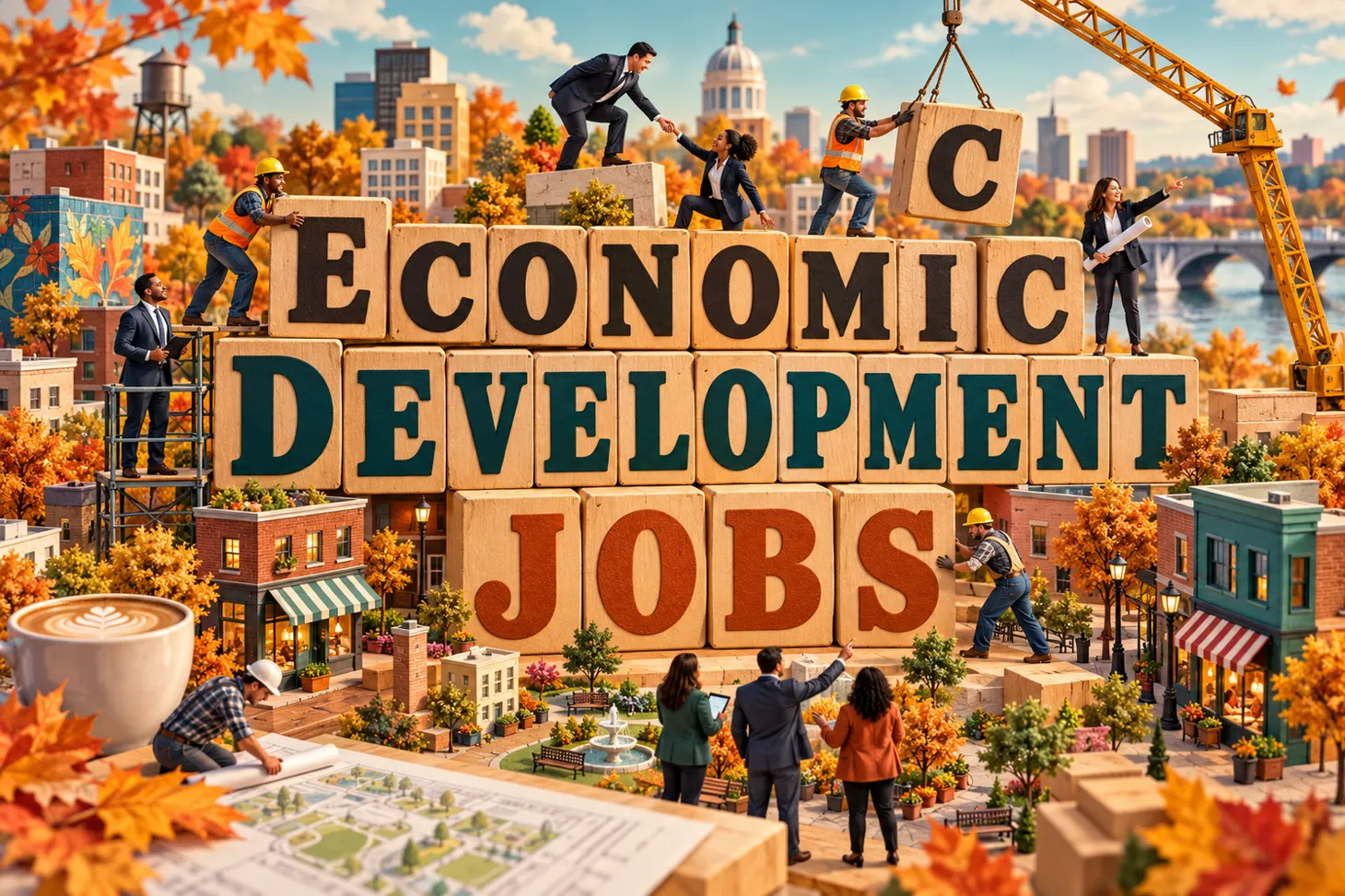
3) 31 new economic development jobs this week: The hiring market spans 20 states and nearly the full professional ladder. Salaries range from $35,922 to $200,000 across EDOs, cities, counties, chambers, utilities, and partner organizations. Browse: 31 New Economic Development Jobs This Week.


Sitehunt helps economic developers understand their sites, match them to projects, and respond with confidence in minutes instead of scrambling for days.
4) When economic developers become the villains: The profession has to explain itself to residents as deliberately as it markets a community to prospects. In When Economic Developers Become the Villains, Rod Crider says residents have legitimate concerns about traffic, infrastructure, environmental impacts, incentives, and quality of life. The problem begins when debate becomes misinformation and personal attack. His answer is transparency and a clearer link between development decisions and the community residents want for the next generation.
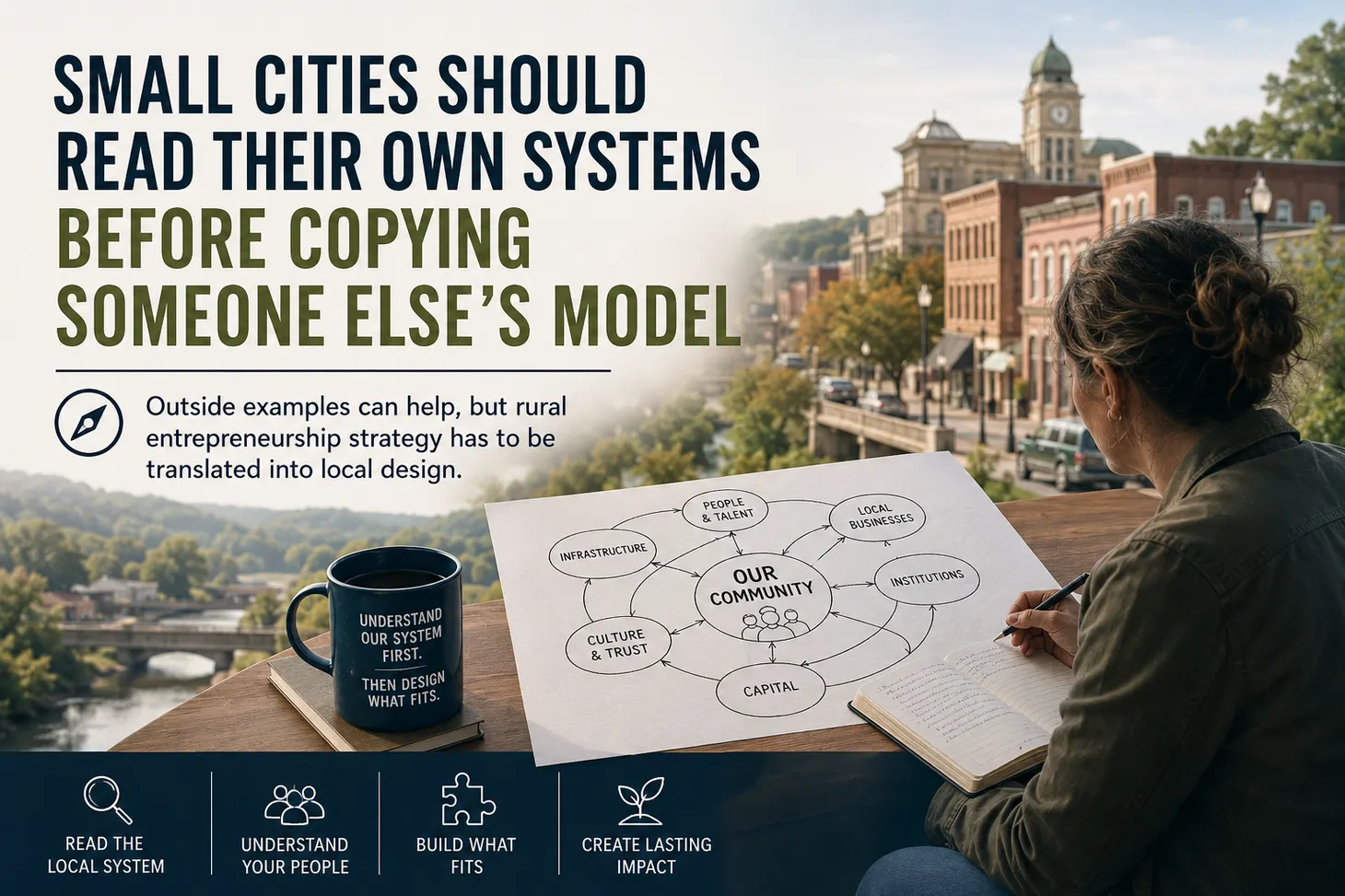
5) Rural economic development is the laboratory: In a small town, every decision has a face and every relationship is load-bearing. In his reflection on small-town leadership, Jim Gibson calls rural practice leadership training without buffers. Bankers, owners, board members, neighbors, and critics overlap, so every decision stays personal. The work teaches practitioners to speak plainly and remember that trust takes years to build and minutes to spend.
6) Rethink what success means in economic development: Jobs announced and dollars invested are outputs, not proof that a strategy changed the economy. Matthew Marzolo argues that conventional scorecards can reward luck, miss job losses, and kill programs whose results take longer than a reporting cycle. Better measurement asks whether employers, educators, capital, and workforce systems changed, not just whether jobs were announced.
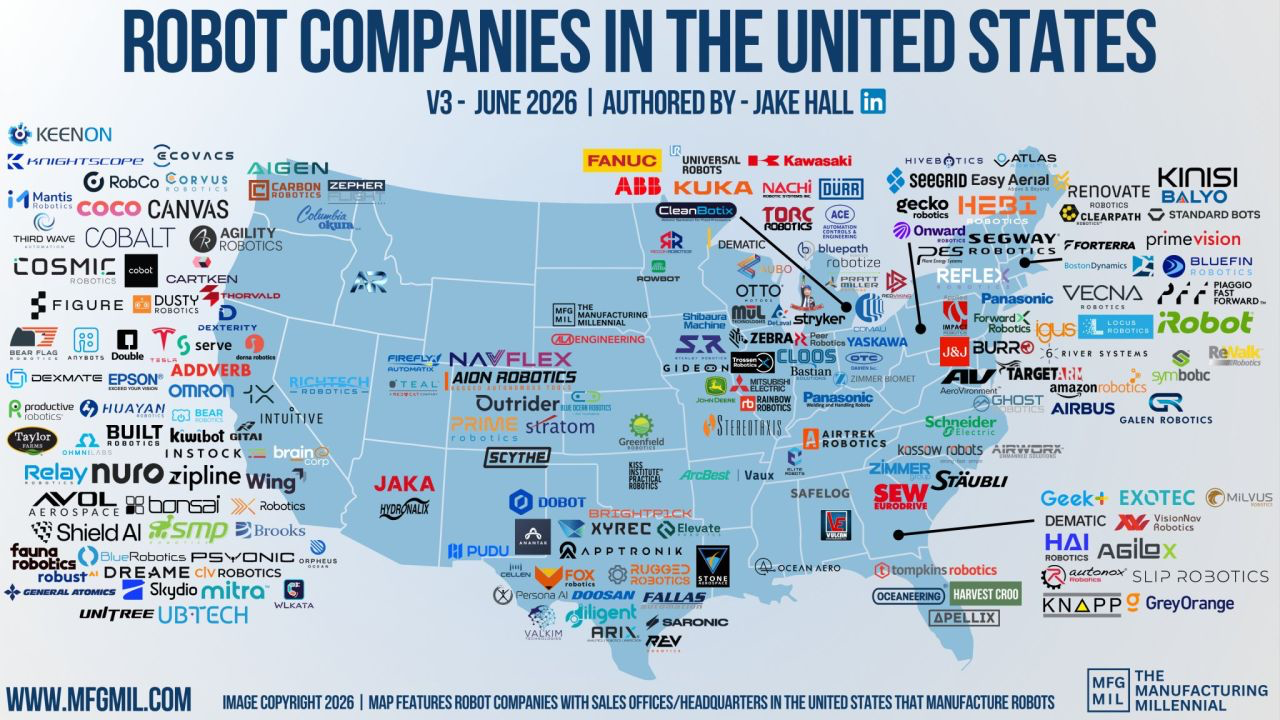
7) The geography of America's robot industry: Automation is more than a factory recruitment target. This June 2026 map shows dense clusters of robot manufacturers, integrators, and sales offices in California, the industrial Midwest, and the Northeast. EDOs can also target the suppliers, maintenance, warehousing, and technician training that support the industry.
8) When did helping your community become greedy?: Data-center debates are becoming tests of institutional trust. In When Did Helping Your Community Become Greedy?, Tim Reynolds says debate is shifting from land use, utilities, taxes, and infrastructure to unsupported claims of personal profit. His broader point holds even for skeptics: communities need evidence, clear benefit agreements, understandable confidentiality rules, and room to debate tradeoffs without alleging corruption.
9) The largest housing affordability bill in decades becomes law: Washington is rewarding communities that make it easier to build, but most of the decisive work remains local. The 21st Century Road to Housing Act has more than 40 provisions, including grants for preapproved housing plans, faster review for some infill, manufactured-home changes estimated to save $5,000 to $10,000, and limits on large corporate landlords. It adds no new funding and does not override zoning, so local permitting, infrastructure, and project economics still decide whether homes get built.
10) Moving back home now looks financially savvy: Housing costs are changing household formation and the meaning of independence. The Wall Street Journal reports that 49% of U.S. adults under 30 live with a parent, citing a Federal Reserve survey. A Thrivent survey found that 55% of young adults who moved home did so from financial necessity. That changes housing demand, migration, spending, caregiving, and whether a young worker can afford to take a local job.
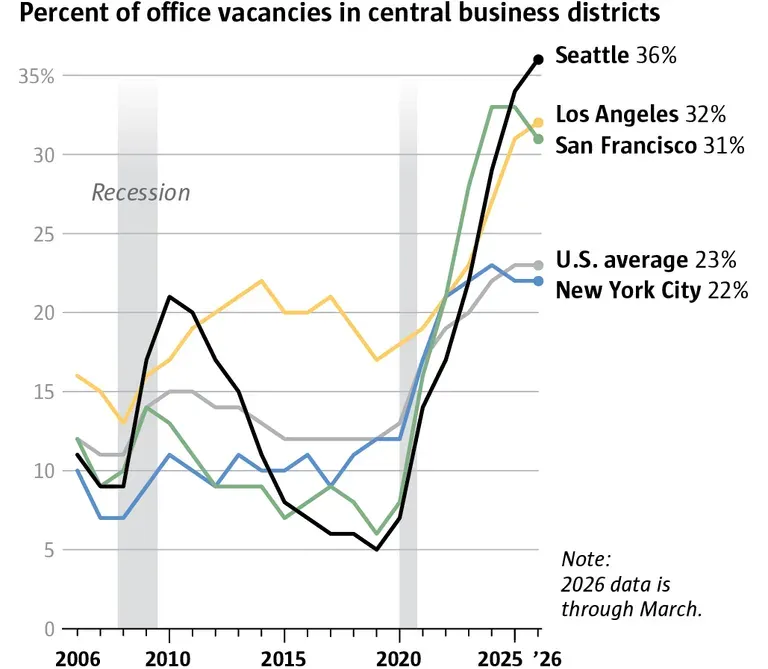
11) Seattle's office market faces years of zombie towers: A downtown can feel busy while its property-tax engine is still deteriorating. The Seattle Times found nearly 37% of downtown office space vacant, versus 23% across major U.S. downtowns. Since 2020, those properties have lost $15 billion, or 46%, in value and generate $128 million less in property taxes. Even pre-pandemic demand would take eight years to absorb the surplus. This is a fiscal, land-use, and transit problem, not just a leasing problem.
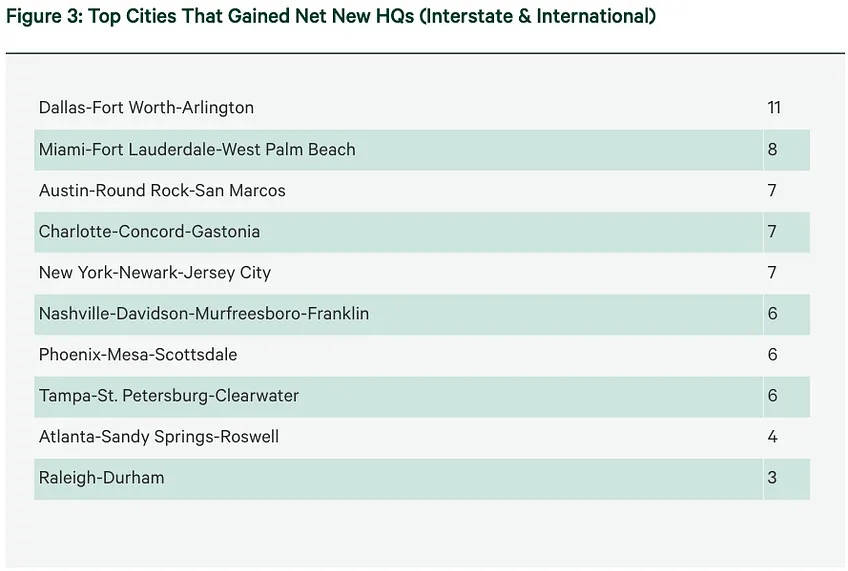
12) Headquarters relocations are increasingly about rightsizing: The migration map hides a reshuffling of corporate space within metros. CBRE's 2026 headquarters analysis says relocation activity rose in 2025. Dallas-Fort Worth led interstate and international gains with 11 headquarters, followed by Miami with eight; Austin, Charlotte, and New York each gained seven. Hybrid work is also driving smaller offices and moves closer to employees, so retention and real-estate strategy matter alongside attraction.
13) Recruiters cannot find workers while new graduates cannot find jobs: The labor market is producing shortages and rejection at the same time. The Washington Post traces the paradox to population change and a mismatch between graduates' skills and employers' needs, not just AI. More training is not enough. Employers must signal demand clearly, credentials must match real openings, and new workers need ways to gain experience.
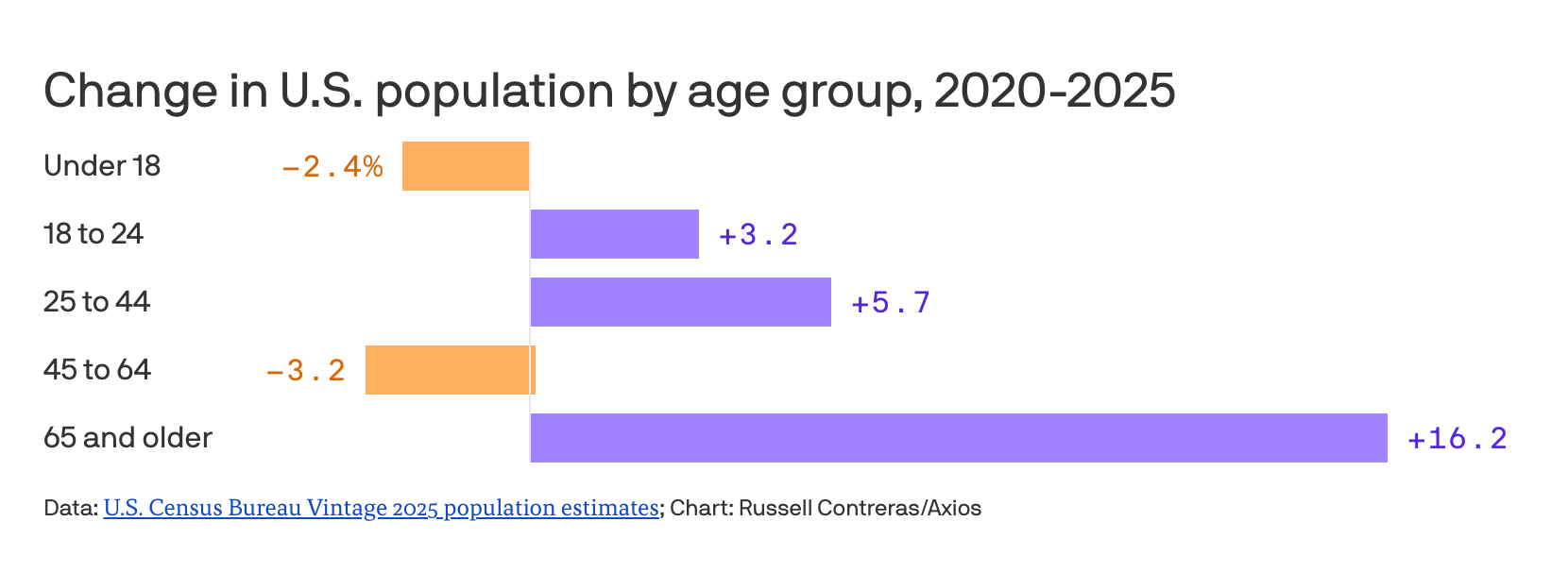
14) America's shrinking demographic middle: The experienced workforce is getting thinner while the retirement-age population grows quickly. Axios' demographic analysis shows the 45-to-64 population fell 3.2% from 2020 to 2025, while the 65-and-older population grew 16.2%. The under-18 population also fell 2.4%. That reshapes succession, mentoring, caregiving, the tax base, healthcare demand, and local leadership.
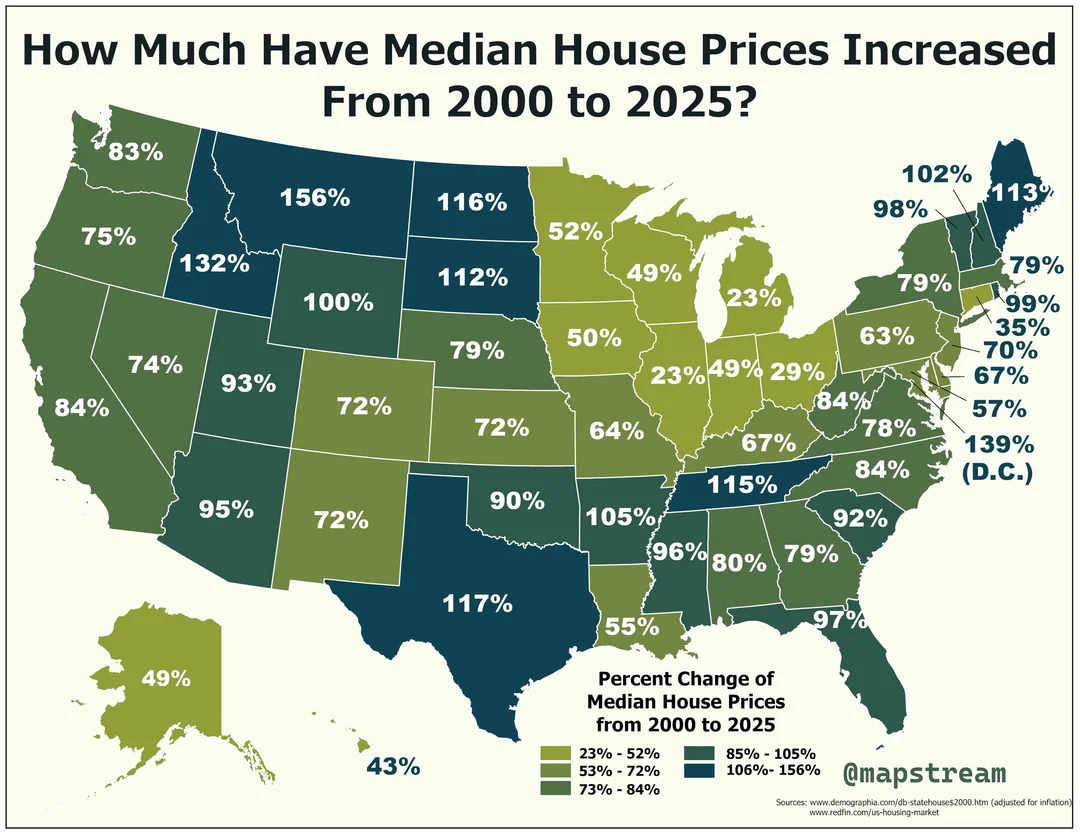
15) Median house prices since 2000: Affordability pressure is national, but its intensity varies sharply by state. The inflation-adjusted map ranges from 23% growth in Michigan and Ohio to 156% in Montana, with Idaho at 132%, Texas at 117%, and Maine at 113%. Price growth can signal demand and wealth creation, but it can also shrink the labor shed, raise wage pressure, and derail recruitment when a candidate checks local listings.
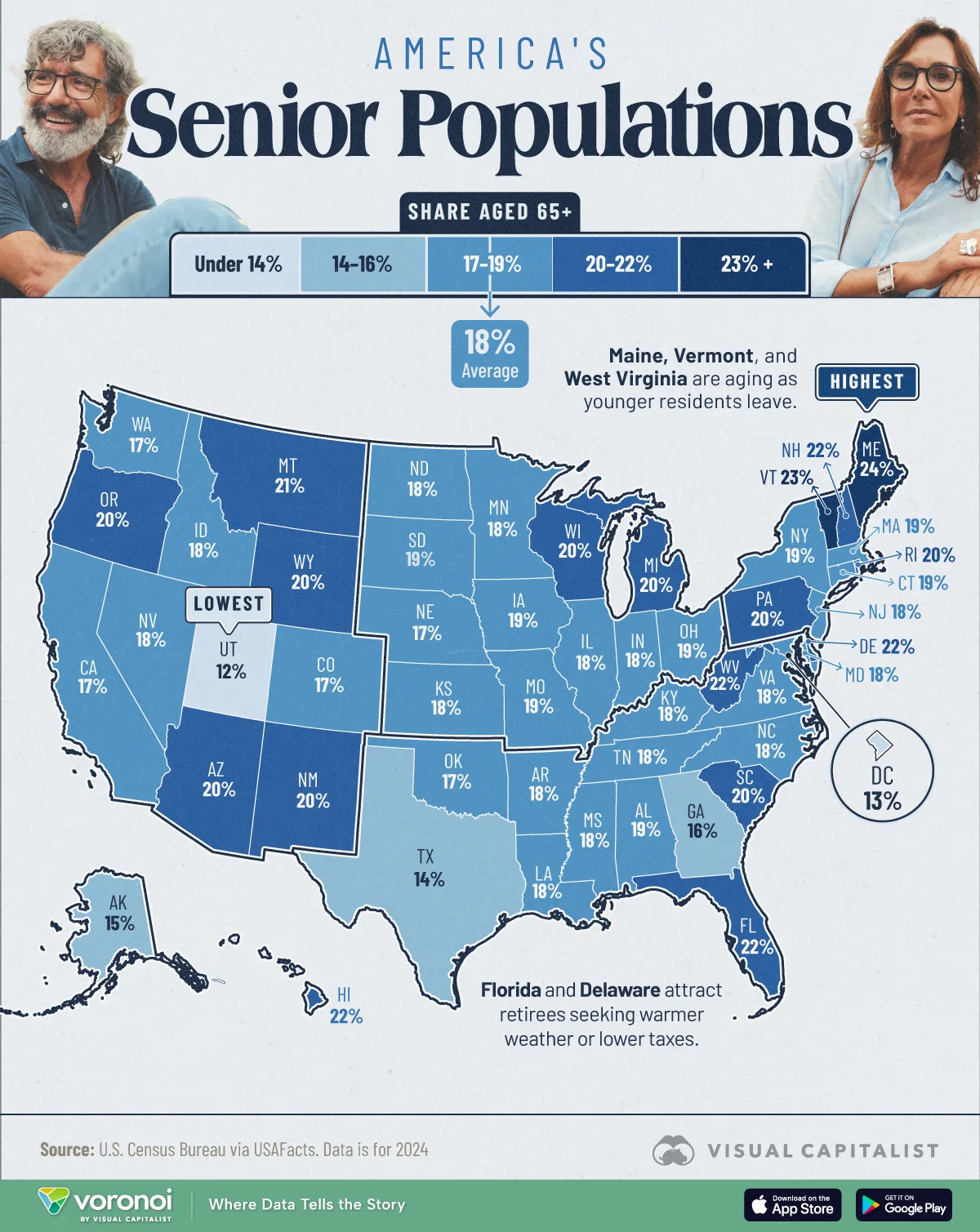
16) The share of seniors in every state: Aging is reshaping local demand at very different speeds. Visual Capitalist's state-by-state map puts Maine at 23.5%, Vermont at 22.9%, and West Virginia at 21.9%. Utah is lowest at 12.4%, versus a 17.7% national average. Those gaps reshape healthcare, housing, transportation, workforce replacement, and public services. By 2034, older adults are projected to outnumber children nationwide.