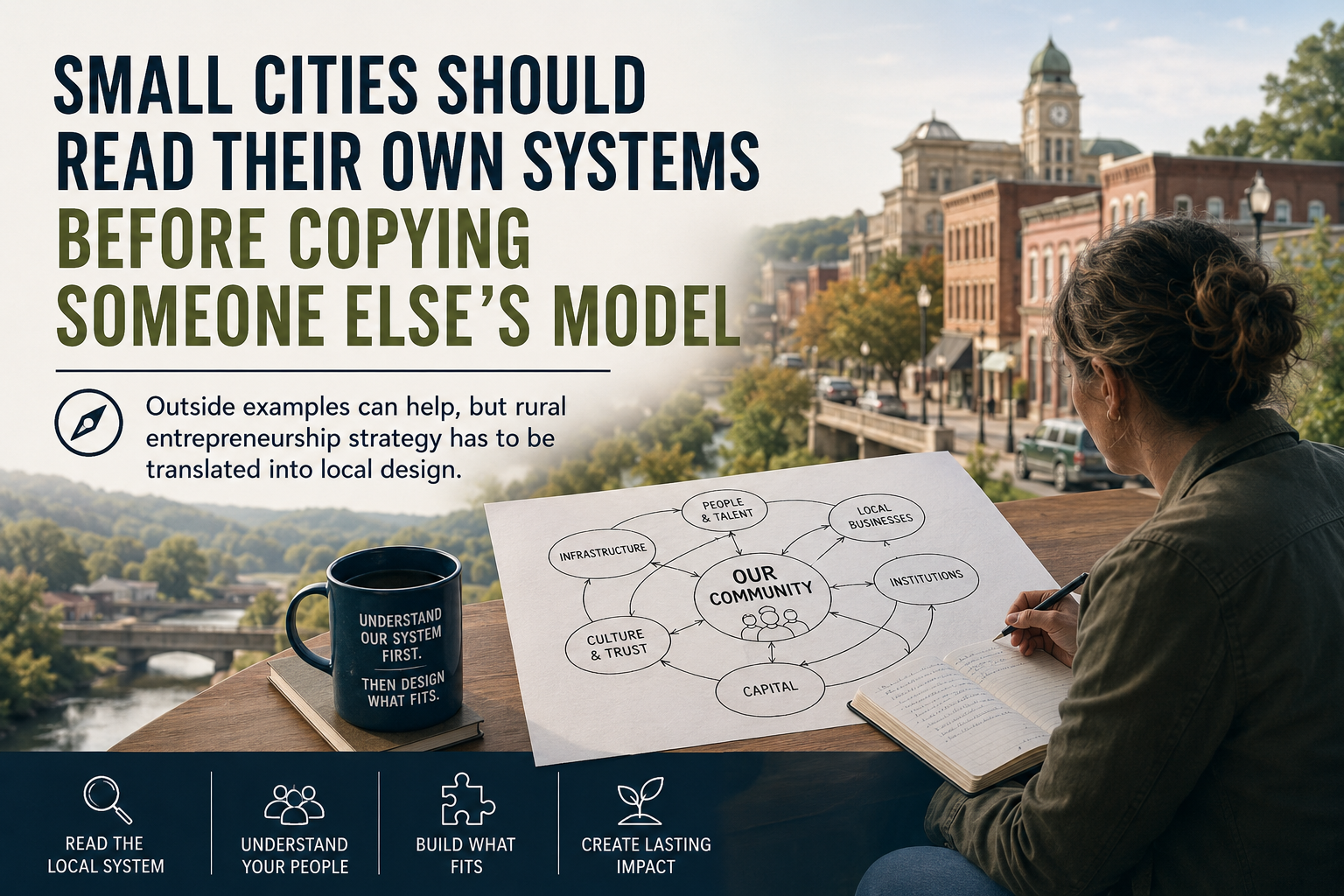
Small Cities Should Read Their Own Systems Before Copying Someone Else's Model
Outside examples can help, but rural entrepreneurship strategy has to be translated into local design.

 Dane Carlson
Small cities do not usually fail at entrepreneurship strategy because they lack ambition. They fail because they borrow models built for a different system and assume the smaller version will behave the same way. That is the trap.
A coworking space looks tangible. An incubator looks modern. An accelerator sounds serious. A mentor network feels like something every entrepreneurial community should have. When a larger market gets attention for one of these models, the temptation is obvious: reduce the size, find a grant, and launch the local version.
Jim Eldridge's conversation with Dane Carlson points to a better discipline.
Before a small city copies someone else's model, it has to understand what that model depends on. It has to read its own local system clearly enough to know what can be supported, what is missing, and what needs to be built first.
That is the strategic value in Eldridge's mix of planning, anthropology, and economic development. He is not arguing against entrepreneurship, ecosystem building, or outside examples. He is arguing against skipping the diagnostic work: understand the place first, then decide what to build.
That sounds slower than launching a visible program. In practice, it is more serious. It keeps a community from mistaking activity for capacity.
Scale Is Not Just a Budget Question
Small cities often approach outside models by asking whether they can afford them.
Could we fund a coworking space? Could we staff an entrepreneurship center? Could we recruit mentors? Could we run a small accelerator?
Those are reasonable questions, but they are not the first questions. Eldridge's point is that a model may fail long before cost becomes the central issue. The problem may not be that the city lacked money. The problem may be that the local system was never ready to carry what the model required.
Capacity is different in a small city. The same civic leaders may sit on every board. The same institutions may be asked to support every initiative. The pool of founders may be real but thin. Local expertise may be strong in some sectors and absent in others. That changes the work.
A city can pay for a coworking space and still lack the founder flow that makes it useful. It can launch a startup program and still lack the connective tissue that turns workshops into companies. It can brand an ecosystem before the ecosystem has enough trust or density to function.
The mistake is treating scale as a matter of shrinking the budget. For small cities, scale is also a matter of institutional fit, human capacity, and local behavior.
Planning Has to Read the Human System
Eldridge's anthropology background matters because it pushes economic development beyond the formal map of a place.
Planning usually starts with visible assets: land, infrastructure, institutions, employers, transportation, utilities, public policy, and development capacity. In Ada, Oklahoma, Eldridge can point to a public regional university, the Chickasaw Nation's headquarters, a federal research center, a major corporate presence, and a diversified local economy for a town of roughly 17,000 people.
Those assets matter. They are part of the community's strategic foundation. But they do not fully explain how the place works.
A local system is also made of relationships, habits, assumptions, influence, trust, memory, and informal patterns of decision-making. Who actually moves ideas through the community? Which institutions cooperate easily, and which only appear aligned on paper? Where does entrepreneurial behavior already exist? Who has credibility with small business owners?
These questions can sound soft compared with site readiness or workforce data. They are not. They determine whether a program will be used, trusted, ignored, or quietly worked around.
A small city can design a technically sound initiative and still miss the way people actually behave. It can create an entrepreneurship program before it understands whether the real barrier is confidence, connections, market knowledge, capital, mentorship, or institutional trust.
That is why Eldridge's approach is useful. It treats planning as more than asset inventory. It treats it as place-reading. Economic developers in small cities need both. They need to know the formal system, and they need to understand the human system underneath it.
Quality Jobs Should Shape the Strategy
Eldridge's view of a quality job also pushes the conversation in a more useful direction.
Economic development often talks about jobs as units: job count, wages, payroll, tax base, and investment. Those measures matter. Communities need them. But a job is not only an economic unit. It is part of a person's life system.
A quality job affects family decisions, housing choices, education, financial stability, and whether a person believes there is a future for them in the community.
That matters for small-city strategy because job creation cannot be separated from the broader local system. A community may attract jobs and still struggle if the work does not support long-term stability. It may grow employers and still lose talent if housing, childcare, transportation, or advancement pathways do not fit the lives people are trying to build.
This does not mean every economic development strategy has to solve every social issue at once. It means the definition of success has to be grounded in how the community actually functions.
If a small city is trying to build an entrepreneurship ecosystem, it should not only ask how many businesses it can launch. It should ask what kinds of firms create durable opportunity. It should ask which businesses can grow into quality jobs. It should ask what local conditions help people stay, build, hire, and reinvest.
That is a different standard than copying a program because it worked somewhere else. It forces the strategy back into place.
Rural Entrepreneurship Has to Be Built in Layers
One of the most practical parts of Eldridge's thinking is that he does not frame rural entrepreneurship as a choice between imitation and inaction.
The lesson is not that small cities should reject accelerators, incubators, coworking spaces, mentor networks, or entrepreneurship centers. The lesson is that those tools have to be translated.
A small city has to understand what each tool is actually supposed to do.
A coworking space is not just a room with desks. It depends on people who need shared space and gain value from being around other builders. An accelerator is not just a curriculum. It depends on founders at the right stage, mentors with relevant experience, market access, and capital pathways. A mentor network is not just a roster of names. It depends on trust, fit, and follow-through.
If those underlying conditions are missing, the visible program will not create them automatically. That is why the building-block approach matters.
A small city may need to identify existing entrepreneurs before it launches formal programming. It may need to build trust before it builds a network. It may need to expose residents to business ownership before it asks for scalable startup activity. It may need to connect local institutions before it brands an ecosystem.
This is not an argument for moving timidly. It is an argument for sequencing the work correctly. Build the layer the system actually needs next, not the layer that looks most impressive from the outside.
The Better Strategy Is Local Design
Outside models still have value. Small cities should study them. They can reveal useful patterns, offer inspiration, and show what later-stage ecosystem maturity might look like.
But an outside model should be a reference point, not a blueprint. The better standard is local design.
That means starting with the real conditions of the place. What assets are genuinely distinctive? What kind of entrepreneurial behavior already exists? Which institutions have capacity, and which are already stretched? Where is the real constraint: staffing, capital, founder density, expertise, trust, civic bandwidth, or market access?
Those questions make the strategy harder to fake. They also make it more likely to succeed.
Eldridge's planning and anthropology lens is valuable because small-city economic development is not just about choosing the right program. It is about understanding what the local system can carry and what it needs to carry more.
The communities that make progress will not be the ones that borrow the flashiest model first. They will be the ones who know themselves well enough to translate outside examples into local design.
For small cities, the strategic advantage is not imitation. It is self-knowledge turned into action.
Sitehunt helps economic developers turn local knowledge into clearer site strategy.
With organized property data, project-fit analysis, and faster RFI response tools, communities can see which sites are ready, where the gaps are, and what needs to be built next.
Because local design works better when the community can see its own system clearly.
Learn more at sitehunt.io.

Econ Dev Show Newsletter
Join the newsletter to receive the latest updates in your inbox.