21 Things Economic Developers Need to Know This Week
The stories Dane thinks you need to see. October 22, 2026 edition.


Welcome to this week's issue of What Economic Developers Need to Know This Week, where we explore the evolving dynamics of our economy.
This week we have 21 tools, stories, graphics, charts and videos that I think you'll find informative, useful, inspiring, and perhaps even humorous. Some are economic development related directly, and some only indirectly.
If you're wondering what to do with the info in this newsletter, send something to your board members. It will make you look good!
Today's email is brought to you by Resource Development Group
Resource Development Group and Convergent Nonprofit Solutions have recently announced a merger of these two well respected firms. RDG is now operating as Resource Development Group, a Convergent Company and will lead the combined operations in economic development and chamber engagements. Meanwhile, the Convergent banner will take the forefront on efforts on supporting traditional philanthropic and higher education organizations
This merger maintains RDG's innovative and custom approach while also creating the deepest bench of economic development and chamber fundraising expertise in the industry, the most complete data set in the country regarding economic development and chamber funding, and the greatest flexibility to be able to support engagement models tailored specifically to every market, regardless of size. Whether you’re a single county EDO ready to kick off your first fundraising campaign or a large regional organization on your third funding cycle, they have the team and experience to get you the results you’re looking for.
This week on the Econ Dev Show
1) Economic development and developers in the news #265: Borrow an idea from a peer doing the work. The latest news roundup brings together 77 stories from 31 states and across the country, from site readiness and workforce partnerships to downtown development. Pick one to discuss with your team, or find someone who has already wrestled with a problem on your desk.
2) Your website has a job to do: A beautiful website still needs to help someone choose your community. Max Karren joins the podcast to discuss AI discoverability, page speed, and lead capture. Before commissioning a redesign, check whether prospects can find your facts, load your pages, and easily start a useful conversation.
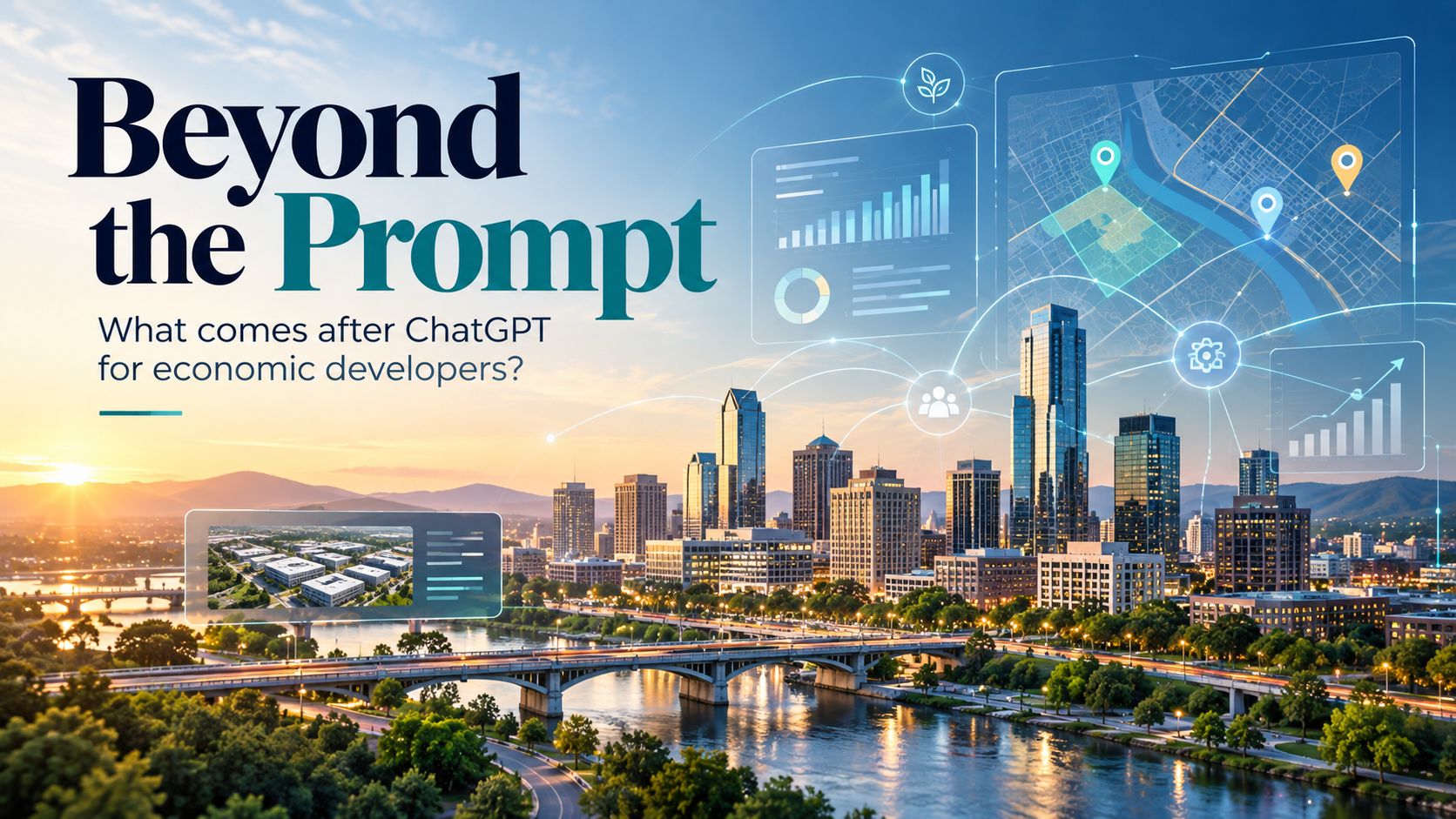
3) What comes after ChatGPT?: Let AI take a task further than the first draft. I’m joining Golden Shovel for a free webinar today, October 22, at noon Central, on using AI for research, property analysis, RFIs, and repetitive work. The goal is more time for relationships, strategy, and community building.
4) Pass along a good opportunity: Someone you know may be ready for the next move. The latest jobs issue lists 65 openings across 28 states and remote roles, from coordinator positions to executive leadership. Browse for yourself or send it to a colleague, and check the individual employer listing for current availability.
The work behind a stronger community
5) Community sentiment is part of site diligence: The next project is being judged before the announcement. Taylor Stepp’s interview explains why his firm now reads council minutes and studies community sentiment during site selection. Power and speed still matter, but so does evidence that a community can get a project through its public process.
6) A strategic plan that fits on one page: Start with a goal, a name, and a deadline. The Honest Economic Developer makes the case for a one-page strategic plan: choose one achievable priority, ask specific people to handle specific tasks, and meet again in 30 days. A useful assignment for a board that already has plenty of plans.
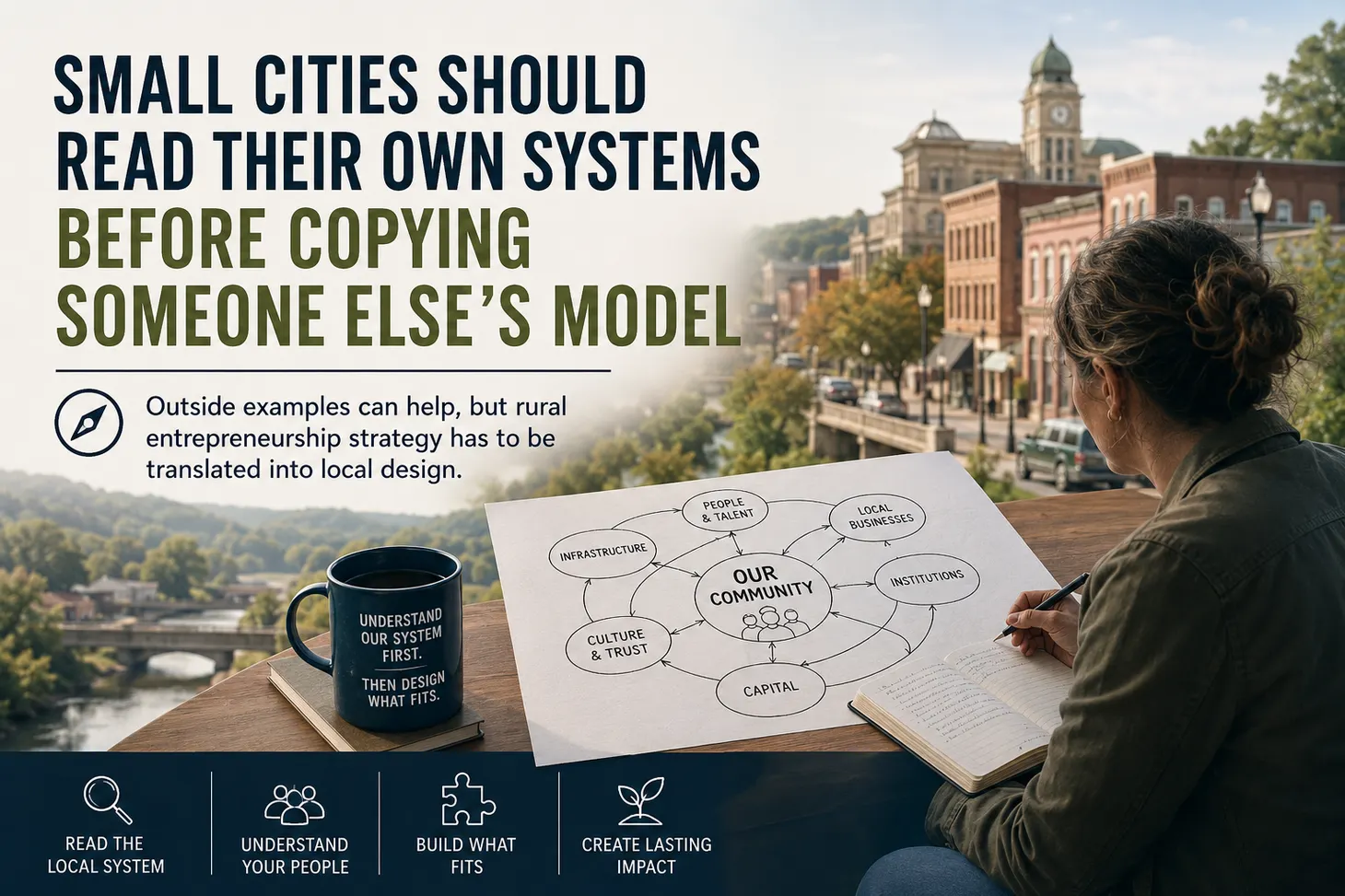
7) Small victories can build a stronger rural community: Small victories can build the trust for bigger changes. On Develop This!, Mason Ainsworth discusses rural infrastructure, placemaking, and community leadership with Dennis Fraise. His starting points are practical: listen well, be transparent, build relationships, and give people visible reasons to believe progress is possible.
8) The jobs after the ribbon cutting: Count who stays, not just what gets announced. Paul O’Brien argues that employee retention and movement belong in economic development’s workforce picture. Who filled the jobs, how long did they stay, and did they leave the employer or the region? Those questions can make an existing-industry conversation more useful than another hiring total.
Sites, investment, and the work ahead
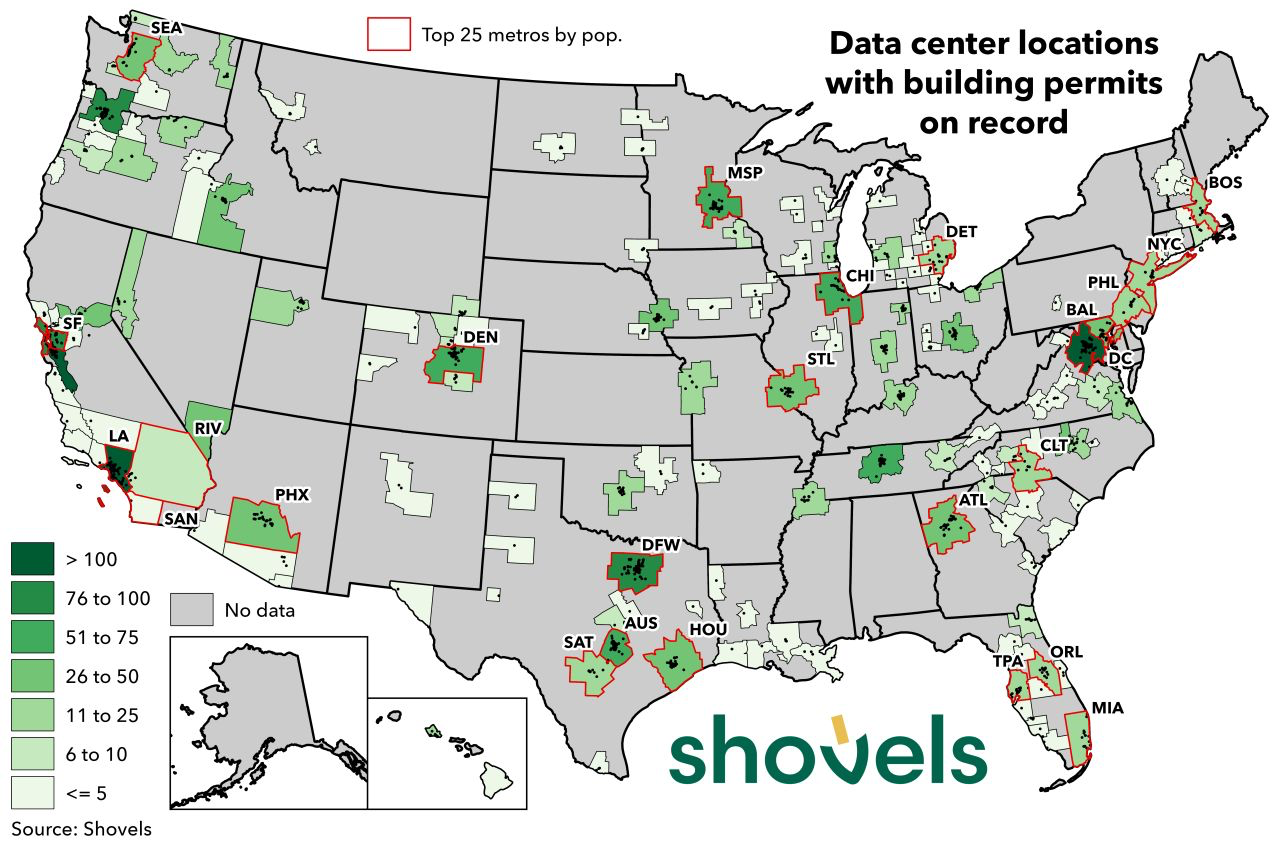
9) A different way to read the data center map: Permit records offer another view of where development is happening. Shovels maps data center locations with building permits on record across 171 metros. Washington leads its dataset. Read this as locations within Shovels coverage, not a census of operating facilities or a measure of their power capacity.
10) The expansion may be equipment, not another building: Ask about next year’s capital budget. In the Philadelphia Fed’s October survey, 52.2% of responding manufacturers expected higher total capital spending in 2027. Equipment and software can mean investment without a bigger building. The next existing-industry visit is a good time to ask what is planned and what could hold it up.

Sitehunt helps economic developers find, understand, enrich and market their sites, match them to projects, and respond with confidence in minutes instead of scrambling for days.
11) Robots still need someone to show them the work: A convincing demo is only the beginning. Brian Potter explains where robot training data comes from, including human demonstrations, remote operation, and video. There is no ready-made equivalent of the internet’s text archive. For manufacturers considering automation, the useful questions concern real tasks, training needs, and reliable performance on the floor.
12) AI’s report card has some very large gaps: A good benchmark score is a narrow claim. Mercor’s map shows which occupational tasks appear in its initial set of 29 AI benchmarks, and how much work remains barely tested. Explore your region’s jobs before accepting a sweeping workforce forecast. Missing test coverage does not establish what AI can or cannot do.
The housing behind the workforce
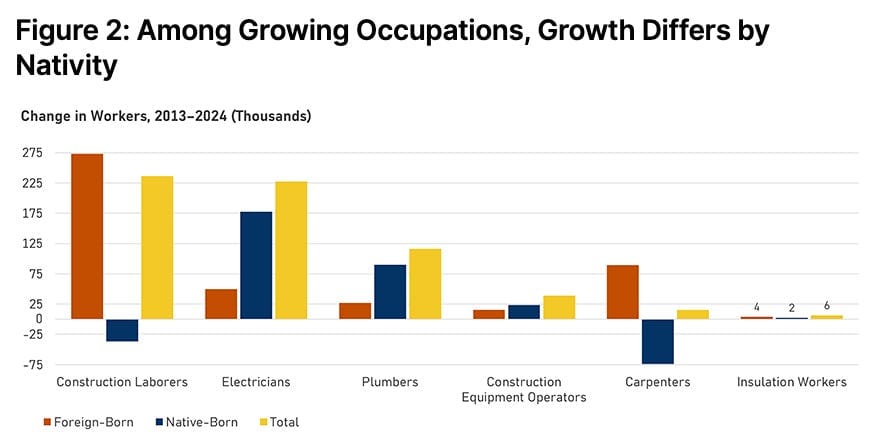
13) Who will build the housing your workforce needs?: The labor constraint changes with the trade. Harvard’s Joint Center for Housing Studies finds immigrants accounted for all net growth in construction trades employment from 2013 to 2024, while electrician and plumber gains were mostly native-born. A useful reminder to ask builders which workers they need before promising a faster housing pipeline.
14) Homebuilding capacity as a service: A builder may be able to buy factory capacity instead of owning it. Promise Robotics announced an agreement supporting production of more than 1,250 D.R. Horton homes and a Phoenix factory planned for early 2027. Its model connects automated manufacturing with installation, creating an interesting overlap between housing supply and industrial recruitment.
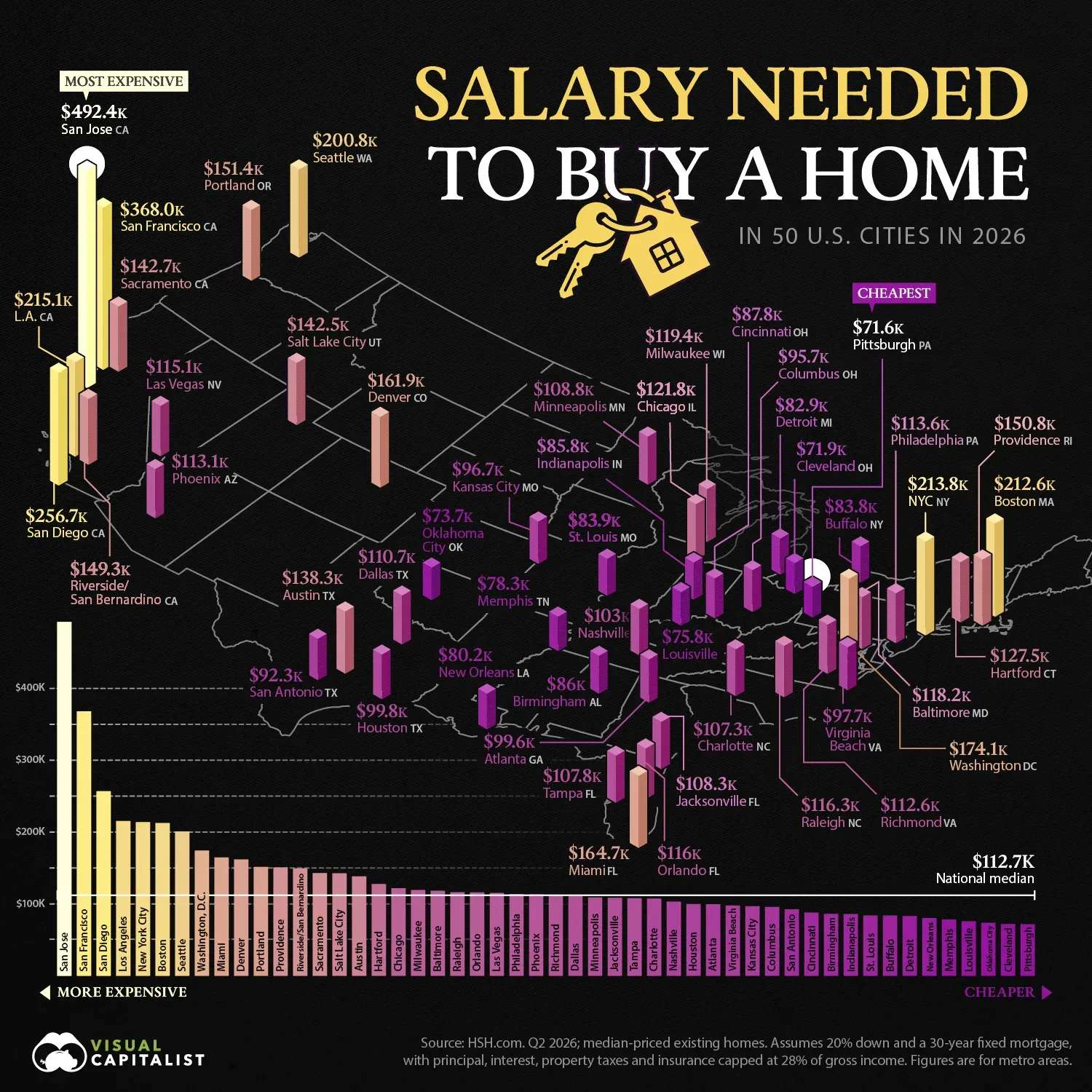
15) What salary buys a home in your market?: Compare your target wages with the cost of arriving. This housing map puts the income needed for a median-priced home above $100,000 in 32 of 50 metros. HSH’s model assumes 20% down and Q2 mortgage rates. Useful recruitment context, with a substantial down-payment hurdle still outside the headline.
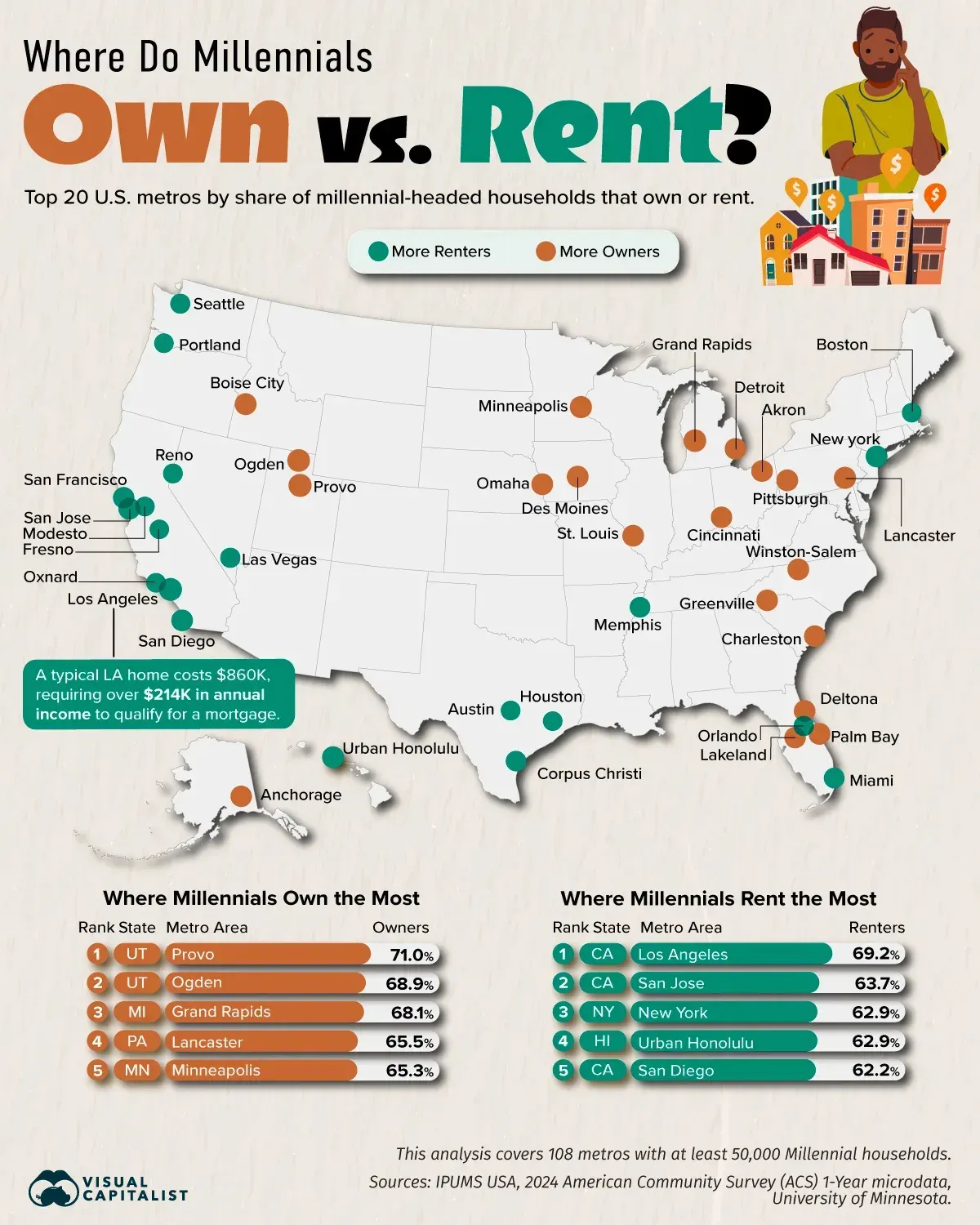
16) Where millennials own, and where they rent: The same generation faces very different housing markets. This map finds 71% of millennial households owned in Provo, while 69% rented in Los Angeles, using 2024 data. That is useful context for talent attraction, though a homeownership rate cannot tell you whether renters prefer renting or cannot afford to buy.
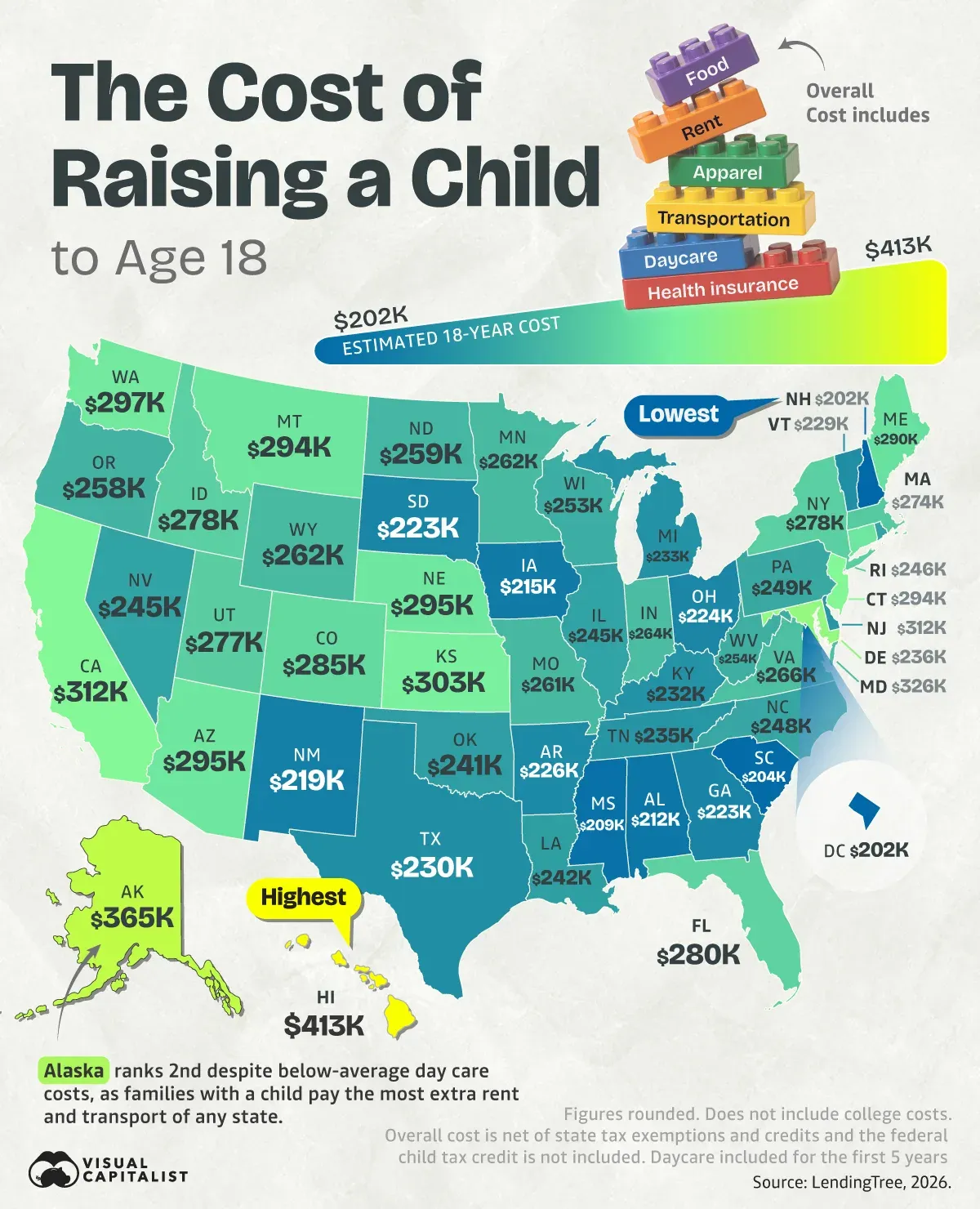
17) The family budget belongs in talent attraction: A job offer has to work for the whole household. This state-by-state comparison maps a modeled 18-year cost of raising one child, from about $202,000 in New Hampshire to $413,000 in Hawaii. Housing, transportation, and childcare all shape a region’s appeal. The underlying costs mostly date to 2024 and exclude college.
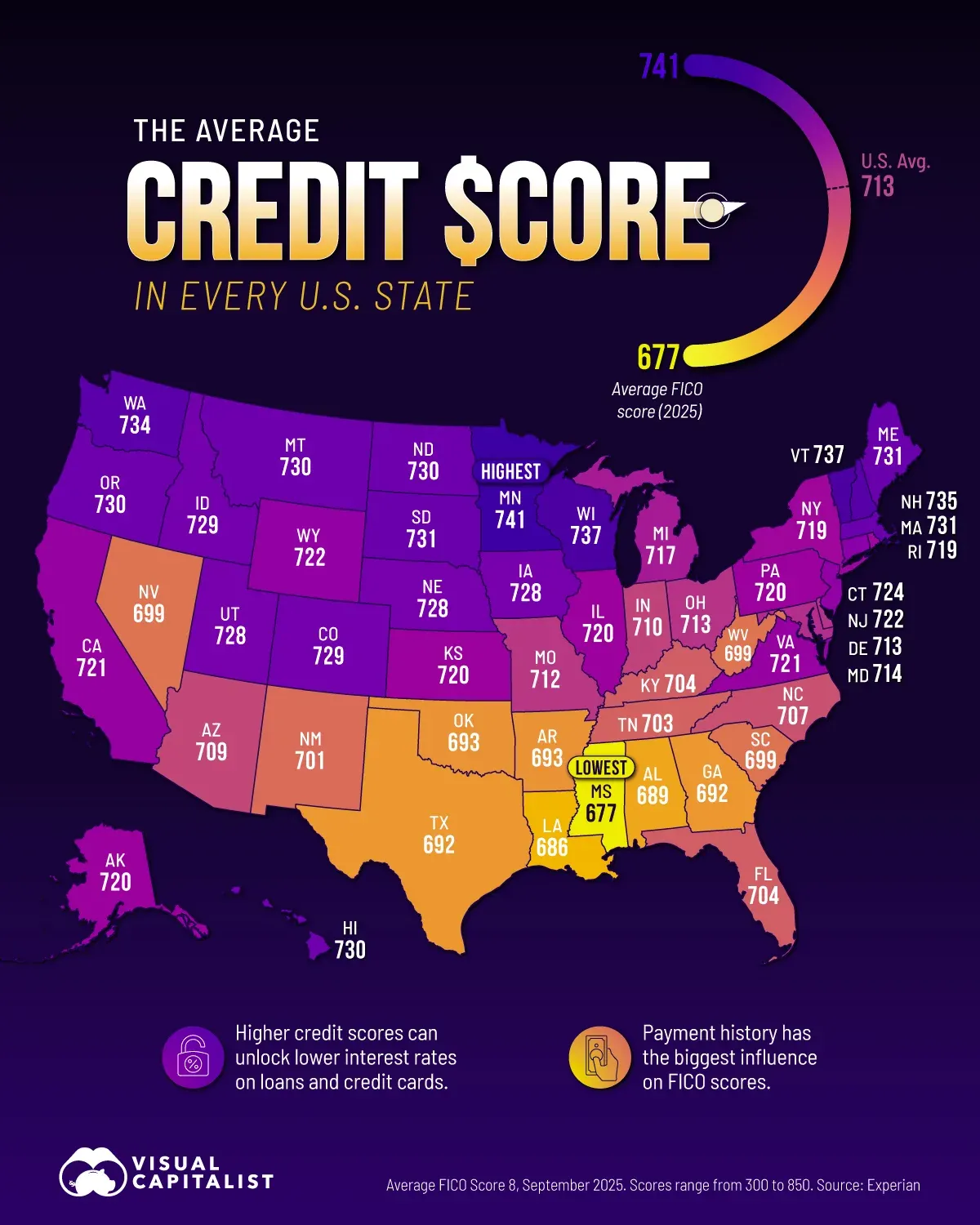
18) Financial resilience has a geography: Access to credit is part of household opportunity. Experian’s state comparison, mapped here, ranges from an average FICO score of 741 in Minnesota to 677 in Mississippi. The national average slipped to 713 in 2025. Read it alongside incomes and debt burdens; a statewide average tells little about any particular borrower.
A wider view of the economy
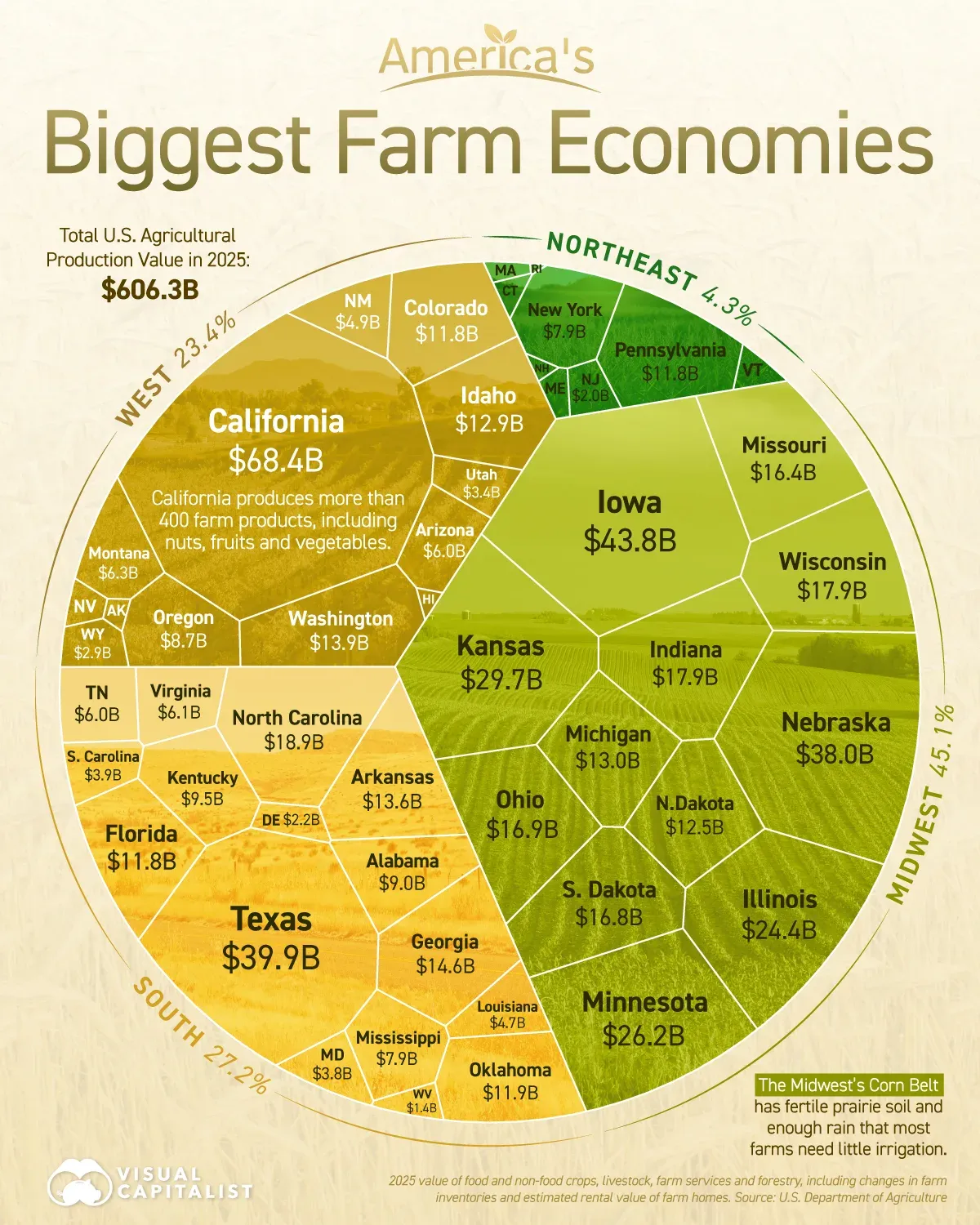
19) America’s farm economy is bigger than the crop map: Agriculture is a network of production and services. This comparison puts California first in 2025 agricultural production value, while the Midwest accounts for 45% of the national total. The measure includes livestock, crops, services, and forestry before costs. For rural development, look beyond farm counts to the businesses supporting that output.
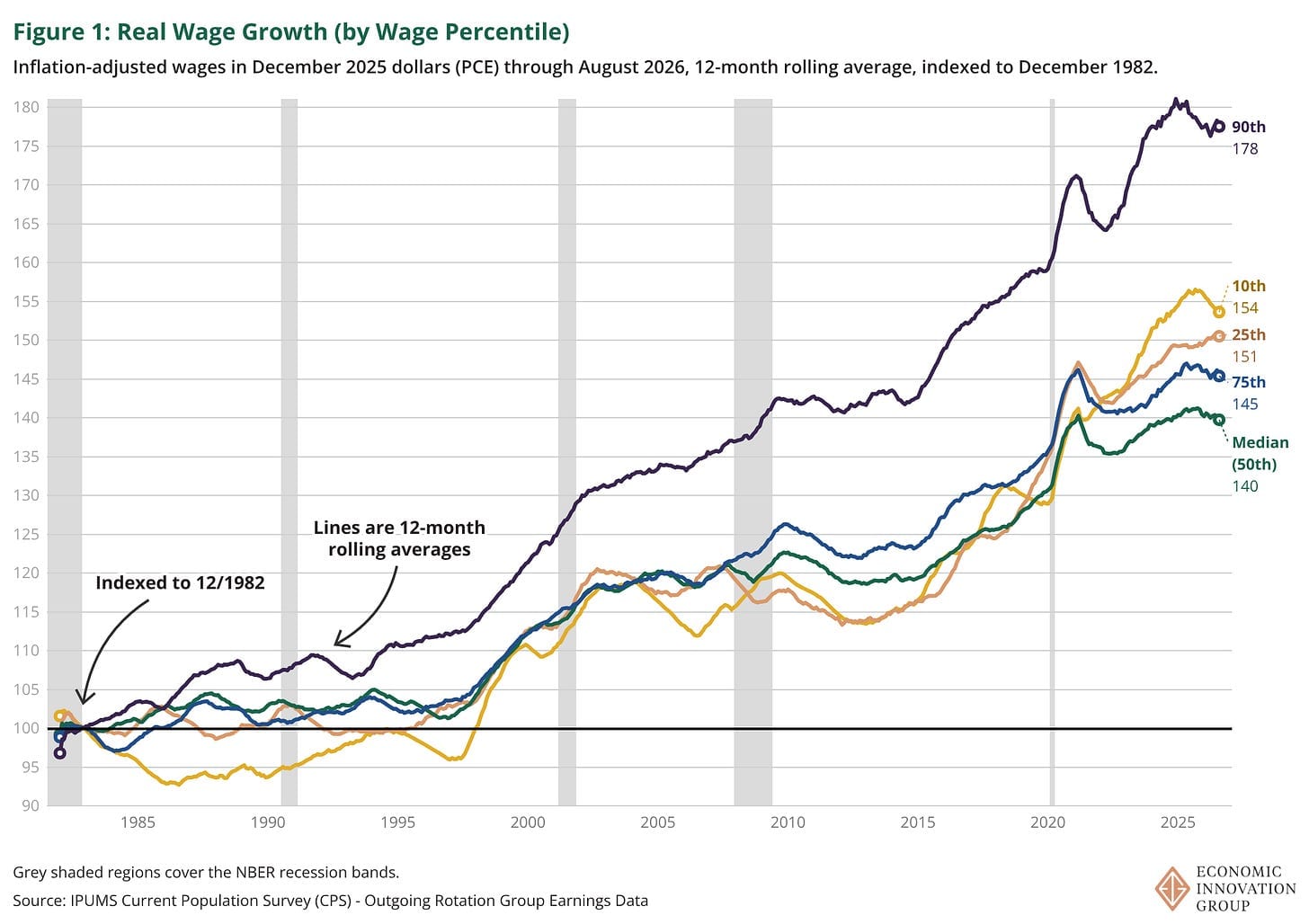
20) Wage growth looks different depending on when you started: The long run hides some very long waits. EIG’s wage charts track inflation-adjusted pay across the distribution since 1982, showing extended periods of stagnation interrupted by stronger gains. The authors explain why workers from different generations can experience the same economy differently. Use the chart to frame a discussion, then check local wages and costs.
21) Which inflation number are we talking about?: The index and the household budget answer different questions. Barry Ritholtz’s forceful essay argues that changes in inflation measurement have obscured price pressure. Pair it with the BLS explanation of what CPI measures. For a board discussion, start by specifying the index, period, and costs you mean.