Building Resilient Economies Through Community-Driven Directories
Most Communities Don’t Know Their Own Economy

 Dane Carlson
Ask most economic developers how many businesses they have, and you’ll get a number that’s too low.
Not because they’re careless. Because a large share of economic activity is invisible.
Home-based businesses. Small contractors. Independent providers. Entrepreneurs operating just outside the formal system.
If you can’t see them, you can’t support them. And if you can’t support them, you’re leaving resilience on the table.
In a recent Econ Dev Show conversation with Rebecca Naragon of USET, one idea stood out:
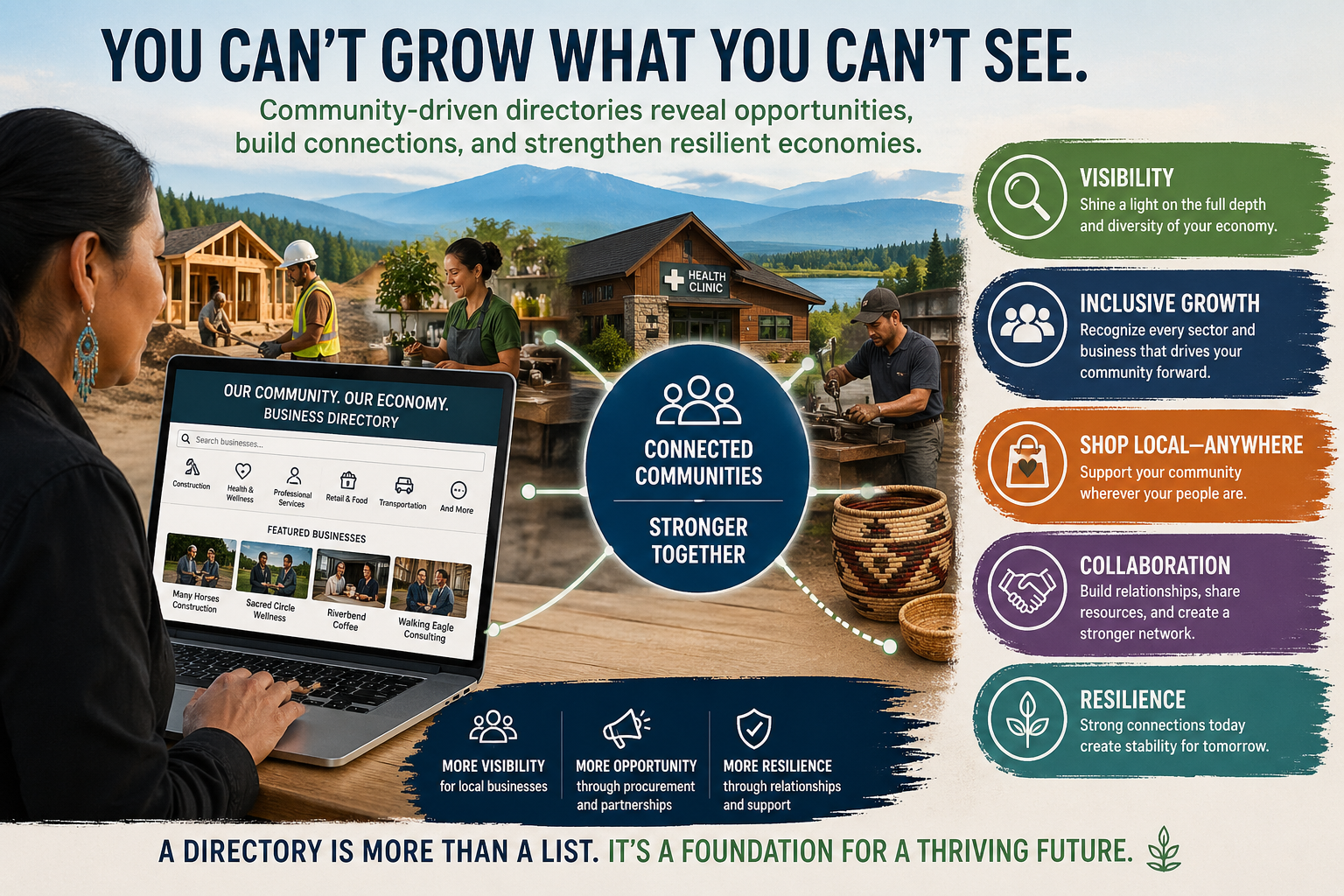
A good business directory doesn’t just list your economy. It reveals it.
Visibility Changes Behavior
The act of building a directory does something subtle but powerful.
It tells business owners: you count.
That alone changes behavior.
Entrepreneurs who thought they were on their own start to see themselves as part of something larger. Residents begin to recognize the depth of what exists locally. External partners see a market that looks more real, more investable.
Most communities aren’t empty. They’re just under-documented.
You’re Probably Defining “Economic Development” Too Narrowly
Too many strategies center on a handful of large employers.
That misses most of the economy.
USET’s approach works because it expands the lens. Health services, trades, sole proprietors, home-based businesses. All of it counts.
Structuring that information using something like NAICS isn’t just administrative. It makes your local economy legible to the outside world, especially procurement officers and buyers who are already trained to think that way.
If your businesses can’t be found in the way buyers search, they effectively don’t exist.
“Shop Local” Doesn’t Mean What You Think
Local isn’t always geographic.
For tribal communities and other dispersed populations, “local” often means relational.
People want to support their community, even if they live hundreds of miles away.
A well-built directory makes that possible. It extends your economy beyond your borders without losing identity.
That’s not just cultural. It’s economic.
Resilience Is Built Before You Need It
Directories aren’t just marketing tools. They’re infrastructure.
Every update, every new listing, every connection strengthens the network.
That matters most when things go wrong.
During disruptions like COVID, the communities that could quickly identify, communicate with, and support their businesses had a real advantage.
The others were guessing.
How to Build One That Actually Works
Skip the perfect launch. Focus on momentum.
- Start with what you know. Then make it easy for businesses to add themselves.
- Go find what’s missing. Especially the small and home-based operators.
- Organize it in a way outsiders understand. Industry structure matters.
- Treat it like a system, not a project. It should never be “done.”
- Use it. For procurement, outreach, targeting, and storytelling.
If it just sits on your website, it won’t do much.
The Real Value
A directory is one of the simplest tools in economic development.
It’s also one of the most underutilized.
Done right, it becomes a live map of your economy. Not the version you report.
The version that actually exists.
Where This Is Going
The next step isn’t just listing businesses.
It’s connecting them to sites, infrastructure, workforce, and opportunity in real time.
That’s where platforms like Sitehunt start to matter. Not as a replacement for this work, but as an extension of it.
Because once you can see your economy clearly, you can start to move faster with it.
And speed, more than incentives, is what wins.

Econ Dev Show Newsletter
Join the newsletter to receive the latest updates in your inbox.