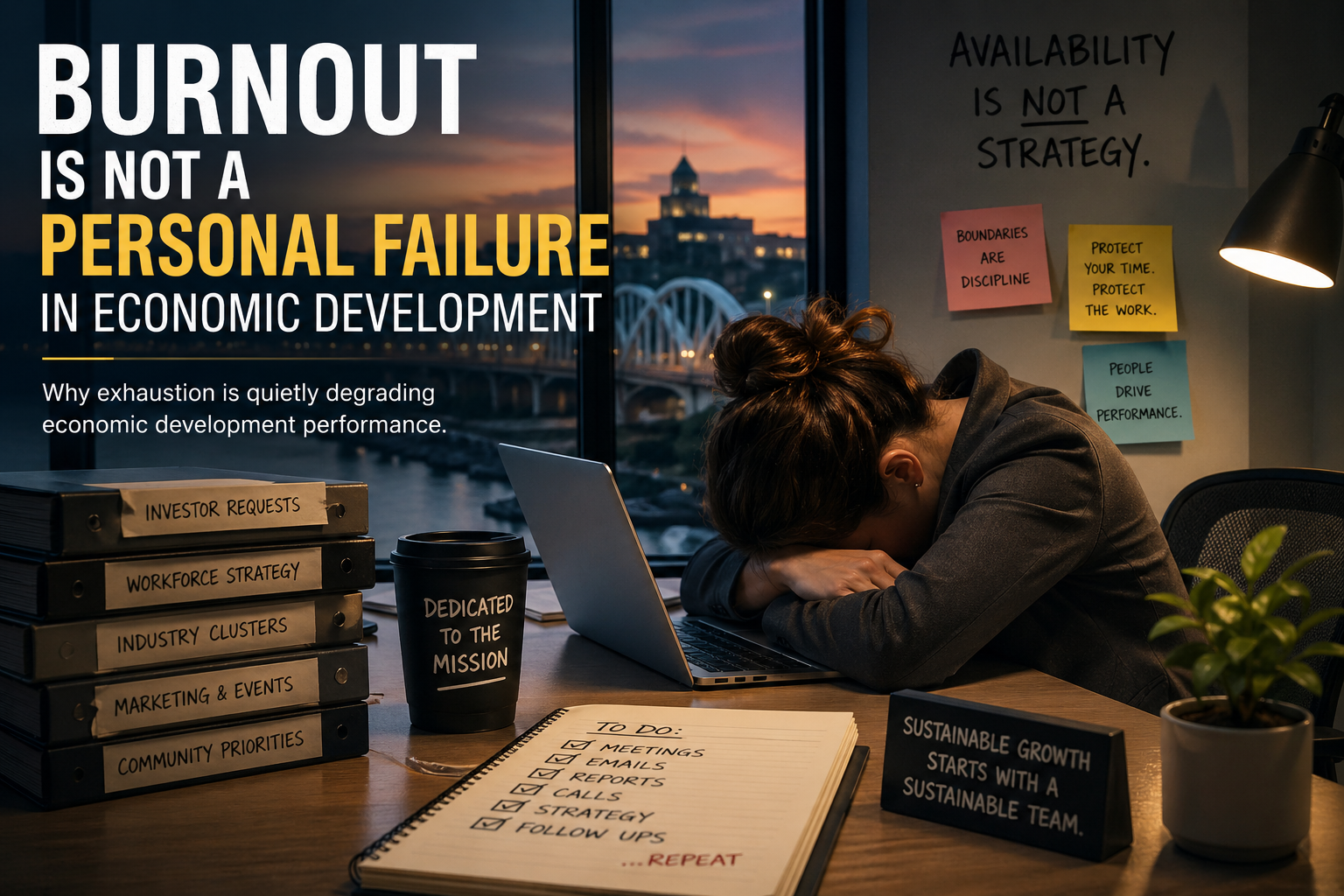
Burnout Is Not a Personal Failure in Economic Development
Rethinking burnout as an organizational risk, not a personal issue

 Dane Carlson
Economic development still rewards exhaustion.
A full calendar. A nonstop inbox. Late-night replies. All signals of commitment.
Until they’re not.
Because that model doesn’t just wear people down. It quietly makes the work worse.
Judgment slips. Patience shortens. Communication thins. Strategy gives way to reaction.
That’s the real problem.
Burnout isn’t personal.
It’s organizational risk.
Dane's conversation Juliet Abdel’s conversation in Cedar Rapids makes that clear. By the time someone feels burned out, performance has already started to erode. The system just hasn’t admitted it yet.
The Field Is Diagnosing the Problem Too Narrowly
When burnout shows up, the response is predictable.
Time management. Resilience. Better habits.
Fine. But marginal.
Those fixes assume the problem is the person.
It’s not.
The problem is a system that rewards overextension and calls it professionalism.
That’s what makes Abdel’s framing useful. She doesn’t treat burnout as a side issue. She ties it directly to leadership and execution.
The real question isn’t how someone feels.
It’s this:
Can your organization still think clearly, lead consistently, and execute its strategy at a high level?
If the answer is no, it doesn’t matter how good your strategy looks on paper.
Boundaries Are Operating Discipline
One of the clearest signals in the episode is around boundaries. Especially after-hours communication.
Economic development romanticizes availability.
Always on. Always responsive. Always saying yes.
That works in bursts.
It fails as a system.
When after-hours communication becomes the norm, it sends a message: the job only works if personal time keeps giving way.
Over time, that erodes the exact capabilities the role depends on:
- Judgment
- Patience
- Long-term thinking
- Steady leadership
Boundaries aren’t softness.
They’re discipline.
You can’t ask people to carry quality of life messaging, workforce strategy, and global investment work while pretending human capacity is infinite.
That contradiction compounds.
The Damage Happens Before Anyone Quits
Burnout is hard to see because the system doesn’t break right away.
Emails still get answered. Meetings still happen. Projects keep moving.
From the outside, it looks fine.
But the quality shifts.
- Strategy gets shorter-term
- Communication gets thinner
- Relationships become transactional
- Decisions become reactive
Strong teams make this worse, not better.
They compensate. They cover gaps. They keep delivering longer than they should.
By the time the problem is obvious, performance has already declined.
A Stronger Culture Protects the Work
The field still treats self-erasure as dedication.
That’s backwards.
The better model is simple: protect the conditions that make sustained performance possible.
That means:
- Real boundaries
- Disciplined workloads
- Clear priorities
- Permission to say no
And systems that don’t rely on constant heroics to function.
This belongs in the same conversation as workforce strategy, industry clusters, and international investment.
If sustainability matters externally, it has to matter internally.
You can’t sell quality of life while eroding it inside your own organization.
The best leaders understand this:
Personal well-being isn’t separate from performance.
It’s part of the system that produces it.
Audit What You’re Actually Rewarding
If this idea matters, it shows up in what your culture rewards.
Ask yourself:
- Is after-hours communication the exception or the standard?
- Do you praise boundaries, or only ignore them?
- Do you measure performance by outcomes, or visible activity?
- Is burnout treated as weakness, or risk?
- Would your strategy survive without overextension?
This isn’t about comfort.
It’s about durability.
That’s the real takeaway from Juliet Abdel’s conversation in Cedar Rapids.
You can build around workforce, clusters, and investment. But none of it holds if the people doing the work are being slowly depleted.
Protecting people isn’t separate from performance.
It is performance.
If your team is constantly reacting, it’s not just a workload problem. It’s a system problem.
Sitehunt helps reduce the scramble by automating site research and RFI responses, so your team can spend less time chasing information and more time doing the work that actually moves deals forward.

Econ Dev Show Newsletter
Join the newsletter to receive the latest updates in your inbox.