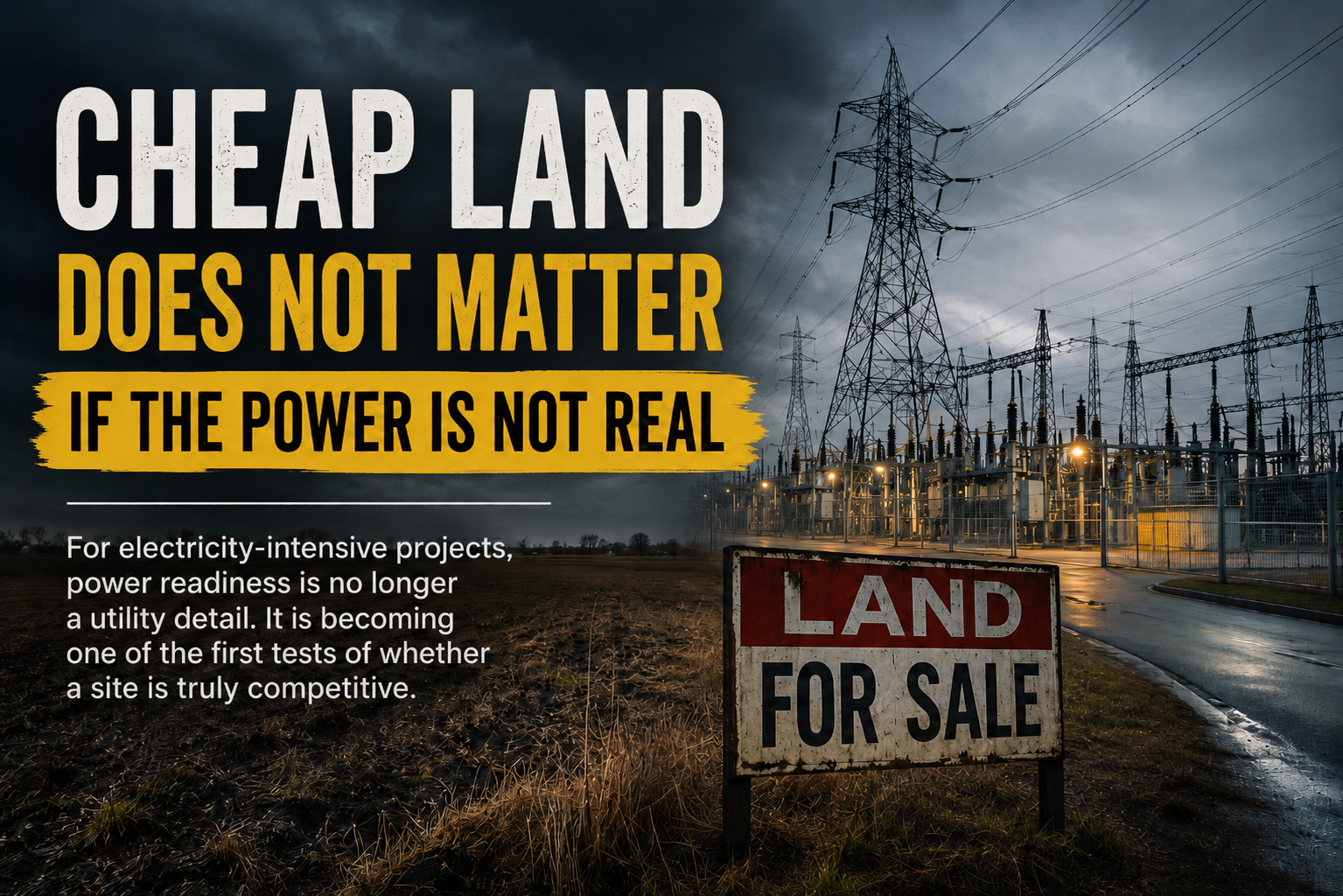
Cheap Land Does Not Matter If the Power Is Not Real
For electricity-intensive projects, power readiness is no longer a utility detail. It is becoming one of the first tests of whether a site is truly competitive.

 Dane Carlson
Cheap land used to buy a community time.
For years, low-cost acreage could help a site earn a second look. It could offset concerns about distance, infrastructure, workforce, or development risk. It gave local leaders something simple and persuasive to say: the project may have challenges here, but we can make the numbers work.
That logic is weakening.
In Timothy Comerford’s conversation on the Econ Dev Show Podcast, the message is blunt: industrial growth is increasingly being shaped by electricity-driven geography. Data centers, large-load industrial users, transmission constraints, utility queues, and public concern over ratepayer impacts are changing what it means for a site to be competitive.
A community can still have land, rail, highway access, a motivated local government, and an incentive package ready to go. But if the electric capacity is not real, the site is not ready.
The old site math is breaking
Power availability is no longer a technical detail to sort out after the recruitment story gets exciting. It is not a late-stage box to check, and it is not a utility issue sitting off to the side of the main economic development conversation.
It is now much closer to the center of the deal.
That shift changes the value of everything around it. Cheap acreage matters less if service cannot be delivered on a timeline the project can actually use. A strong incentive package matters less if grid investment creates political strain or ratepayer pressure. A promising location matters less if transmission constraints make the site functionally unavailable for the user being recruited.
This does not mean every project needs massive power. It means communities need to stop treating electric capacity as interchangeable, flexible, or easily solved with enough enthusiasm.
For many serious projects, the first hard truth is timing. Local conversations often talk about power like it is a months-long problem. Comerford’s point is that the real answer is often years, not months.
That difference is not just a scheduling issue. It changes the entire structure of the deal.
A project that needs power in 18 months and a site that can realistically be served in five years are not close to aligned. They are mismatched.
Vague readiness eventually collapses
That mismatch can stay hidden for a while. It can be softened in early conversations and buried under phrases like “available nearby,” “capacity in the area,” or “utility coordination underway.”
But eventually the prospect asks the sharper questions.
How much power? At what voltage? From what source? Through what upgrades? At what cost? By what date?
That is when vague readiness collapses.
False optimism is especially dangerous here because it feels productive. It keeps the conversation alive, helps a community stay in the hunt, and gives local leaders something positive to report.
But optimism does not build substations. It does not shorten interconnection queues, resolve transmission constraints, or move a utility’s capital plan faster. It usually just delays the moment when everyone has to admit what the site can actually support.
That delay has a cost. It consumes staff time. It distorts expectations. It can pull elected officials into a story before the fundamentals are proven. It may even lead a community to describe a site in ways that are technically defensible but practically misleading.
The site may not be bad. It may simply be wrong for that project, at that load, on that timeline.
That distinction matters.
Economic development teams do not need to become utility engineers. But they do need enough discipline to know when the electric answer is solid, when it is conditional, and when it is mostly hope.
The market is becoming less forgiving of that difference.
Power changes the politics
This is also where the politics get harder.
Incentive policy is cleaner when the public conversation is about jobs, investment, payroll, and tax base. It gets more complicated when a project’s power demand raises questions about who pays, who benefits, and how the grid is being expanded.
Large-load users do not arrive in a vacuum. They affect utility planning. They can trigger infrastructure upgrades. They may invite scrutiny from residents, regulators, existing businesses, and other ratepayers.
At that point, the question becomes larger than whether a project looks good in a press release. It becomes whether the public system around that project can absorb the burden of making it possible.
That does not make these projects bad. It makes them serious.
And serious projects require a different kind of local evaluation.
A community that wants to compete in this environment has to ask harder questions earlier. Is the load request credible? Is the user real or speculative? Is the project ready to convert, or is it shopping for leverage? Is the site being considered because it fits the operating need, or because it looks cheap on a spreadsheet? Does the utility see a path, or is everyone politely avoiding the hard answer?
Those questions are not anti-growth.
They protect the community’s credibility.
Serious projects require harder questions
In a looser market, economic developers could afford to chase more possibilities. They could keep conversations warm, stretch a site’s story, and hope the complicated pieces would resolve later.
In a tighter power market, that approach becomes risky.
Massive power requests can create false urgency, pull attention away from better-fit projects, and make communities act as if every inquiry deserves the same level of mobilization.
It does not.
The better teams will get more selective, not because they are less ambitious, but because they understand that power readiness is now part of competitiveness. They will know which sites have real capacity, which sites have a plausible upgrade path, and which sites should not be marketed to certain users until the infrastructure story changes.
They will build stronger relationships with utilities before the prospect arrives. They will separate promotional language from operational truth.
That last point may be the most important.
Economic development has always depended on storytelling, but the story now has to survive technical review. “Good site” is no longer enough. “Available land” is no longer enough. “Utilities nearby” is not enough.
The claim has to hold up when a serious user starts testing delivery timing, electric capacity, transmission access, cost exposure, and risk.
This is where some communities will lose ground without realizing it. They will keep marketing sites the old way while prospects evaluate them under new conditions. They will think they are competing on land, incentives, and location, while the prospect is quietly ranking them on power viability.
By the time that difference becomes obvious, the decision may already be made.
Real power keeps the conversation alive
The practical takeaway is not that cheap land has no value.
It still does.
Land cost, local support, speed, workforce, transportation, permitting, and incentives still matter. But they matter inside a different hierarchy than they used to. For electricity-intensive projects, power readiness can move from supporting detail to gatekeeper.
When that happens, every other advantage becomes conditional.
That is the shift Comerford’s conversation makes clear. Electricity is not just another infrastructure category. It is becoming one of the forces redrawing the competitive map for industrial development.
It determines which sites are real, which timelines are believable, which incentive conversations are politically durable, and which communities can make claims that survive contact with the utility.
For economic developers, the lesson is simple: do the hard work before the prospect asks the hard question.
Know which sites are ready. Know which ones are conditional. Know which ones are not a fit yet. And when you market a site, make sure the infrastructure story is more than a hopeful phrase in a brochure.
Cheap land can still start a conversation.
Real power is what keeps it alive.
Sitehunt helps economic developers move from vague property marketing to real site intelligence. Before the next RFI arrives, know what your sites can actually support, including infrastructure, constraints, logistics, workforce, and readiness factors that determine whether a property belongs in the conversation. Get a demo.

Econ Dev Show Newsletter
Join the newsletter to receive the latest updates in your inbox.