Downtown Revitalization Gets Weaker When Communities Wait for Outsiders to Save It
Why the strongest downtown strategies start with the businesses already making, hiring, and building value close to home.
 Dane Carlson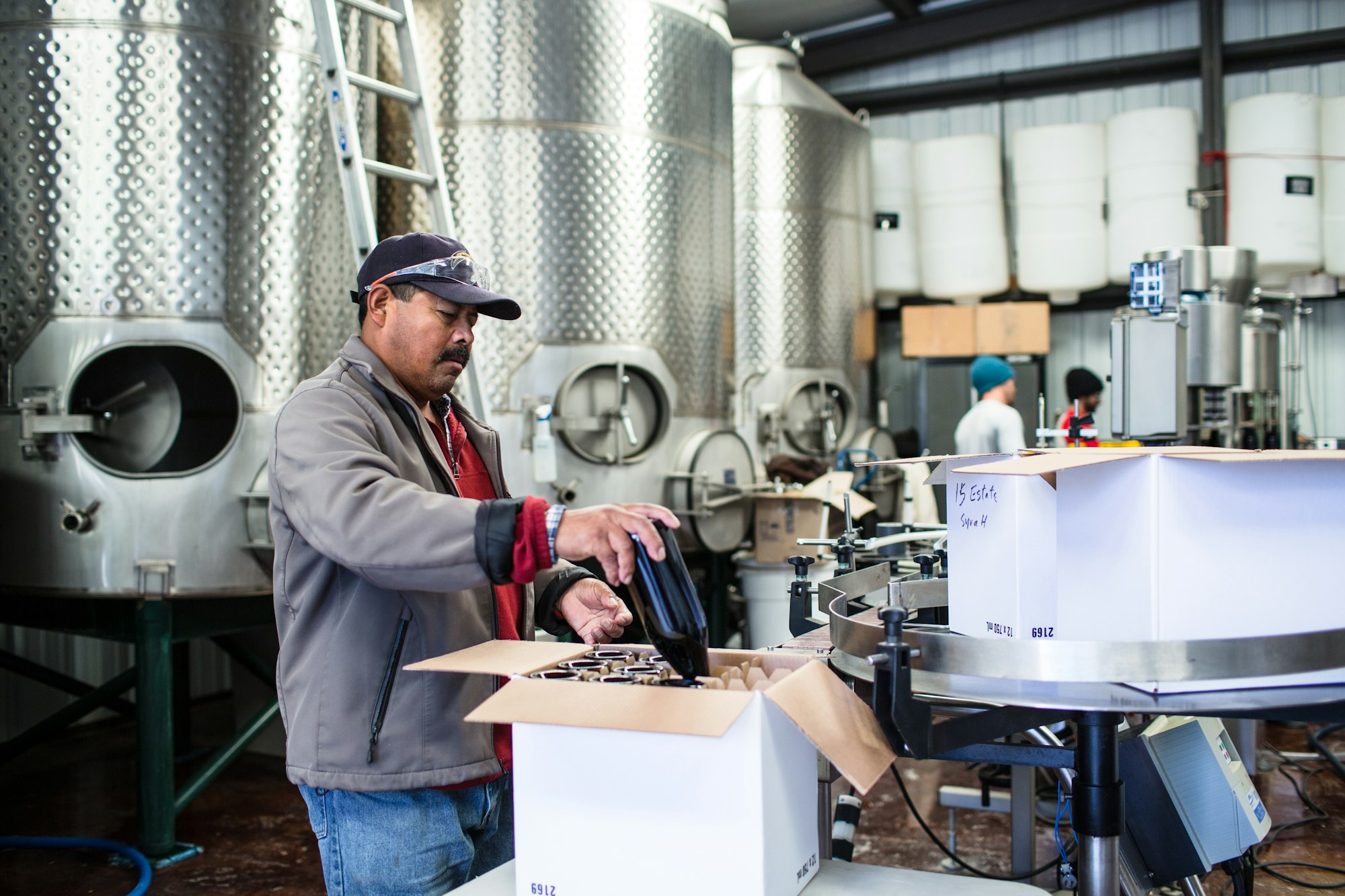
Many downtown strategies still carry a quiet rescue fantasy.
The right developer will come. The right retailer will arrive. The right destination business will choose the corridor. The right outside investor will finally see what locals have not been able to unlock.
It is an understandable hope. Every struggling downtown has vacant storefronts, tired buildings, or underused blocks that seem like they are one great project away from turning the corner.
But that rescue fantasy is also one reason so many revitalization efforts stay weak.
In her conversation with Dane Carlson on the Econ Dev Show, Ilana Preuss pushes against that mindset directly. Her argument in Recast Your City is not simply that small-scale manufacturing belongs downtown. It is that communities get into trouble when they keep waiting for outsiders to do economic work that their own local businesses could be doing.
That is the deeper problem behind many empty storefronts and stalled revitalization plans.
Too many communities still carry a big box mindset, even when they say they want something local. They assume the district becomes healthy when the right outside tenant finally chooses it.
But that is not really a strategy.
It is outsider dependence with better branding.
Why the Rescue Model Fails
The rescue model is attractive because it promises scale and speed.
One major tenant. One recognizable brand. One highly visible investment. One project that signals to everyone that the district is back.
Sometimes, that kind of project helps. Outside investment can matter. Regional developers can bring capacity. Larger tenants can fill gaps that local businesses cannot. But when revitalization depends too heavily on outside recruitment, it creates fragility.
The community has less control over the business mix. It has less influence over timing. It has less ability to shape what kind of economic activity actually takes root. The district becomes reactive. It waits for interest instead of building momentum from assets already in place.
That is especially dangerous in downtowns that are already struggling.
A corridor full of empty storefronts, weak foot traffic, and years of deferred reinvestment usually does not need a miracle first. It needs productive local businesses that can use space, stay in place, hire people, adapt buildings, and create community wealth over time.
That kind of revitalization is less flashy.
But it is often much sturdier.
The Productive Downtown Is Stronger Than the Decorative One
This is where Ilana Preuss’s small-scale manufacturing framework becomes especially useful.
A productive downtown is different from a decorative one.
A decorative district may look better than it used to. The streetscape may be improved. The storefronts may be cleaner. The events calendar may be fuller. The banners may be new.
Those things can help. They can make a place feel cared for again.
But a downtown can look improved and still be economically thin.
If the district depends too much on occasional consumer spending, too little on daily business activity, and too heavily on businesses that could just as easily be somewhere else, the revitalization is fragile. It may be attractive, but it is not necessarily productive.
A productive downtown has more depth.
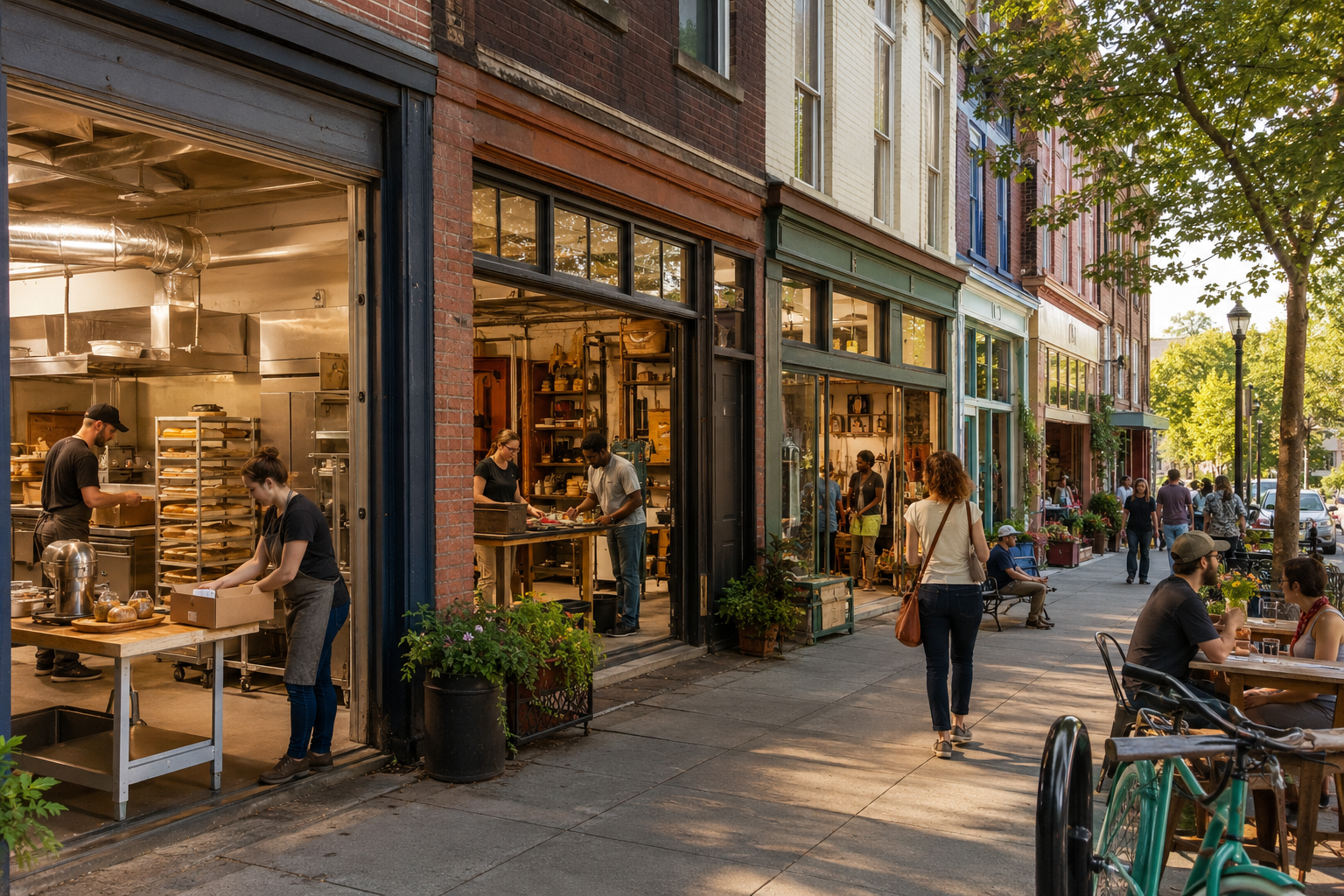
It includes local businesses that make, assemble, roast, repair, design, fabricate, package, or produce. It creates a stronger daily rhythm. It gives the district a more rooted economic purpose. It connects storefronts to work, not just shopping.
That shift matters.
It changes downtown revitalization from a surface-level aesthetic exercise into a real economic development strategy.
It also changes who benefits. When local businesses grow inside the district, more of the gains are likely to circulate locally. Local owners build value. Local workers gain opportunity. Local buildings become more useful. The corridor becomes part of a community wealth strategy, not just a backdrop for spending.
The Big Box Mindset Never Fully Left
Most communities would never say they are waiting to be rescued by outsiders.
But a lot of downtown strategy still behaves that way.
It privileges external recruitment over local expansion. It treats empty storefronts mainly as a tenant attraction problem. It measures progress by who can be landed, rather than by what kind of local economic fabric is being rebuilt.
That is the big box mindset in a more polished form.
It assumes the best thing for a district is usually something large, visible, and external enough to signal change quickly.
Ilana Preuss’s framework is valuable because it challenges that instinct. It asks communities to look again at the businesses they already have. It asks whether small-scale manufacturers, makers, food producers, repair businesses, designers, and other productive enterprises might belong in places where they have too often been overlooked.
That is a different growth logic.
It does not begin with the question, “Who can we recruit?”
It begins with better questions.
Who is already producing value here? Who is ready to grow? Which local businesses need a different kind of space? Which vacant buildings could become useful again if communities widened their idea of what belongs downtown?
That kind of work may be slower in some ways. But it is more durable in the ways that matter.
Why Local Supply Chain Thinking Belongs Downtown
Local businesses do not only fill storefronts.
They can also strengthen local supply chains, create business-to-business activity, and build more interdependence within the district and the broader community.
That is easy to miss when downtown strategy is reduced to beautification, events, restaurants, and retail mix. Those things influence the experience of a place, but they do not automatically create a stronger economic base.
Small-scale manufacturing can.
A business that makes something downtown may buy from nearby suppliers, hire local workers, sell into regional markets, and reinvest in its own space. It may generate activity beyond the dinner rush or weekend event. It may give people a reason to visit, work, ship, learn, collaborate, and produce in the same district.
That does not solve every downtown problem.
But it creates a more grounded kind of revitalization than waiting for a chain tenant or outside operator to decide the district is finally investable.
It also gives economic developers a more practical role. Instead of simply marketing vacant space, they can help identify local growth companies, understand their space needs, connect them with property owners, reduce regulatory friction, and support the conditions that allow productive businesses to stay and expand.
That is economic development work.
And it belongs downtown.
What Communities Should Stop Doing
Communities should stop treating local businesses as the backup plan after outsider recruitment falls through.
They should stop assuming productive uses are incompatible with a strong main street.
They should stop designing revitalization plans around appearance first and economic use second.
They should stop talking about local pride as if pride alone can revive a corridor without giving local businesses better chances to occupy, adapt, and grow inside it.
Those habits weaken revitalization because they keep the community dependent on actors it cannot control.
A better downtown strategy starts closer to home.
It treats vacant storefronts not just as empty retail boxes, but as possible production spaces, growth spaces, and ownership opportunities. It sees local entrepreneurs not as decorative evidence of authenticity, but as serious economic actors. It recognizes that the community already has assets worth building around.
The Better Revitalization Bet
The stronger bet is not that outsiders never matter.
Of course they do.
Outside investment, regional partners, and recruited businesses can all play a role in downtown revitalization. But they should not be the whole theory of change.
Downtowns become more resilient when communities build from productive local businesses first. That means taking small-scale manufacturing seriously. It means widening the kinds of uses considered compatible with main street. It means treating local supply chain activity as part of the revitalization strategy, not as something separate from it.
That is the contrarian takeaway from Ilana Preuss’s episode.
Downtown revitalization gets weaker when communities wait for outsiders to save it.
It gets stronger when they build the conditions where local businesses can do more of the saving themselves.
Sitehunt helps economic developers turn scattered property, infrastructure, workforce, and market data into clear answers for business attraction, retention, and revitalization work.
Whether you are evaluating downtown buildings, responding to RFIs, or trying to understand which sites are truly ready for growth, Sitehunt helps your team move faster with better information.
Econ Dev Show Newsletter
Join the newsletter to receive the latest updates in your inbox.