Economic Development Needs Better Public Storytelling Than It Usually Gives Itself
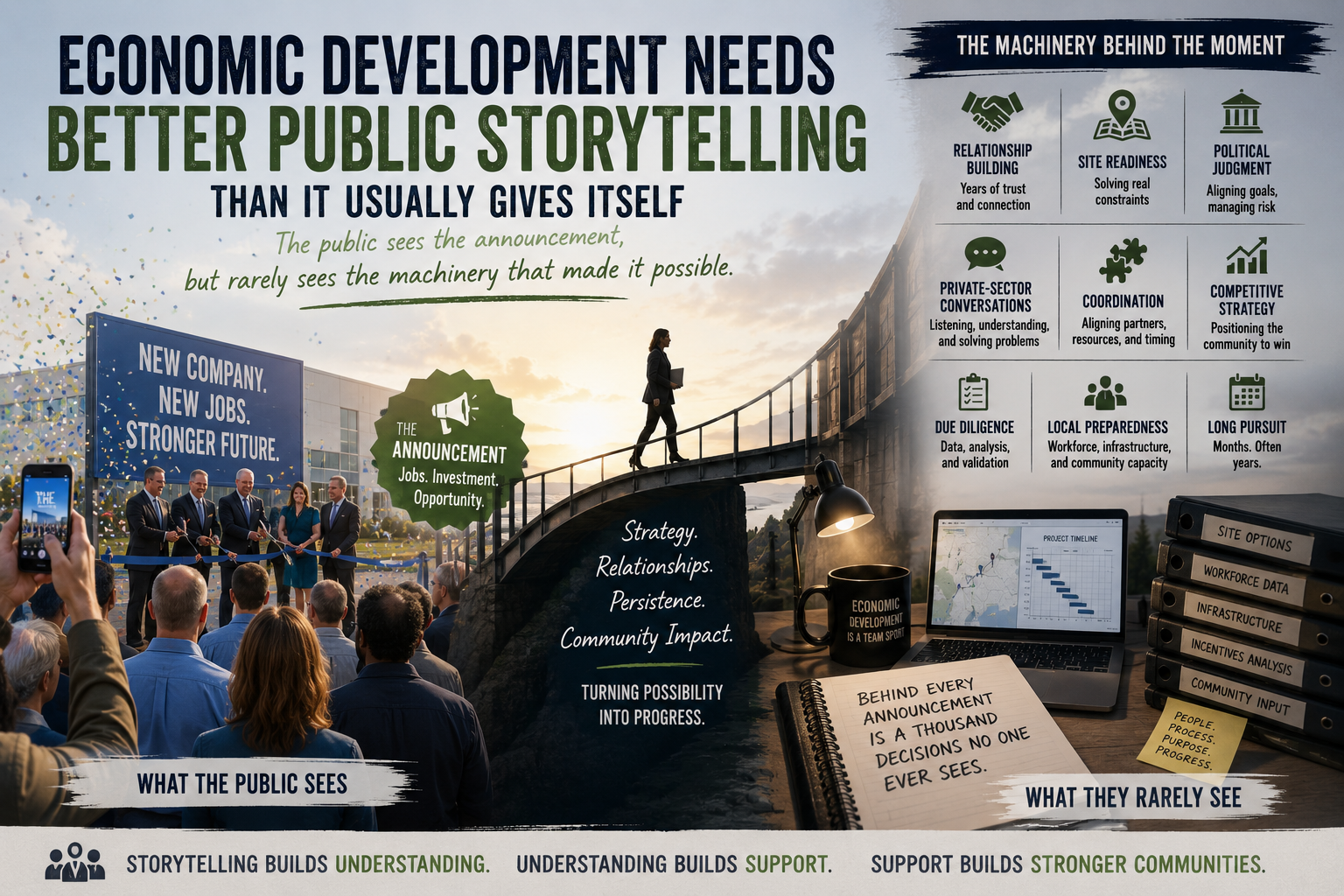
The public sees the announcement, but rarely sees the machinery that made it possible.

Economic development has a visibility problem, but not in the way the profession usually describes it.
Most communities know when a company announces a project. They see the ribbon cutting. They hear the job count. They read the press release. What they often do not understand is the work behind the announcement.
They do not see the long pursuit, the relationship-building, the site constraints, the political judgment, or the practical translation between public goals and private-sector decisions. They see the outcome, but not the machinery.
That is not just a communications gap. It is a strategy problem.
Don Erwin's conversation with Dane Carlson, centered on his economic development novel, points directly at that problem. Economic development knows how to communicate inside the field. It knows how to write announcements, produce reports, and explain projects to other practitioners. But it is much weaker at helping a broader audience understand what the profession actually does and why it matters.
That weakness has consequences. When people do not understand economic development, they tend to reduce it to its most visible parts: incentives, recruitment, ribbon cuttings, politics, or controversy. They miss the strategic choices and constant judgment required to help communities compete for jobs, investment, and long-term economic capacity.
That is why Erwin's fiction matters as more than a creative side project. It points toward something the field needs more of: narrative as translation.
The Field Explains Itself Mostly to Itself
Economic development produces a lot of communication. The problem is that much of it is written for people who already understand the work.
Industry articles, newsletters, conference sessions, technical reports, and project summaries all have value. They help practitioners compare methods and learn from one another. But they usually assume the reader already understands the basic logic of the profession.
A resident may not know why site readiness matters. A student may not understand what an economic developer actually does all day. A journalist may see a project only through incentives. Even local leaders can support economic development without fully understanding the process behind it.
That creates a public understanding gap. Economic developers know that a project can take years. They know how much depends on timing, relationships, confidentiality, site information, infrastructure, workforce capacity, and coordination across institutions. They know a community's competitiveness is not built in a single announcement.
But if the broader audience never sees that process clearly, the work becomes easy to flatten.
This is where public storytelling becomes strategic. The purpose is not to make economic development sound more heroic. The purpose is to make it legible enough that people can understand what is actually being done in their name and on behalf of their community.
Fiction Can Show What Technical Writing Often Leaves Out
One of the useful points in Erwin's episode is that economic developers are often limited in how openly they can describe the field's real methods.
No one is likely to publish a detailed article giving away their best lead-generation technique. Practitioners are not going to disclose confidential project details, private conversations, or the full pursuit logic behind competitive deals. Much of the work depends on discretion.
That discretion is necessary, but it also leaves a lot of the profession hidden from public view. Fiction creates a different kind of opening.
A novel can show the relationships, personalities, pressures, tradeoffs, and institutional dynamics of economic development without pretending to be a technical manual. It can make the work feel concrete without exposing confidential details. That matters because economic development is not only a set of outcomes. It is a set of interactions.
A report can say a project created jobs. A press release can list the investment amount. A case study can explain the timeline. But narrative can show the human and institutional process that makes those outcomes possible. That is the part the field often fails to translate.
Erwin's choice to use fiction is useful because fiction can carry complexity in a way that technical writing often cannot. It can bring readers into the work through character, conflict, setting, and consequence.
That does not mean every EDO needs to become a publisher of novels. It means the field should pay attention to what narrative can do that conventional industry communication often does not.
Promotion Is Not the Same as Translation
Economic development often treats public communication as promotion.
That instinct is understandable. Communities want to celebrate wins. EDOs want to market assets. Local leaders want to show progress.
But promotion and translation are different jobs. Promotion tells people the community is competitive. Translation shows what it takes to become competitive.
Promotion says a company chose the region. Translation explains why the decision was difficult, what the community had to solve, and how different pieces of the local economy affected the outcome.
Promotion announces the result. Translation makes the process understandable.
A field that only promotes itself may become more visible without becoming better understood. That is a dangerous distinction. Visibility can create attention, but comprehension creates trust, support, and better public judgment.
Without translation, the profession remains vulnerable to shallow criticism and weak assumptions. Residents may see incentives without understanding the competitive context. Elected officials may see announcements without understanding long-term capacity building. Local partners may underestimate the work because they only see the public-facing end of it.
Better storytelling does not solve all of those problems. But it gives the field a stronger public foundation by helping people understand economic development as a profession with methods, constraints, judgment calls, and consequences.
The Audience Is Larger Than the Field Assumes
Another important point in Erwin's conversation is that although his story is set in Alabama, the themes are not confined to Alabama. That matters.
Economic development can feel deeply local because every community has its own politics, institutions, assets, limitations, and history. But many of the tensions in the work are widely shared. Communities everywhere wrestle with recruitment, retention, workforce, industrial change, public perception, infrastructure, and competition.
That gives the field a larger storytelling opportunity than it often recognizes.
Economic development touches subjects ordinary people already care about: jobs, wages, local identity, opportunity, business growth, public investment, industrial change, and the future of places they love.
The issue is not that the subject is too boring for a broader audience. The issue is that the field often presents it in forms that are too internal, too flat, or too disconnected from human stakes.
Narrative strategy can widen the audience without dumbing down the work. A better public-facing explanation does not have to oversimplify economic development. It has to give people an entry point through examples, people, decisions, tensions, and consequences.
That is an operational lesson for EDOs, not just a communications preference.
What EDOs Should Do Differently
The practical takeaway is not that every organization should copy Erwin's format. The lesson is broader: economic development needs more deliberate public storytelling.
That starts with writing and speaking for people outside the profession, not only for peers inside it.
EDOs should tell more stories that explain the process, not just the outcomes. A project announcement can still celebrate the win, but it should also help the public understand what made the win possible. What had to be solved? What assets mattered? What relationships were involved? What constraints did the community have to overcome? What does this project reveal about the local economy?
They should also use more case-driven explanations. A workforce initiative, industrial site, small business program, or recruitment effort becomes more meaningful when the public can see the chain of decisions behind it.
That is the larger value of Erwin's example. His novel does not matter simply because it is unusual. It matters because it exposes a weakness in the profession's normal communication habits. Economic development has important stories, but it often tells them in formats built for insiders, funders, or announcements. That leaves too much of the real work invisible.
A profession that wants to be understood has to give people more than outcomes. It has to give them a way into the work.
Economic development does not only need better messaging. It needs better translation. It needs public storytelling that shows the process, the stakes, the judgment, and the people behind the projects.
If the field wants broader trust, stronger talent pipelines, and more informed public support, it cannot keep explaining itself mostly to itself.
The same lesson applies to project response work.
Sitehunt helps economic developers turn scattered site information into clear, confident project responses. It gives communities a better way to organize industrial property data, evaluate sites against real project requirements, and explain opportunities with more clarity.
Because better storytelling starts with better understanding of what a community can actually offer.
Learn more at sitehunt.io.

Econ Dev Show Newsletter
Join the newsletter to receive the latest updates in your inbox.