Podcast 234: Why Rural Communities Need More Than Grant Money with Amy Renner
Most times the community doesn't need another grant. It needs another pair of hands.


Episode 234 of the Econ Dev Show Podcast is out. Listen now.
In this episode Dane talks with Amy Renner, Community Development Senior Program Manager for the Rural Community Assistance Partnership, about what rural communities really need to move economic development projects forward.
Drawing on her experience as the former mayor of a 1,000-person Appalachian community and her current work providing technical assistance across rural America, Amy explains why limited staff capacity can be a bigger obstacle than limited funding, how relationships can unlock resources that communities cannot provide for themselves, and why grants work best when paired with planning and technical expertise.
They explore RCAP’s work through the U.S. Department of Transportation’s Thriving Communities program, examples involving outdoor recreation, infrastructure, mixed-use development, transportation, and entrepreneurship, and the importance of community-led planning that produces action instead of another report sitting on a shelf.
The conversation ultimately makes the case that transformative rural development starts by building the relationships and capacity necessary to turn good ideas into projects that are actually ready to fund and implement.

Sitehunt helps economic developers find, understand and enrich their sites, match them to projects, and respond with confidence in minutes instead of scrambling for days.
Like this show? Please leave us a review here — even one sentence helps!
Episode Links
- RCAP - The Rural Community Assistance Partnership (RCAP)
- Rural Community Assistance Partnership Incorporated (RCAP)
- RCAP - Facebook
- Our Impact - The Rural Community Assistance Partnership (RCAP)
- Turning Rural Investment into Real Impact
- Programs - The Rural Community Assistance Partnership (RCAP)
- News & Stories - The Rural Community Assistance Partnership (RCAP)
- Rural Community Assistance Partnership - RCAP - YouTube
- Thriving Communities Program | US Department of Transportation
10 Actionable Takeaways for Economic Developers
1. Diagnose capacity problems before assuming you have a funding problem.
When a project isn't moving, ask whether the real constraint is money, staff time, technical knowledge, project management, or the ability to navigate funding requirements. Small communities may have good ideas but simply lack the bandwidth to develop them.
2. Start building relationships before you need something.
Amy said one of the things she wishes she had done sooner as mayor was build relationships faster. Develop connections with county governments, regional organizations, state agencies, legislators, nonprofits, and technical-assistance providers before a crisis or major funding opportunity arrives.
3. Say the difficult things about your community out loud.
Economic developers naturally promote their communities' strengths, but sometimes attracting resources requires being candid about infrastructure failures, financial limitations, staffing constraints, or other problems. People cannot help solve a problem they don't know exists.
4. Treat technical assistance as part of the investment, not overhead.
Grant dollars alone may not be enough. Communities can struggle with matching requirements, compliance, planning, engineering, stakeholder engagement, or implementation. Build technical expertise and project management into the strategy from the beginning.
5. Do the planning work required to make projects fundable.
Before pursuing millions of dollars for a transformative project, complete the studies, feasibility work, engineering, environmental analysis, stakeholder engagement, and other groundwork necessary to demonstrate that the project is a sound investment.
6. Investigate the problem underneath the problem.
A community that says it has a road problem may actually have a revenue problem, jurisdictional problem, stormwater problem, or planning problem. Use a needs-assessment approach to identify root causes before committing to a solution.
7. Make plans community-led rather than consultant-led.
Don't bring in outsiders to prescribe a solution and hand over a finished report. Keep local leaders and stakeholders responsible for setting priorities, making decisions, and adapting the work as circumstances change. Technical experts should extend the community's capacity rather than replace its judgment.
8. Build real coalitions, not grant-application partnerships.
A partner's logo or support letter is not the same thing as a functioning relationship. Create working groups, meet regularly, involve partners in project decisions, and demonstrate that those organizations will remain involved throughout implementation.
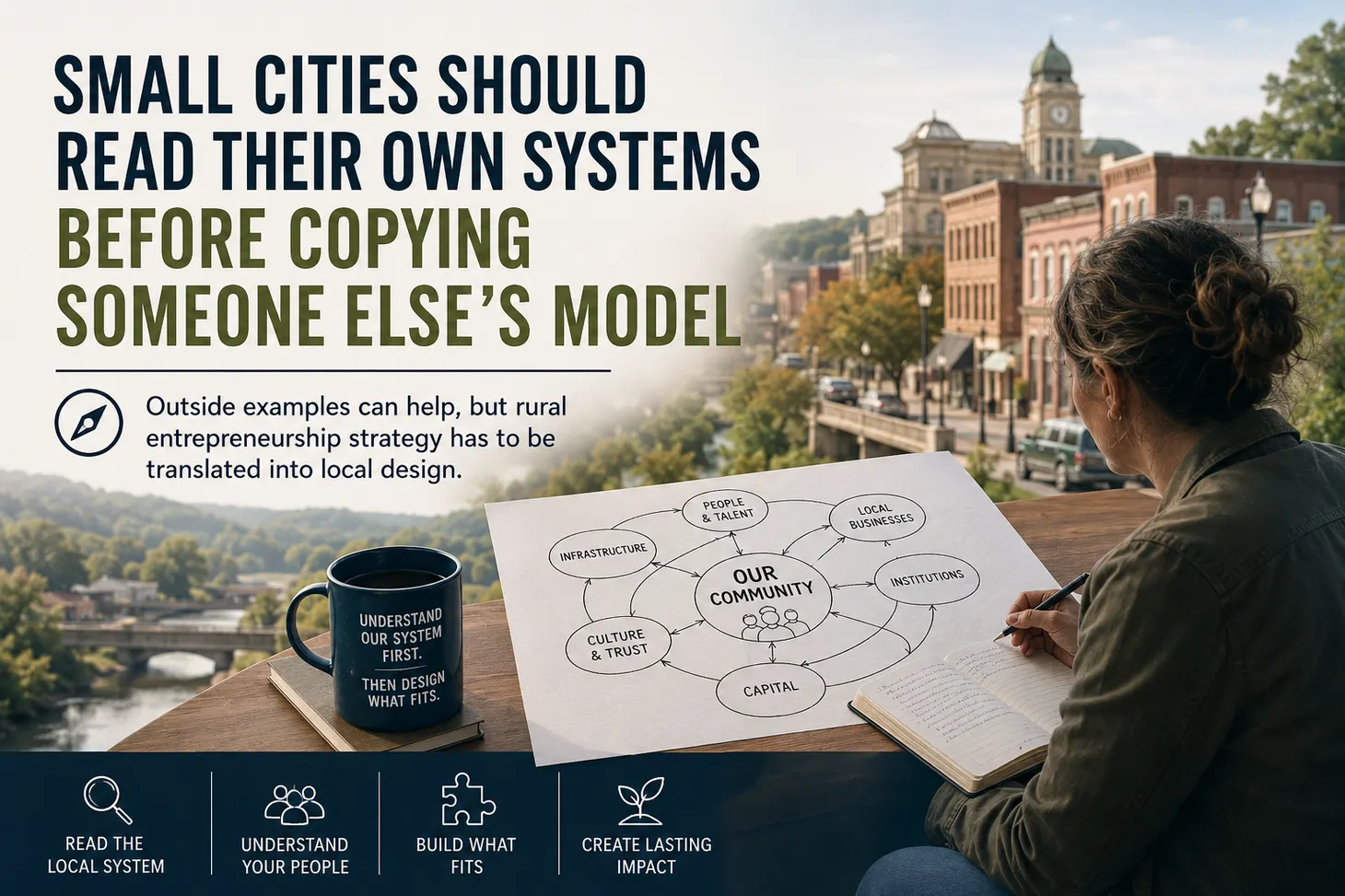
9. Look at economic development problems as interconnected systems.
Transportation can affect housing, childcare, workforce access, tourism, pedestrian safety, business development, and redevelopment. Instead of treating each issue independently, examine how projects and challenges interact across the entire community.
10. Use outside expertise as an extension of your staff.
A small community will never employ specialists in every discipline it needs. Build a network of regional organizations, technical-assistance providers, engineers, grant writers, planners, state agencies, and other experts who can temporarily provide the capacity your organization cannot reasonably maintain internally.

Econ Dev Show Newsletter
Join the newsletter to receive the latest updates in your inbox.