Regions Do Not Compete Globally When They Sound Local and Fragmented
Why regional alignment matters more than another inventory of assets


 Dane Carlson
A region can have every asset on paper and still fail to compete.
That is one of the clearest lessons from Johnna Reeder Kleymeyer’s conversation about Colorado Springs on the Econ Dev Show. The problem is not that most regions lack strengths. Many have plenty. They have major employers, public institutions, military connections, workforce programs, business organizations, elected officials, higher education partners, infrastructure, and sector clusters that look impressive in a boardroom presentation.
But that is not the real test.
The harder question is whether those strengths add up to a case the outside world can understand.
Assets Are Not the Same as a Competitive Story
Colorado Springs is a useful example because its economic development story is not built around one simple advantage. Its position depends on several assets working together: aerospace, defense, advanced manufacturing, a military workforce, institutional leadership, and a more coordinated approach to advocacy. None of those pieces is small. But none of them matters as much alone as they do when they reinforce each other.
That is where many regions fall short. They do not lack assets. They lack coherence.
A company evaluating a market does not experience a region the way local leaders do. It does not care which organization owns which part of the story. It does not care which jurisdiction gets credit. It does not have time to decode overlapping messages from the chamber, the EDC, the city, the county, the workforce board, the airport, the colleges, and every other institution with a stake in the outcome.
From the inside, that fragmentation can feel normal. Everyone has a role. Everyone has a board. Everyone has a mission. Everyone has a reason to speak. From the outside, it feels like uncertainty.
And uncertainty is expensive.
In site selection, a scattered regional message raises quiet questions. Who is actually leading? Which assets are real? Which promises can be delivered? Is this a region with momentum, or just a collection of organizations trying to sound aligned?
Those questions do not always kill a project immediately. They usually do something more subtle and more damaging. They make the region easier to set aside.
Global Competition Requires a Story That Travels
That is why global competition is not just about using global language. A region does not become globally competitive by calling its assets “world-class” or saying it has international reach. It becomes competitive when its strengths are organized into a story that is clear, credible, and useful to decision-makers.
Colorado Springs has a story that travels because the pieces connect. Aerospace and defense are not isolated talking points. They are tied to the region’s military presence, technical workforce, advanced manufacturing base, and institutional ecosystem. The civilian transition story strengthens the workforce argument because it answers a real employer question: where does the talent come from?
That is a much stronger message than simply saying, “We have a great workforce.”
It explains the source of the workforce. It explains the experience that workforce brings. It explains how people move from military service into the private-sector economy. And it helps employers understand why the region has a practical advantage in industries that require discipline, technical skill, and operational seriousness.
That kind of connection matters because it makes the region easier to understand. It also makes the pitch more believable.
Aerospace, defense, and advanced manufacturing are not casual sectors. They require specialized talent, supplier depth, infrastructure, trust, and institutional capacity. A region cannot bluff its way into those markets with generic language about quality of life and available land. It has to show why the industry fits there, why the workforce can support it, and why the region has the leadership capacity to keep building around it.
Leadership Means Making the Story True
That is where economic development leadership becomes more than promotion.
The work is not just telling a better story. It is making sure the story is true enough to hold up under pressure. That means connecting the sector strategy to the workforce strategy. It means making the civilian transition pipeline visible to employers. It means helping institutions understand where they fit in the larger regional case. It means resisting the temptation for every organization to bend the message back toward its own brand.
And sometimes it means narrowing the pitch so the region sounds more focused, not less ambitious.
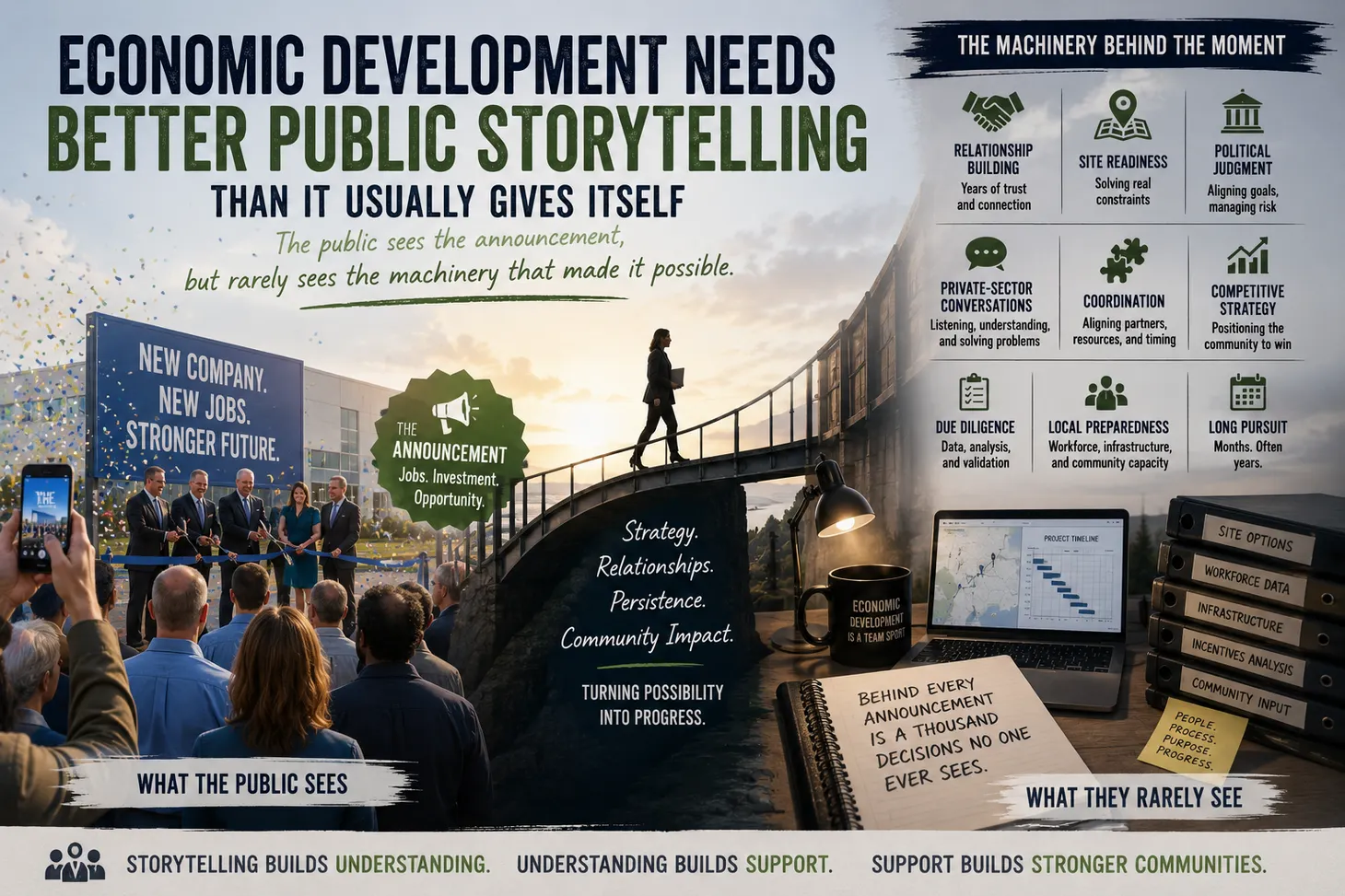
That kind of work is easy to undervalue because it is less visible than a ribbon-cutting or project announcement. Alignment rarely gets a headline. Coordination does not photograph well. A cleaner regional message may not feel like a win inside the room because it often requires institutions to give up some control over the story.
But the market notices.
It notices when a region can explain itself quickly. It notices when the talent story fits the industry story. It notices when public and private institutions seem to be pulling in the same direction. It notices when a prospect does not have to work too hard to understand why a place should be taken seriously.
The opposite is also true. The market notices when a region sounds smaller than it really is.
That is one of the hidden costs of fragmentation. It shrinks the region before anyone ever visits. A place may have real depth in aerospace, defense, or advanced manufacturing, but if those assets are presented as disconnected facts, their competitive value gets diluted. The region becomes a list instead of a case.
A list says, “Here is what we have.”
A case says, “Here is why it matters.”
Economic developers live in that difference. Prospects do not make decisions based on civic pride. They make decisions based on risk, timing, labor, infrastructure, cost, confidence, and execution. A competitive story has to speak to those concerns. It has to reduce confusion. It has to make the next conversation easier.
Workforce Is More Than a Talking Point
Colorado Springs also shows why individual opportunity cannot be treated as a side note.
Global competition can become abstract very quickly. The language turns into clusters, sectors, assets, and strategy. All of that matters. But economic development loses something important when it forgets the people who are supposed to benefit from growth.
Johnna Reeder Kleymeyer’s emphasis on civilian transition keeps the story grounded. It ties the regional pitch to real people moving from military service into new careers. That matters because the workforce story is not just about filling jobs. It is about whether the region can convert its institutional advantages into opportunity for residents and value for employers at the same time.
That makes the economic development case stronger, not softer.
A region that can connect industry growth to individual mobility has a more durable story than one that only talks about recruitment. It can show employers that talent is not an abstraction. It can show residents that growth is not just something happening around them. It can show institutions why coordination matters beyond the next announcement.
The Lesson for Economic Developers
This is the part fragmented regions often miss. They may have the right ingredients, but they keep presenting them in ways that serve internal audiences more than external ones. They talk to each other. They protect their lanes. They preserve familiar habits. Then they wonder why the market does not fully understand what local leaders believe should be obvious.
But competitive positioning is never obvious to outsiders. It has to be built through discipline, repetition, and leadership. It has to be built by deciding what the region wants to be known for and making sure the institutions around that story behave accordingly. It has to be built by turning local assets into a market-facing argument.
Colorado Springs is not a model because every region should copy its sector mix. Most places cannot, and most places should not. The lesson is not “go become Colorado Springs.” The lesson is that institutional assets only become market power when they are connected. Sector strength only becomes competitive advantage when it is legible. Regional leadership only matters when it can turn separate voices into a clear case for growth.
That is the standard for regions that want to compete beyond their own borders.
Not louder messaging. Not more slogans. Not another disconnected inventory of assets.
A region competes globally when the outside world can understand what it is, why it matters, and whether it can move with enough discipline to deliver.
Colorado Springs is working from that premise, and more regions should take it seriously. Because no matter how strong the asset list looks from the inside, regions do not compete globally when they still sound local and fragmented.
Sitehunt Helps Economic Developers Tell a Clearer Site Story
Sitehunt automates industrial site research so economic developers can respond to site selection RFIs in minutes, not days.
Instead of manually chasing GIS layers, property records, infrastructure details, environmental constraints, labor data, transportation access, and site documentation, Sitehunt pulls the pieces together so your team can evaluate sites faster, answer hard questions with more confidence, and present a clearer story to prospects.

Econ Dev Show Newsletter
Join the newsletter to receive the latest updates in your inbox.