What Happens to a Community When It Loses Manufacturing?
A Sugar Land case study on industrial identity, redevelopment, and economic development after the factory leaves

 Dane Carlson
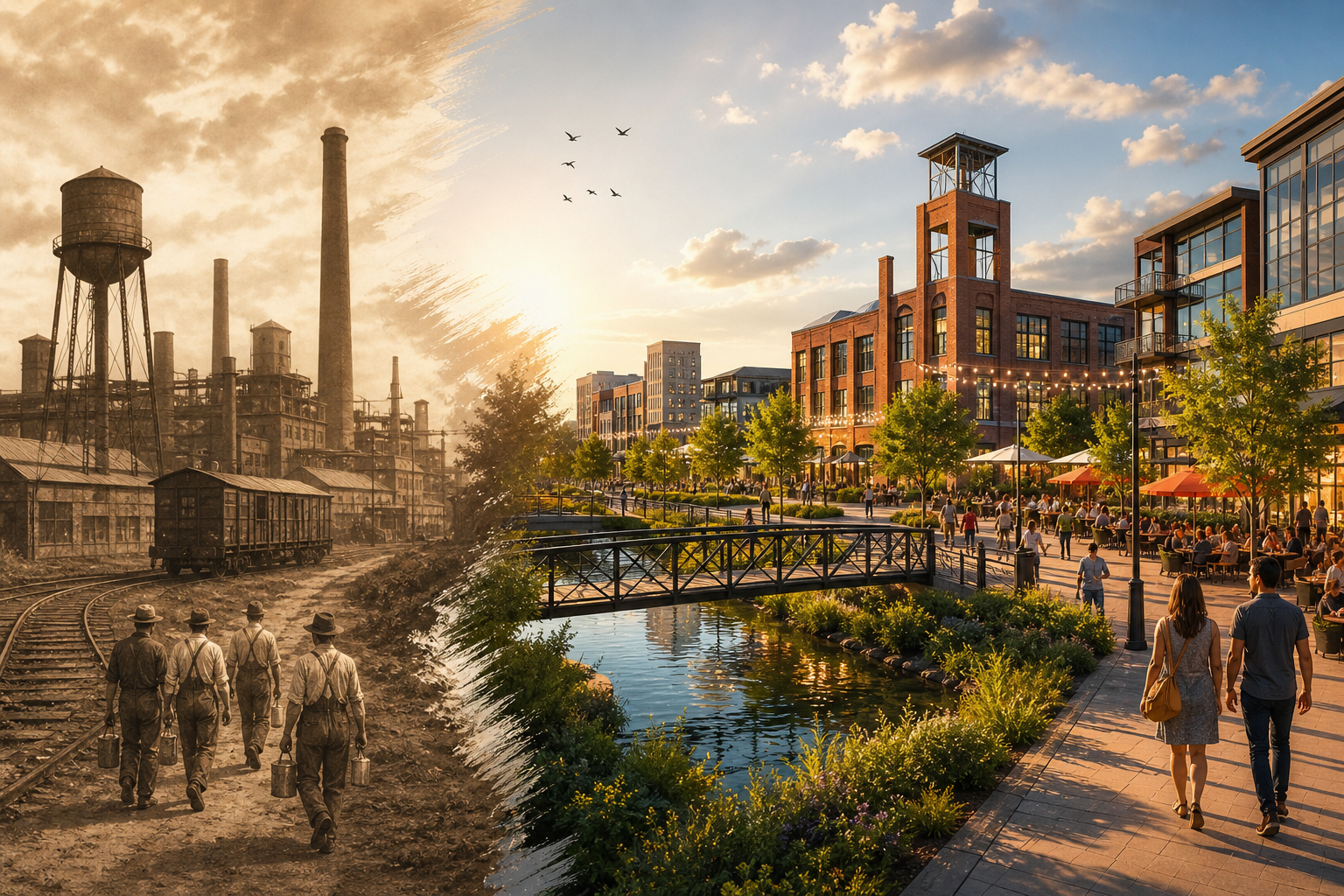
Some communities lose a factory.
Others lose the thing that taught the whole place who it was.
That is what makes Sugar Land worth studying. This is not just a story about Imperial Sugar. It is not just a story about redevelopment, density, historic preservation, or what to do with old buildings.
It is a story about what happens after a community loses the economic engine that gave it shape.
In my conversation with Jessica Huble, Director of Economic Development and Tourism for the City of Sugar Land, that larger lesson kept coming through. Sugar Land’s challenge is specific, but it is also familiar. Many communities have their own version of this story.
A mill that once anchored the town.
A plant that employed generations of the same family.
A refinery, warehouse district, rail-served site, or industrial corridor that once explained why the place existed in the first place.
The names change. The pattern does not.
Economic development becomes harder after that kind of loss because the work is not just replacing jobs. It is replacing coherence.
Sugar Land Was Not Just Near the Mill
Sugar Land’s history makes that pattern unusually clear.
The city did not simply happen to have a sugar refinery. The community grew around Imperial Sugar. For much of its early life, the company did more than operate in the town. It helped organize the town.
According to the City of Sugar Land’s official history, the refinery and surrounding acreage became a model company town, with streets, houses, churches, schools, utilities, and other essential systems built around the needs of workers and their families.
That matters.
Manufacturing, when it is deeply rooted in a place, does more than create payroll. It shapes routines. It shapes land use. It shapes local institutions. It shapes what residents expect from leadership and what outsiders think the place is for.
In a company town, the factory is not just one employer among many. It becomes part of the civic operating system.
That is why the loss feels so disorienting when it comes.
The payroll loss is real. The tax base loss is real. The vacant buildings are real.
But the deeper loss is harder to measure.
A community loses its center of gravity.
The Hardest Part Comes After the Closure
When a major industrial site closes, the first questions are usually practical.
How many jobs were lost? Can they be replaced? What happens to the property? Who owns it now? Can the site be reused?
Those questions matter. Economic developers have to ask them.
But they are not the whole story.
The harder question comes later, after the shock fades and the old site remains:
What is this place now?
That is the question many communities face after manufacturing leaves. The buildings may still stand. The land may still be central. Residents may still remember exactly what the site meant.
But the economic logic that once made everything clear is gone.
That creates a strange civic gap.
Longtime residents see memory.
Developers see land.
Local governments see infrastructure, fiscal sustainability, and public pressure.
Newer residents may see only an underused site in a valuable location.
Everyone is looking at the same place, but not everyone is seeing the same thing.
That is why redevelopment in former manufacturing communities is never just about site reuse. It is about translation.
Manufacturing Loss Is Also an Identity Problem
This is the part many redevelopment conversations still undersell.
Factory loss is not only an economic event. It is a civic turning point.
In a large metro, the closure of one plant may be absorbed into a broader economy. It still hurts, but the region has other centers of gravity.
In a smaller community, the same loss can hit much harder. The plant may have sponsored youth sports. It may have employed multiple generations of the same family. It may have shaped shift changes, traffic patterns, diner rushes, school expectations, and the local idea of what opportunity looks like.
When that disappears, the community does not only ask, “Where will people work?”
It also asks, “Who are we now?”
That question does not fit neatly into a fiscal model, but it still shapes whether redevelopment succeeds.
If leaders ignore the emotional meaning of a place, residents often resist even practical plans. If leaders focus only on memory and avoid economics, the site may sit underused for years while the community waits for a past that is not coming back.
The work is to respect both realities at once.
A place can be emotionally important and economically underperforming.
A site can deserve preservation and still need a second life.
A community can honor what was built there without pretending the old manufacturing model is returning.
Industrial History Cannot Just Become Decoration
Former industrial communities often make one of two mistakes.
Some cling too tightly to the past and treat every change as a betrayal.
Others move too quickly and reduce industrial history to a mural, a logo, or a district name while the new development could belong almost anywhere.
Neither approach is enough.
A former manufacturing site cannot survive on nostalgia alone. But it also should not be erased so completely that the place loses one of its most important civic anchors.
That is the challenge in Sugar Land.
The Imperial Historic District matters not just because it is old land in a good location. It matters because it is one of the places where the city’s identity was formed.
The city acquired the site in 2025 after multiple private-led redevelopment efforts failed, and the official vision for the district emphasizes preserving industrial character while positioning the property for a viable future.
That is a serious move.
It suggests the city understands that old industrial places need more than preservation language. They need a second economic life.
Without one, preservation can become managed decline.
Redevelopment Has to Solve More Than a Site Problem
This is where Sugar Land becomes useful to economic developers far beyond Sugar Land.
The challenge is not simply what to build.
It is how a community adapts when the land that once explained its past now has to help fund its future.
That tension exists all over the country.
A mill closes. A plant downsizes. A warehouse corridor loses its original purpose. A rail-served industrial district empties out. A once-dominant employer becomes memory instead of infrastructure.
Then local leaders are left with the same basic problem:
How do we turn a place built for one economy into an asset for the next one?
That is not easy work.
Old industrial sites can be expensive to reuse. Infrastructure may be outdated. Environmental issues may complicate the deal. The buildings may be meaningful but difficult. The community may want preservation, while the numbers may demand density, mixed-use development, or stronger revenue generation to support municipal services.
This is where economic development strategy becomes more than recruitment.
It becomes translation.
Leaders have to translate memory into design. They have to translate public attachment into a workable redevelopment vision. They have to translate underused land into fiscal sustainability. They have to translate an old industrial identity into a future that still feels local.
That is the work many landlocked cities and smaller industrial communities are facing now.
The Best Communities Do Not Erase the Old Story
The easiest redevelopment path is often the most generic one.
Clear the site. Start over. Build what the market will take. Move on.
Sometimes, some version of that may be necessary. Not every structure can be saved. Not every site can carry its history in the same way.
But communities should be careful before they erase the places that explain them.
Industrial character gives a community texture. It gives residents a shared reference point. It tells outsiders that the place was not accidental.
Something was made there.
People worked there.
Families were supported there.
The city grew around real production, not just rooftops and retail.
That matters, especially now, when every community says it is business-friendly, every region says it offers quality of life, and every redevelopment pitch risks sounding interchangeable.
Former manufacturing communities often have a story with real weight.
The challenge is turning that story into strategy instead of sentiment.
What Other Communities Can Learn From Sugar Land
Sugar Land’s lesson is not that every city should preserve every old factory.
The lesson is that redevelopment should begin with a deeper understanding of what the industrial base actually gave the community.
Not just jobs.
A sense of purpose.
A civic center of gravity.
A shared identity.
A physical pattern.
A reason for people to gather, move, work, and invest in one place.
When that disappears, redevelopment has to answer bigger questions.
What did this site mean?
What does the community still need from it?
What parts of the old identity are worth carrying forward?
What parts of the old economy are gone for good?
What new uses can support municipal services and long-term fiscal sustainability?
How do we build a future that still feels specific to this place?
Those are not soft questions. They are strategic ones.
A redevelopment plan that ignores identity may struggle to earn trust.
A preservation plan that ignores economics may struggle to happen at all.
A strong plan has to do both.
It has to make the site useful again without making it anonymous.
Adaptation Without Amnesia
The real challenge for former manufacturing communities is not choosing between the past and the future.
It is learning how to connect them.
Sugar Land cannot bring back the old company town model. Most communities cannot recreate the industrial economy that built them. The land economics have changed. The labor market has changed. The infrastructure needs have changed. Expectations around density, mobility, amenities, and municipal services have changed.
But that does not mean the past has no role.
The past can guide what should be protected. It can shape design. It can inform community engagement. It can give redevelopment a stronger civic purpose. It can remind leaders that a site is not just a parcel on a map.
It is a piece of the community’s memory.
That is why Jessica Huble’s conversation matters.
Sugar Land is a specific example, but the tension is widely recognizable. Many communities are trying to figure out what comes after the industrial logic that built them.
The ones that handle it best will not only ask, “What can we build here?”
They will ask, “What should this place become now, and how do we make sure people still recognize it when it does?”
That is the harder question.
It is also the more important one.
Former industrial sites, redevelopment properties, and available land all need more than a pin on a map.
Sitehunt helps economic developers turn site data into decision-ready intelligence, so they can understand what a property can support, where it falls short, and how to position it for the right opportunities.
Use Sitehunt to make your sites easier to understand, evaluate, and market.

Econ Dev Show Newsletter
Join the newsletter to receive the latest updates in your inbox.