Why Fast-Growing Regions Need a Product Strategy Before a Recruitment Strategy
A Central Texas case study on product readiness, workforce corridors, and regional economic development strategy.

 Dane Carlson
Economic development strategy breaks down in one predictable place: confusing marketing with readiness.
Fast-growing regions don’t win because they promote better. They win because, when a real project shows up, they are simply easier to say yes to.
That’s the difference.
In markets like Central Texas, demand isn’t the issue. Population growth, location, and sustained interest are already there. The real constraints are quieter and harder to fix: product readiness, infrastructure planning, and whether a region can move with clarity when it matters.
If those break down, growth doesn’t stop.
It just goes somewhere else.
That’s the more useful takeaway from Dane Carlson’s conversation with Mike Kamerlander. Economic development isn’t a lead generation problem. It’s a systems problem, and those systems either hold under pressure or they don’t.
Growth Does Not Fix a Weak Product
Growth can hide operational gaps for a while.
In regions like Central Texas, strong tailwinds create the impression that everything is working. Deals keep coming in. Interest stays high. From the outside, it looks like momentum.
It isn’t.
When inbound demand outpaces site preparation, entitlement clarity, and infrastructure planning, the system starts to leak. Projects stall. Timelines stretch. Credibility erodes.
Quietly at first. Then all at once.
This is where “no product, no project” stops being a phrase and becomes a filter. A hard one. (FYI, "No Product, No Project" is a registered trademark of Garner Economics LLC.)
Companies don’t choose potential. They choose certainty.
If a site is undefined, if infrastructure is unclear, or if approvals are unpredictable, the deal doesn’t slow down and wait for answers. It moves.
Many communities misread this moment. They assume the problem is visibility or messaging. It usually isn’t. The pitch is often fine.
The product behind it isn’t strong enough to survive diligence.
Regional Strategy Only Works If Local Capacity Holds
The Hays Caldwell Economic Development Partnership matters, but not just because it’s regional.
It matters because it works.
A two-county, ten-city partnership reflects how economic activity actually moves. Labor doesn’t stop at city lines, and freight doesn’t respect jurisdictional boundaries, whether governance does or not.
The system is already regional.
But structure alone doesn’t solve anything. Regional strategy only works when local capacity holds underneath it.
Cities and counties aren’t just participants. They’re the primary customer.
If the regional model makes their job easier, alignment strengthens. If it adds friction or obscures value, it breaks. Usually faster than expected.
That’s where most regional efforts go wrong. They build the brand first and assume alignment will follow.
It doesn’t.
Alignment doesn’t follow exposure or messaging or brand awareness.
It follows utility.
When local jurisdictions can see, clearly and practically, how the regional structure expands their capacity, reduces duplication, and improves readiness, the model holds. That’s when a workforce corridor becomes real, not as a map, but as a system tied to land, infrastructure, and movement.
Speed to Market Is Really About Predictability
Speed to market gets talked about constantly.
It’s usually framed the wrong way.
It doesn’t mean rushing decisions or cutting corners to move faster.
It means removing uncertainty.
Companies can plan around a demanding process. They can adjust timelines, allocate resources, and absorb complexity. What they struggle with is unpredictability. Shifting requirements. Unclear approvals. Hidden friction.
That’s what kills momentum.
Predictable processes are part of the product.
A region becomes more competitive when its systems behave consistently, when approvals follow known paths, when information is current, and when stakeholders are working from the same baseline.
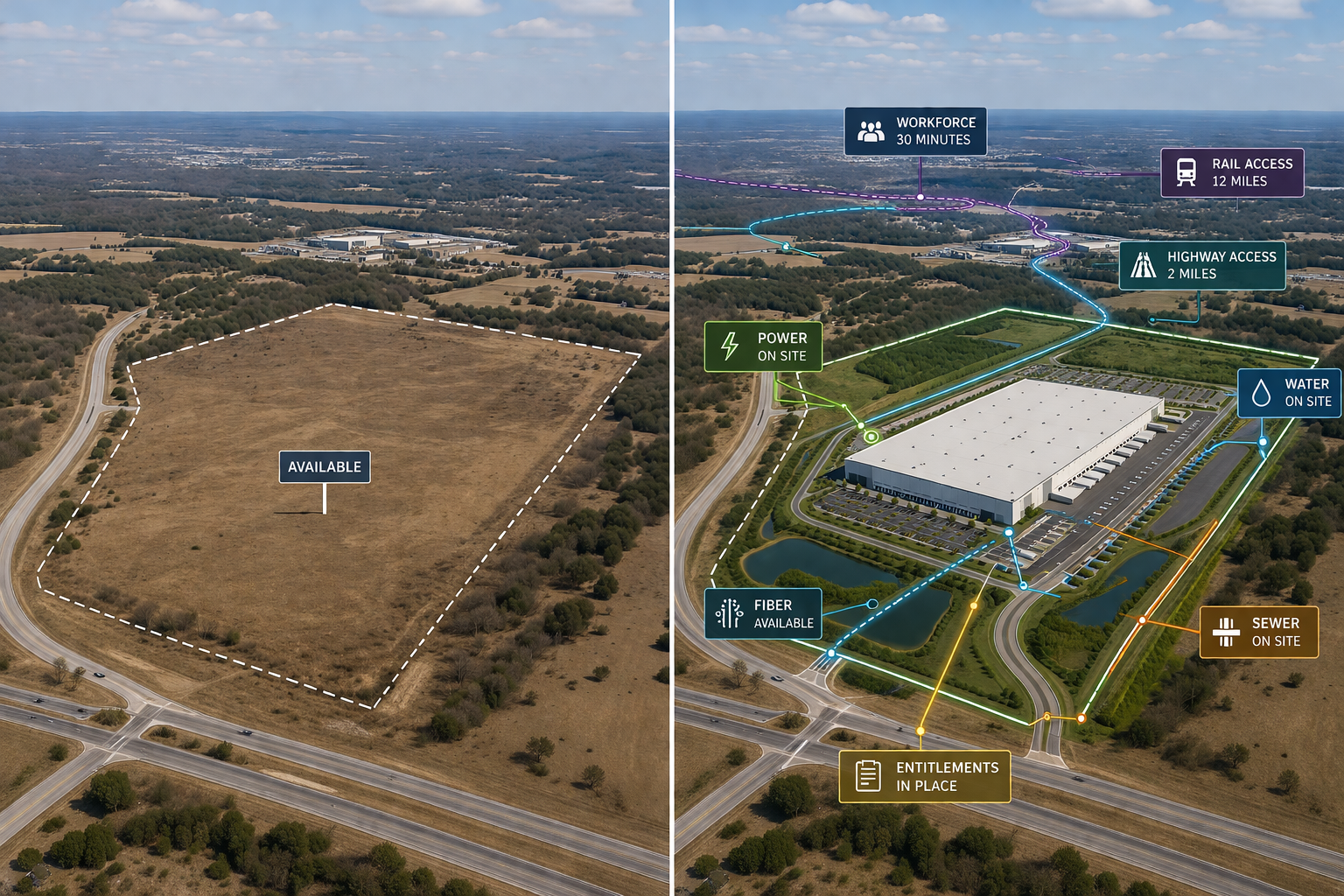
Shovel-ready sites matter for the same reason. They compress uncertainty. They reduce the number of variables that can derail a project between interest and execution.
Readiness isn’t separate from attraction strategy. It is the attraction strategy.
Economic Outlook Events Should Do More Than Signal
Most economic outlook events are presentations.
They don’t need to be.
In fact, that’s probably the least useful version of them.
Used well, they can function as coordination tools.
Mike Kamerlander points to a more practical approach. Bring public and private actors into the same room, not just to share information, but to test assumptions, compare signals, and identify gaps before they turn into constraints.
In high-growth regions, that matters more than it seems.
Momentum can mask problems. Everything looks strong until infrastructure lags, site inventory tightens, or jurisdictions start operating from different expectations. By the time those issues show up in deals, it’s already too late.
A well-run event changes that.
It becomes a working session. A place to align on what needs to be fixed next, not just what has already happened.
Attention turns into action.
The Real Constraint Is Coordination
The constraint isn’t marketing.
It’s coordination.
Product readiness depends on land, infrastructure, entitlements, and data all lining up at the same time, in the same place, with the same level of clarity.
That’s hard to do.
Regional economic development depends on multiple jurisdictions moving in the same direction without losing local clarity. Speed to market depends on processes behaving consistently across the system.
When those elements drift, performance drops, even in strong markets.
When they align, something different happens.
Regions become easier to work with.
And that’s what companies actually select for. Not just incentives or workforce or location, but clarity. The sense that the path forward is visible and dependable.
Applying This in Your Own Region
The goal isn’t to replicate Central Texas. The structure is specific. The principle isn’t.
Start with this: are you treating product readiness as a side function or the core strategy?
Then look at your regional model. Does it create clarity for your cities and counties, or does it make their job harder?
And your workforce corridor, is it reflected in real decisions about land, infrastructure, and transportation, or does it only exist in the messaging?
Finally, when a project actually begins, are your shovel-ready sites predictable under pressure, or do questions start to surface that should have already been answered?
These aren’t branding questions.
They’re system questions.
And systems either support growth, or they quietly limit it.
Build the Product First
The strongest regions don’t rely on perfect timing or better storytelling.
They reduce friction. They make decisions easier. They build environments where projects can move forward without unnecessary uncertainty.
That’s what Central Texas is getting right. Not perfectly, but directionally. Product readiness, infrastructure planning, predictable processes, and regional coordination are being treated as connected problems, not separate initiatives.
That’s the shift.
Build the product first.
Then, when the market shows up, let it find you ready.
For teams trying to keep site data, infrastructure details, and process clarity aligned across multiple jurisdictions, Sitehunt helps reduce friction before it shows up in a deal.

Econ Dev Show Newsletter
Join the newsletter to receive the latest updates in your inbox.