Skip to content

13 Things Economic Developers Need to Know This Week

The stories Dane thinks you need to see. July 23, 2026 edition.

Dane Carlson
Dane Carlson
6 min read
13 Things Economic Developers Need to Know This Week

Welcome to this week's issue of What Economic Developers Need to Know This Week, where we explore the evolving dynamics of our economy.

This week we have 13 tools, stories, graphics, charts and videos that I think you'll find informative, useful, inspiring, and perhaps even humorous. Some are economic development related directly, and some only indirectly.

If you're wondering what to do with the info in this newsletter, send something to your board members. It will make you look good!


Today's email is brought to you by Resource Development Group

Founded in 1995, RDG offers customized economic development fundraising solutions exclusively for Chambers of Commerce and Economic Development Organizations. That’s their niche. That’s their specialty.

Their highly experienced team has raised over $2 billion -- yes, that’s $2 billion with a “B” -- for communities of all sizes and organizations just like yours.

Every community is unique. Tulsa, OK, is not Maury County, TN. Atlanta, GA is not Detroit, MI. Chattanooga, TN is not Charlottesville, VA. Don’t use another community’s fundraising playbook and expect the same results!

RDG's experts excel in providing customized economic development fundraising solutions for every situation. So whether you’re a single county EDO ready to kick off your first fundraising campaign or a large regional organization on your third funding cycle, they have the team and experience to get you the results you’re looking for.

Learn More

1) Economic development and developers in the news #253: The national headlines become real projects, policies, and personnel decisions at the local level. This week's Economic Development and Developers in the News follows 51 executives and organizations across 24 states. Among the stories: Alabama awarded $2.3 million to ready a 230-acre industrial site, Connecticut opened a $25 million brownfield round, Arizona landed another $100 billion from TSMC, and communities in Maryland and New York are reconsidering data-center rules.

Economic Development and Developers in the News #253

2) Podcast 228, capital is not the bottleneck: Another venture fund will not fix an ecosystem that lacks customers, coaching, or consequential problems to solve. In Capital Is Not the Bottleneck with Liz Maxwell, Liz describes a healthy venture ecosystem as the interaction of talent, capital, customers, and meaningful problems. Her warning is to look beneath pitch events and accelerators at the connective work that helps founders win customers, raise money, grow revenue, and create jobs.

Podcast 228: Capital Is Not the Bottleneck with Liz Maxwell

3) 52 new economic development jobs this week: The list is a useful snapshot of how broad the profession has become. The latest economic development jobs list spans 29 states and salaries from $52,000 to $280,000. It ranges from specialists and city directors to a chamber president and CEO, with roles in housing, finance, utilities, transportation, innovation, data centers, and AWS economic development.

52 New Economic Development Jobs This Week

Sitehunt helps economic developers find and understand their sites, match them to projects, and respond with confidence in minutes instead of scrambling for days.

Learn More

4) When you cannot outspend the competition, outthink it: Scarcity can force the strategic discipline that larger incentive budgets sometimes allow communities to skip. Jim Gibson argues that a smaller market can invest in quality of life, schools, talent, and entrepreneurship instead of joining every incentive bidding contest. He also describes controlling industrial land through a partnership rather than purchasing it. The larger lesson is that communities that cannot afford sloppy deals often become better at diligence, creativity, and saying no.


5) Audit the startup ecosystem before launching another accelerator: Too many places prescribe a program before identifying the problem. Paul O'Brien's AUDIT framework moves in sequence from awareness and understanding to diagnosis, insight, and transformation. His test is whether all the visible activity actually produces founders who reach revenue, locally recirculating capital, and mentors with startup experience. If it does not, another pitch event or innovation hub may reinforce the strong parts while leaving the structural gap untouched.


6) Four free frameworks for power, sites, and AI governance: The useful part is not the advice, but the questions each paper teaches an EDO to ask. Drawing on more than 15 years and $8 billion in advised investment, Hyphen Strategies' resource library covers AI governance, utility interconnection, industrial location decisions, and certified-site readiness. The common method is validation: test power claims, inventory AI exposure, eliminate fatal site flaws early, and build competitive intelligence even without a megasite budget.


7) Only 53% of U.S. adults own their home: The familiar 65% homeownership rate measures housing units, not people. The Minneapolis Fed's new homeowners-to-population ratio counts adult owners instead. It finds that 13.9% of adults live in an owner-occupied home they do not own, and that the apparent 37% homeownership rate for households headed by someone under 35 falls to 22% when all young adults are counted. The Washington Post's explanation makes the policy consequence plain: adults are about as likely to rent or live in someone else's home as they are to own one.


8) Boomers were supposed to downsize, but some are buying bigger homes: Housing demand follows how people want to live, not a tidy demographic script. The Wall Street Journal opens with empty nesters who moved from a home under 2,000 square feet into the 5,000-square-foot house next door. They renovated it for family gatherings, seven grandchildren, and aging in place, including a more accessible bathtub. For communities counting on older owners to release family-sized houses, the example is a warning to plan for accessible and multigenerational supply as well as turnover.


9) Nuclear power is set to ramp up over the next decade: The buildout is real, but almost all of it still uses conventional large reactors. BloombergNEF forecasts global capacity will grow 44%, from 372 gigawatts in 2025 to 535 gigawatts by 2036. Canary Media reports that 76 reactors totaling 83 gigawatts were under construction in the first half of 2026, with nearly half in China. The U.S. has two advanced reactors underway and a possible Michigan restart; the test is whether this generation can control the cost overruns and missed deadlines that stalled the last one.

Nuclear power is set to ramp up over the next decade

10) The data-center land rush is creating a new class of rural multimillionaires: The new value of farmland is sometimes the power system beside it. The Wall Street Journal profiles a Pennsylvania family whose 89-acre farm sold for $22 million. Across Salem Township, 96 families sold roughly 1,700 acres to QTS for $586 million. MUFG's map of operating and planned U.S. sites shows why the pressure is spreading: planned capacity is clustering in Texas, Arizona, Louisiana, the Midwest, and secondary eastern markets, not only Northern Virginia.

Operating and planned U.S. data center sites

11) A worker-starved factory found 900 people by offering flexible shifts: The labor shortage eased when the company changed the job instead of asking workers to change their lives. At GE Appliances' Georgia plant, NPR found an app-based pool of more than 900 people who choose four-hour shifts and, in some cases, their tasks. Roughly 450 work in a typical week, averaging 24 hours, and their labor helped support a $180 million expansion that added 600 jobs. The tradeoff is real, lower pay and few benefits, but the model attracts retirees, caregivers, gig workers, and experienced employees who might otherwise leave.


12) AI was supposed to take your job. Why hasn't it?: Automation has historically erased far fewer occupations than the forecasts suggest. The Maxinomics video says that among the job titles tracked by the U.S. Census over the past 60 years, only one was fully eliminated by automation. ATMs changed banking, autopilot changed aviation, and spreadsheets changed accounting, but cheaper output also expanded demand and created new work. Citing research that 60% of today's jobs did not exist in 1940, the video reframes the workforce question from which jobs disappear to which tasks change and which new markets become possible.


13) Punctuation has become a generational dialect: Online, marks that once organized sentences now carry tone, irony, and social identity. Judith Shulevitz traces the shift from periods that end thoughts to periods that can read as passive-aggressive, and from correct punctuation to correctness used as irony. Her larger point is that every channel now demands its own tiny adjustments, from texting family to messaging colleagues to posting publicly. For EDOs speaking to boards, employers, residents, and students, grammar alone no longer guarantees that the same sentence lands the same way.


🫶
The Econ Dev Show is a product of Sitehunt, and is made possible by our Econ Dev Pro members (join now) and sponsors: Convergence CRM/Tom Wengler, Econ Dev Ops, Econ Dev Tools, Join an Economic Development LinkedIn Boost Group, and Resource Development Group. (Become a sponsor.)

Related Posts

Members Public

Economic Development and Developers in the News # 253

Econ dev news from 51 economic development executives and organizations in 24 states.

Economic Development and Developers in the News # 253
Members Public

Podcast 228: Capital Is Not the Bottleneck with Liz Maxwell

Why customers may matter more than another venture fund

Podcast 228: Capital Is Not the Bottleneck with Liz Maxwell
Members Public

52 New Economic Development Jobs This Week

In 29 states, from $52,000 - $280,000

52 New Economic Development Jobs This Week
Members Public

The Beautiful Game, the Brutal Business

Years of invisible work, one brutal public scoreboard.

The Beautiful Game, the Brutal Business
Members Public

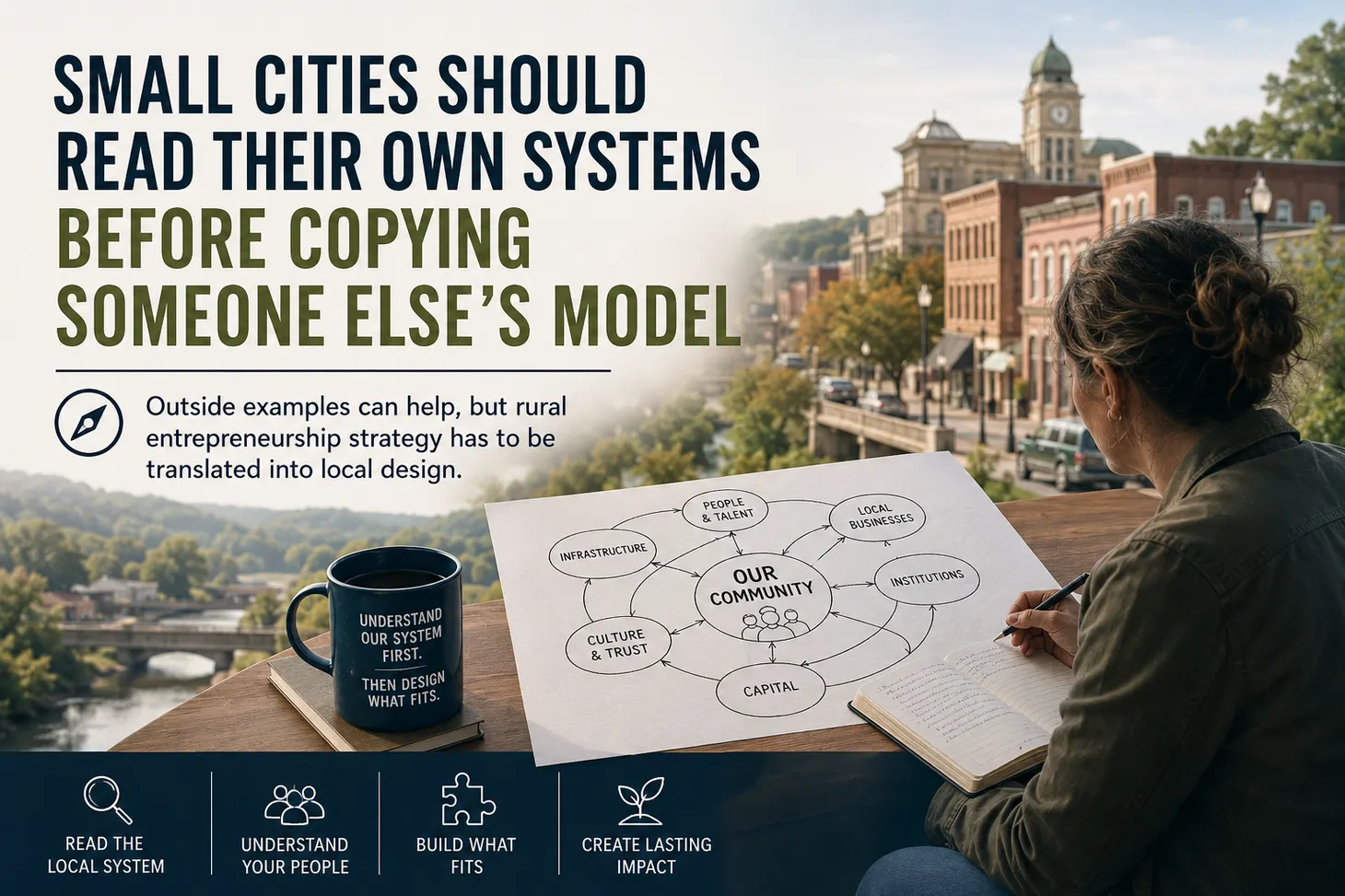
Small Cities Should Read Their Own Systems Before Copying Someone Else's Model

Outside examples can help, but rural entrepreneurship strategy has to be translated into local design.
Small Cities Should Read Their Own Systems Before Copying Someone Else's Model