14 Things Economic Developers Need to Know This Week
The stories Dane thinks you need to see. July 30, 2026 edition.

Welcome to this week's issue of What Economic Developers Need to Know This Week, where we explore the evolving dynamics of our economy.
This week we have 14 tools, stories, graphics, charts and videos that I think you'll find informative, useful, inspiring, and perhaps even humorous. Some are economic development related directly, and some only indirectly.
If you're wondering what to do with the info in this newsletter, send something to your board members. It will make you look good!
Today's email is brought to you by Resource Development Group
Resource Development Group and Convergent Nonprofit Solutions have recently announced a merger of these two well respected firms. RDG is now operating as Resource Development Group, a Convergent Company and will lead the combined operations in economic development and chamber engagements. Meanwhile, the Convergent banner will take the forefront on efforts on supporting traditional philanthropic and higher education organizations
This merger maintains RDG's innovative and custom approach while also creating the deepest bench of economic development and chamber fundraising expertise in the industry, the most complete data set in the country regarding economic development and chamber funding, and the greatest flexibility to be able to support engagement models tailored specifically to every market, regardless of size.
Whether you’re a single county EDO ready to kick off your first fundraising campaign or a large regional organization on your third funding cycle, they have the team and experience to get you the results you’re looking for.
1) Economic development and developers in the news #254: This week's headlines make the profession's range impossible to miss. The latest Economic Development and Developers in the News follows 54 executives and organizations across 25 states.
2) The five contradictions of economic development: The best practitioners learn to do two opposing things at once. After more than 500 conversations, I keep finding the same five tensions: move faster and take the long view; compete harder and partner more deeply; use more technology and become more human; tell a simpler story and do more complicated work; chase wins and study losses. You do not solve these contradictions once. You manage them every day.

3) Podcast 229, how Monterey Bay became an advanced air mobility hub: Monterey Bay did not wait for one giant asset to make it an aviation hub. In my conversation with Lavera Alexander, she explains how the region connected four public-use airports with manufacturers, research institutions, workforce partners, and community leaders to create a coordinated flight network. The playbook is practical: organize before funding appears, explain the public benefit early, face infrastructure gaps honestly, and tie certification pathways to high-paying jobs that do not require a four-year degree.
4) 23 new economic development jobs this week: This hiring list is a field guide to what communities need now. The 23 openings span 17 states, with published salaries from $39,461 to $307,769.

Sitehunt helps economic developers find and understand their sites, match them to projects, and respond with confidence in minutes instead of scrambling for days.
5) What is under your feet in New York City?: New York's biggest competitive advantage may be the infrastructure most people never see. Practical Engineering's illustrated tour and companion video descend through water mains, electrical networks, steam, gas, telecommunications, sewers, subways, and deep water tunnels. Roughly 85% of the city's electrical lines are underground. Manhattan's steam network serves about 1,500 customers, and more than 900 sampling stations test water at the distribution edge. A site's real value depends on the capacity below it, and on whether anyone has mapped and maintained that capacity.
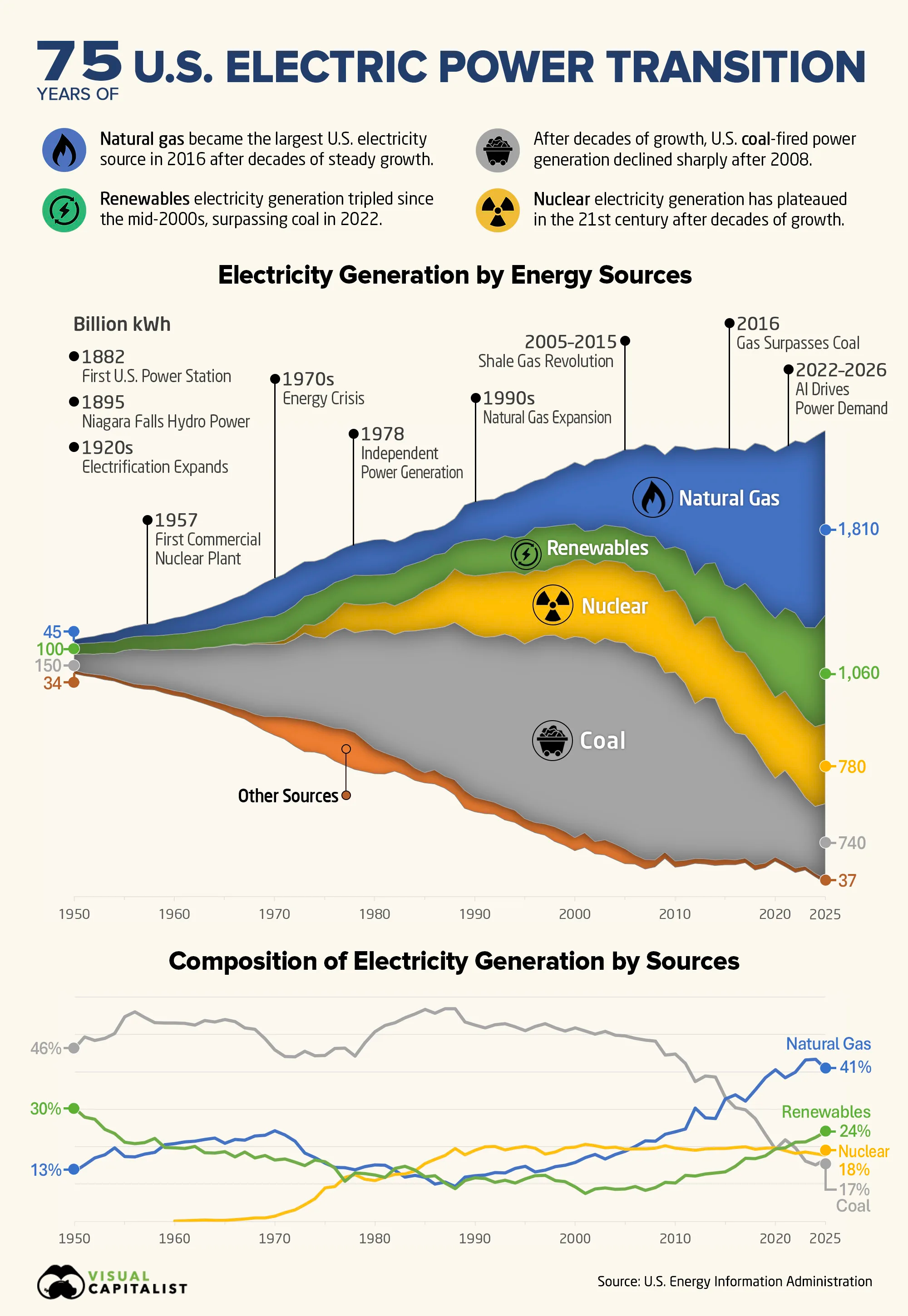
6) Seventy-five years of America's electricity transition: For site selectors, the national energy transition matters less than the power available at a specific meter. The long view of U.S. electricity generation shows natural gas becoming the largest source in 2016 and supplying 41% of generation in 2025. Renewables tripled from the mid-2000s, passed coal in 2022, and reached 24%. Nuclear held 18%, while coal fell to 17%. The winning community will know its local generation mix, transmission limits, interconnection queue, and path to new firm capacity.
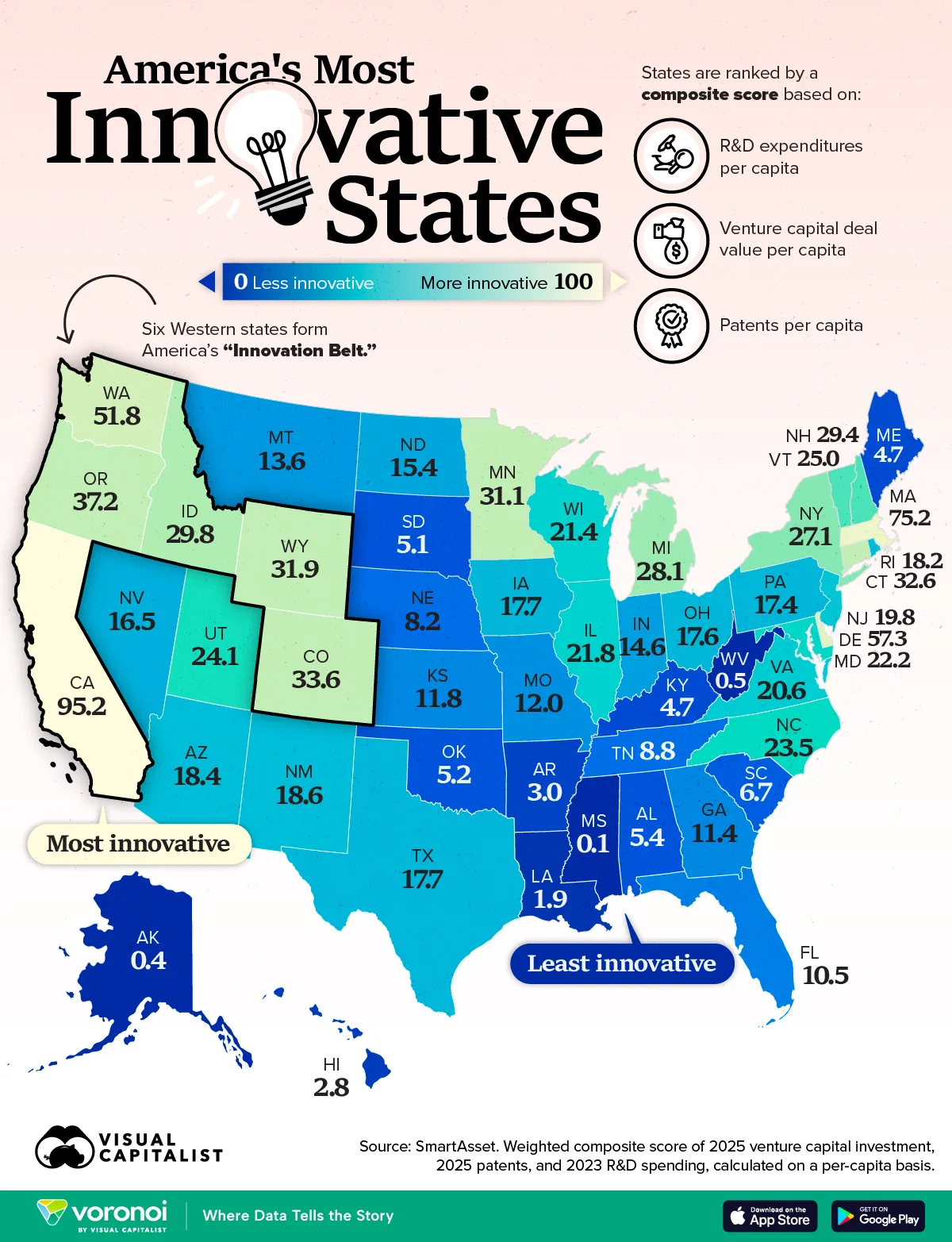
7) Where innovation is thriving across America: A ranking earns its keep when it shows what is missing. This 50-state ranking combines patents per capita in 2025, venture capital deal value per capita in 2025, and research spending per capita in 2023.
8) The best cities for engineers are not simply the places with the most jobs: Engineers stay where they can advance without shrinking the rest of their lives. A new Livability and Chmura analysis ranks cities of 50,000 to 500,000 people on opportunity, cost-adjusted earnings, growth and demand, and career acceleration. The regional profiles connect those measures to real clusters: defense electronics in Nashua, steel and process engineering in Middletown, aerospace communications in Palm Bay, and robotics and automation in Waltham and Rochester Hills. That is a better talent pitch than jobs plus amenities: come here, grow here, and do not have to move again.
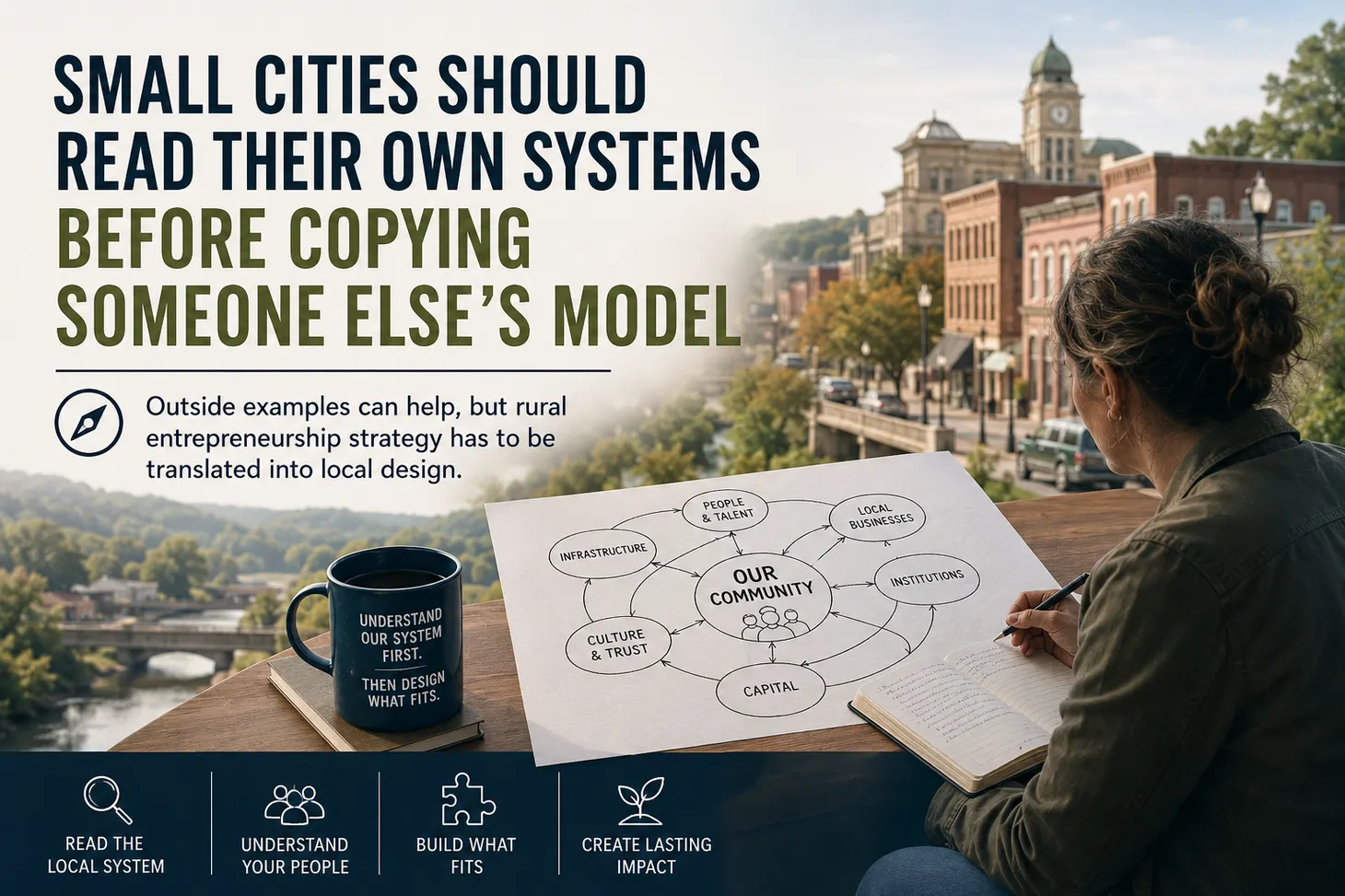
9) Stop teaching entrepreneurship as a business-plan class: If a program teaches pitch decks instead of judgment under uncertainty, it is teaching business, not entrepreneurship. Paul O'Brien argues that schools often teach either ordinary business or a Silicon Valley startup framework, then call it entrepreneurship. His alternative separates founders, who need hands-on incubators, from three educational tracks: understanding entrepreneurship, working inside entrepreneurial environments, and supporting entrepreneurs through policy, finance, law, health, research, or teaching.
11) It was never about the stadium: Stadium deals deserve the same discipline as any other incentive package. Sam Blatt notes that roughly 62 major-league stadiums and arenas will be at least 30 years old by 2030, putting communities inside another redevelopment cycle. His case for demanding more calls for specific community-benefit agreements, independent analysis of what the land could produce without the project, meaningful penalties, clawbacks, and a financing structure that returns value beyond the stadium footprint. Civic pride is real. It is not a substitute for enforceable public returns.
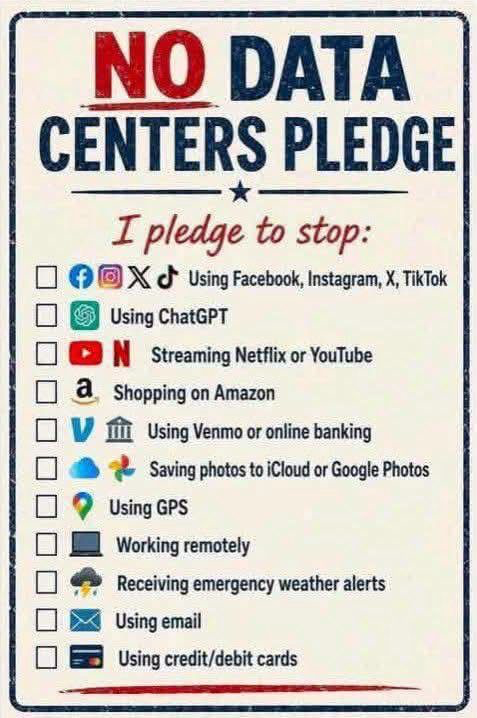
12) A data-center meme is not a public-engagement strategy: Dependence on data centers does not cancel a community's right to scrutinize them. Kelly Forbes shares a "No Data Centers Pledge" that asks opponents to give up social media, streaming, online shopping, banking, and AI. The meme makes our digital dependence vivid. The discussion beneath it makes the better point: residents can use those services and still question land use, power and water demand, tax treatment, noise, and local benefits. Economic developers need answers, not a gotcha.
13) Twenty-four charts for understanding the first half of 2026: These charts matter most where the stories conflict. Grant Varner's midyear collection moves across labor, housing, careers, technology, and culture. It puts a strong stock market beside weak consumer sentiment, rising millennial wealth beside homeownership that feels out of reach, and hiring at AI-heavy firms beside a broader market that is punishing young workers. Treat those tensions as hypotheses, not final answers. Use the collection to ask which national story actually describes your residents.
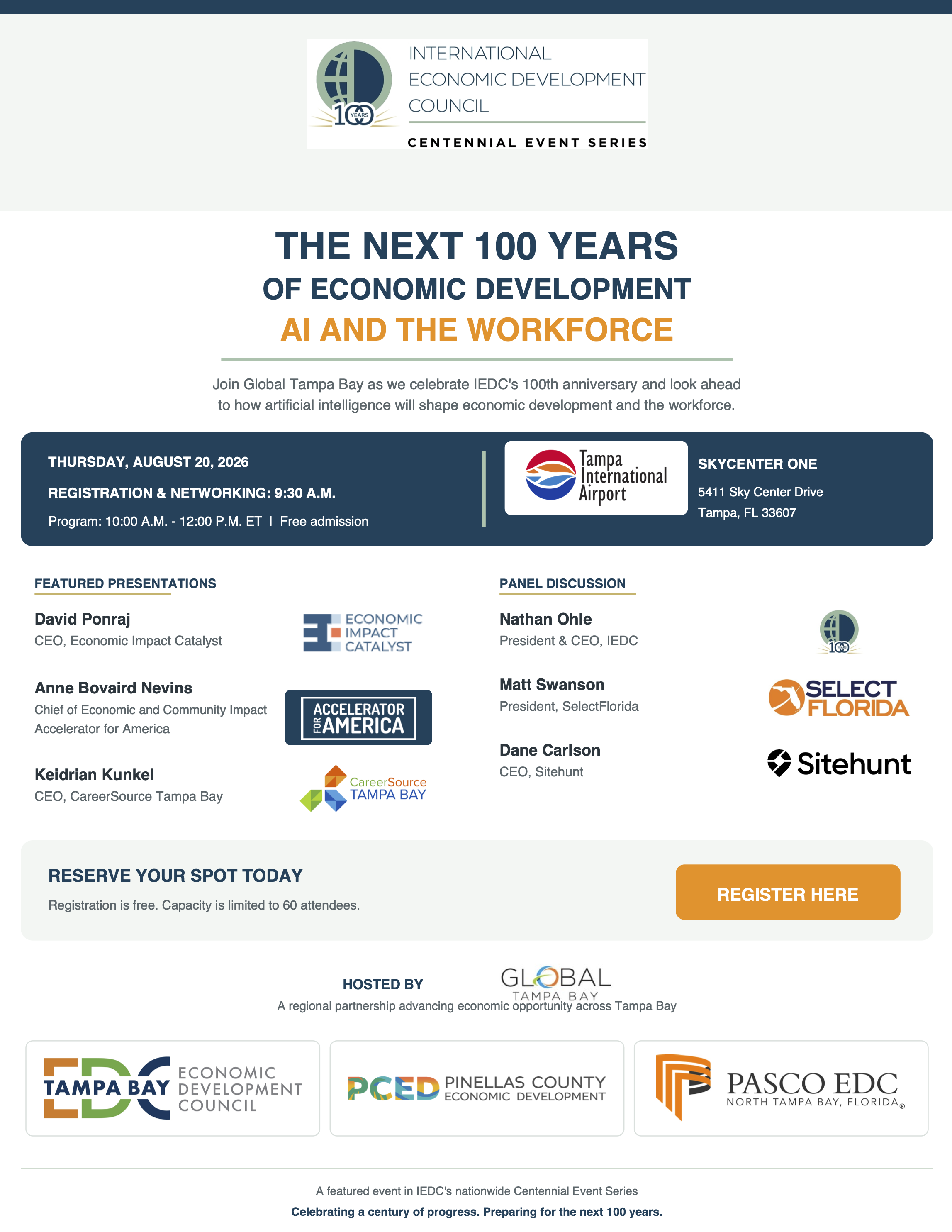
14) The next 100 years of economic development, AI and the workforce: The AI workforce debate is becoming a question of institutions, not just automation. On August 20, I will join Nathan Ohle of IEDC and Matt Swanson of SelectFlorida for a free panel at SkyCenter One at Tampa International Airport. The Centennial Event also includes David Ponraj, Anne Bovaird Nevins, and Keidrian Kunkel, along with regional partners from across Tampa Bay. If you are nearby, here's the registration link.