24 Things Economic Developers Need to Know This Week
The stories Dane thinks you need to see. September 17, 2026 edition.

Welcome to this week's issue of What Economic Developers Need to Know This Week, where we explore the evolving dynamics of our economy.
This week we have 24 tools, stories, graphics, charts and videos that I think you'll find informative, useful, inspiring, and perhaps even humorous. Some are economic development related directly, and some only indirectly.
If you're wondering what to do with the info in this newsletter, send something to your board members. It will make you look good!
Today's email is brought to you by Resource Development Group
Resource Development Group and Convergent Nonprofit Solutions have recently announced a merger of these two well respected firms. RDG is now operating as Resource Development Group, a Convergent Company and will lead the combined operations in economic development and chamber engagements. Meanwhile, the Convergent banner will take the forefront on efforts on supporting traditional philanthropic and higher education organizations
This merger maintains RDG's innovative and custom approach while also creating the deepest bench of economic development and chamber fundraising expertise in the industry, the most complete data set in the country regarding economic development and chamber funding, and the greatest flexibility to be able to support engagement models tailored specifically to every market, regardless of size.
Whether you’re a single county EDO ready to kick off your first fundraising campaign or a large regional organization on your third funding cycle, they have the team and experience to get you the results you’re looking for.
Join us for EconDevCamp 2026 in New Orleans

Sitehunt is proud to support the third annual EconDevCamp on October 25, 2026, in New Orleans, just before the IEDC Annual Conference.
This collaborative “unconference” brings together economic developers, entrepreneurship support organizations, and small-business champions for lunch and candid, participant-led conversations about the field’s most relevant challenges and opportunities. No panels. No fluff. Just real discussions and practical ideas you can bring home.
Sitehunt members can receive 50% off registration with code SITEHUNT. Learn more and register at EconDevCamp.com.
1) Economic development and developers in the news #260: Find someone working on the problem you are trying to solve. The latest roundup brings together news from 58 economic development executives and organizations in 27 states. It is a useful place to spot an idea, a potential partner, or a peer worth calling.

2) A look at who is hiring: Your next colleague may be looking for their next community. The September 11 jobs roundup collected 65 opportunities across 29 states, with listed salaries reaching $256,000. Share it with someone ready for a move, or use it to see how other organizations describe the work and price their positions.

3) Catch up on last week's issue: Keep the useful ideas within reach. The September 10 edition collected 26 stories and charts on essential retail, startup support, infrastructure, housing, workforce, AI, and trade. There is plenty in it for your next board packet or conversation with a local employer.

Sitehunt helps economic developers find, understand, enrich and market their sites, match them to projects, and respond with confidence in minutes instead of scrambling for days.
4) Learn the field from the people doing the work: Experienced peers can help you find your footing in a profession with many specialties. In a video shared by Jackson Petr, Kyle Buckley of St. Tammany Economic Development Corporation talks about learning from other practitioners, the growing Gulf South Commerce Park, and the satisfaction of creating opportunities for his community.
5) A good idea needs a funding mechanism: Agreeing that economic development matters does not pay for the work. Grant Taylor compares Texas and New Mexico, tracing decades of discussion about dedicated local funding. His argument is about follow-through: communities need a dependable way to turn an adopted strategy into projects, staff capacity, and sustained effort.
6) Three jobs for a startup strategy: Policy, programs, and promotion need to reinforce one another. Paul O'Brien's latest essay argues for programs built around regional strengths and promotion that includes founders your organization never funded. A practical test: can an entrepreneur find the right expertise, customers, and capital across the whole region, or only navigate your program calendar?
7) Look beyond the downtown innovation district: Your region's productive network may cross several city limits. In a Central Texas case study, O'Brien looks at Round Rock, Cedar Park, Georgetown, and Taylor to challenge the assumption that innovation belongs in the urban core. Map the employers, founders, suppliers, and training institutions already doing the work before deciding where the next hub should go.
8) Nashville's next act could reach beyond music: The next industry you recruit may already share your community's talent. Richard Florida connects Nashville's music roots to its media potential, following reporting that Paramount is seeking roughly 400,000 square feet of office space there. No move has been announced. Start with the skills, suppliers, and relationships your community already has, then ask: who else needs them?
9) A quarter point can change the project math: A great site still needs a workable financing plan. The Fed raised its benchmark target range to 3.75% to 4.00% on September 16, citing elevated inflation. For your next developer or lender call, ask what the change does to the financing gap, the contingency budget, and the construction timeline. A project that depends on cheaper money deserves another look.
10) Get the project into the financing pipeline early: Knowing an incentive exists is only the beginning. Thane Hutcheson's overview of Wisconsin's new state New Markets Tax Credit program explains its separate rural and metro allocation pools and the role of community development entities in selecting projects. His practical advice is to build those relationships before the next allocation round opens.
11) Manufacturers need help putting new technology to work: The support network matters as much as the equipment. Genelle Taylor Kumpe raises concerns about California's manufacturing-assistance gap. NIST's new MEP awards will support technology adoption in 11 states and Puerto Rico, while California and Alaska await another competition. It is a useful prompt for business visits: who helps your smaller manufacturers turn an automation plan into a working process?
12) Put the data-center promises in writing: The agreement needs to work after the groundbreaking. Mark Cuban's checklist for towns considering a data center calls for independent advisers, measurable water and noise limits, and financial backing for infrastructure and eventual closure. The useful question for each promise: who checks it, who pays, and what happens if it is broken?
13) Some cities finish building before others finish permitting: Time belongs on the housing dashboard. Research by Leonardo D'Amico, Evan Soltas, and Audrey Wang, summarized by Soltas, compares standardized housing projects using records from 60 U.S. cities. The differences are striking: faster cities can complete projects while slower ones are still reviewing permits. Track the time from application to approval alongside the number of approvals.
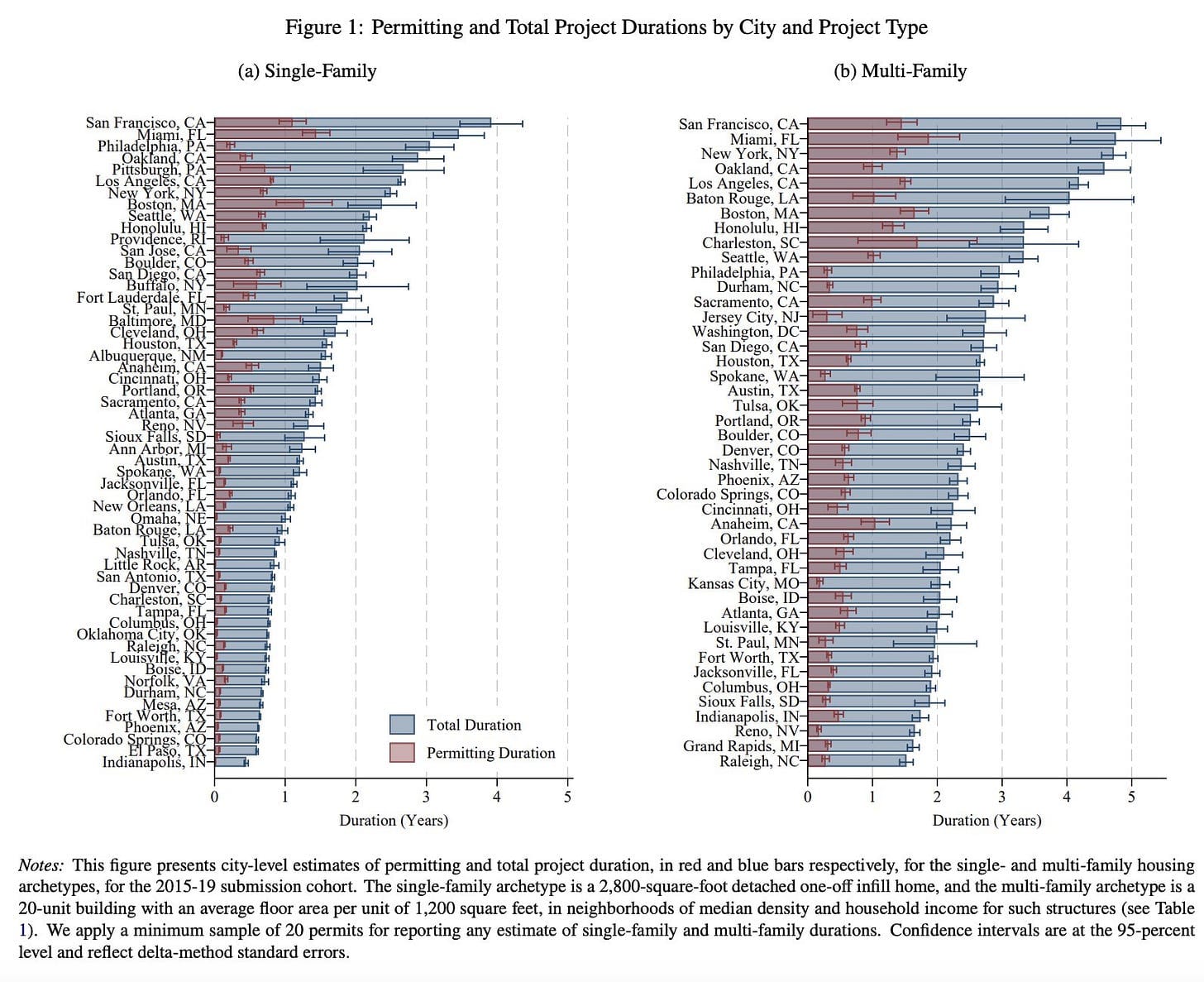
Chart: D'Amico, Soltas, and Wang, reproduced in Construction Physics. Compares standardized projects submitted in 2015 to 2019; these are adjusted estimates, not current turnaround guarantees.
14) Where construction automation actually works: Repetition and predictable conditions matter more than a flashy robot. Brian Potter's historical review finds the strongest track record in factory production and repetitive on-site tasks such as paving and curb forming. For communities pursuing faster housing delivery, the opportunity may be in component manufacturers, production methods, and skilled operators as much as in a new building technology.
15) Follow the investment behind the AI boom: Data centers are reshaping the competition for capital and power. This ranking of announced greenfield foreign investment puts communications first at $139.3 billion in the first half of 2026, with data centers accounting for more than 94% of that total. These are project commitments, not completed facilities; the associated energy and supplier demand deserves attention too.
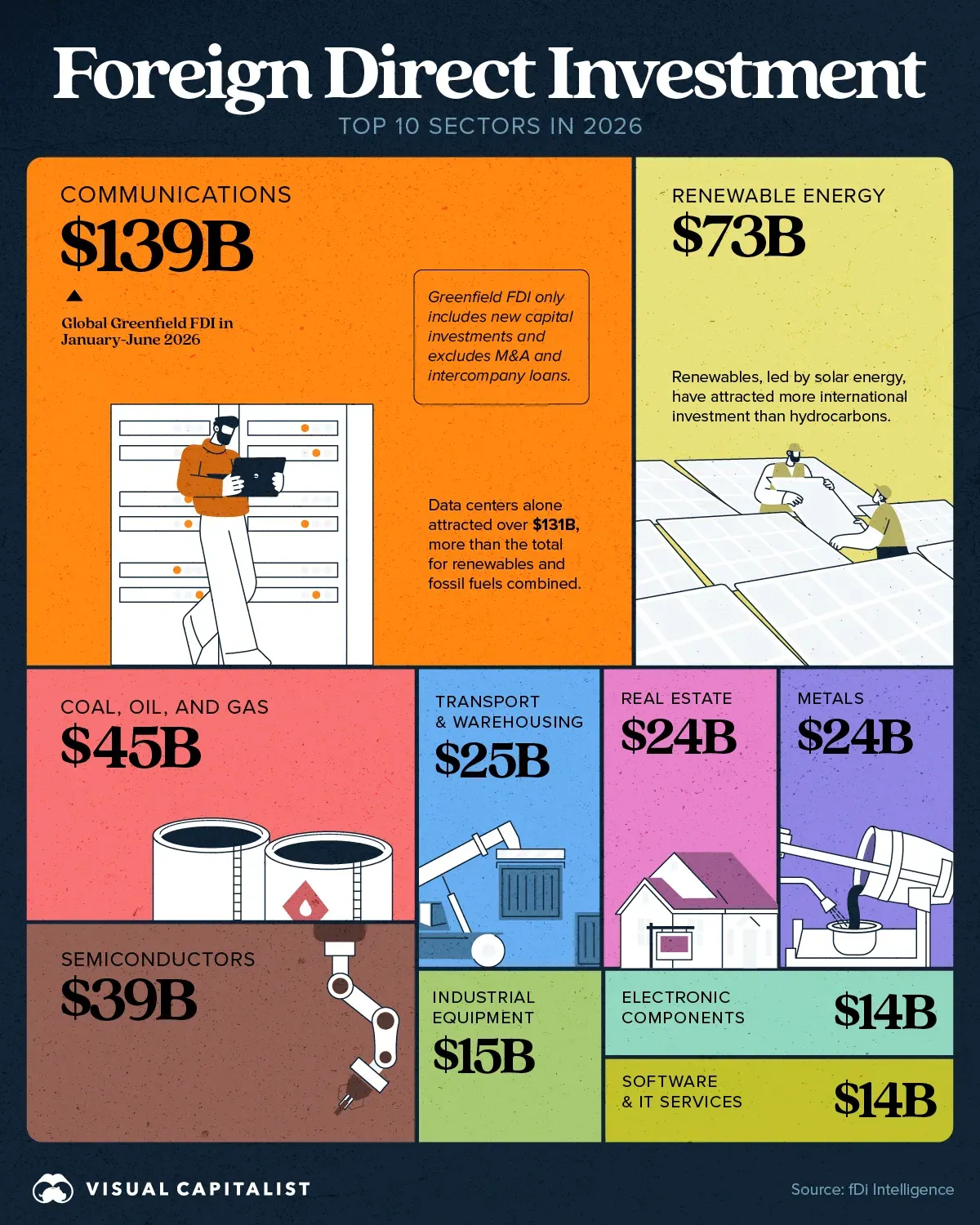
Graphic: Visual Capitalist. Data: fDi Intelligence, January to June 2026. Excludes mergers, acquisitions, and intercompany loans.
16) A region with a country's worth of natural gas: Industrial advantages can be easier to see at the regional scale. This comparison of U.S. gas-producing regions with entire countries puts Appalachia's Shale Crescent at 36.7 billion cubic feet per day in 2025, ahead of Iran, China, and Canada individually. Production is useful context for recruitment; a specific site's delivered price, pipeline capacity, and service terms still determine its advantage.
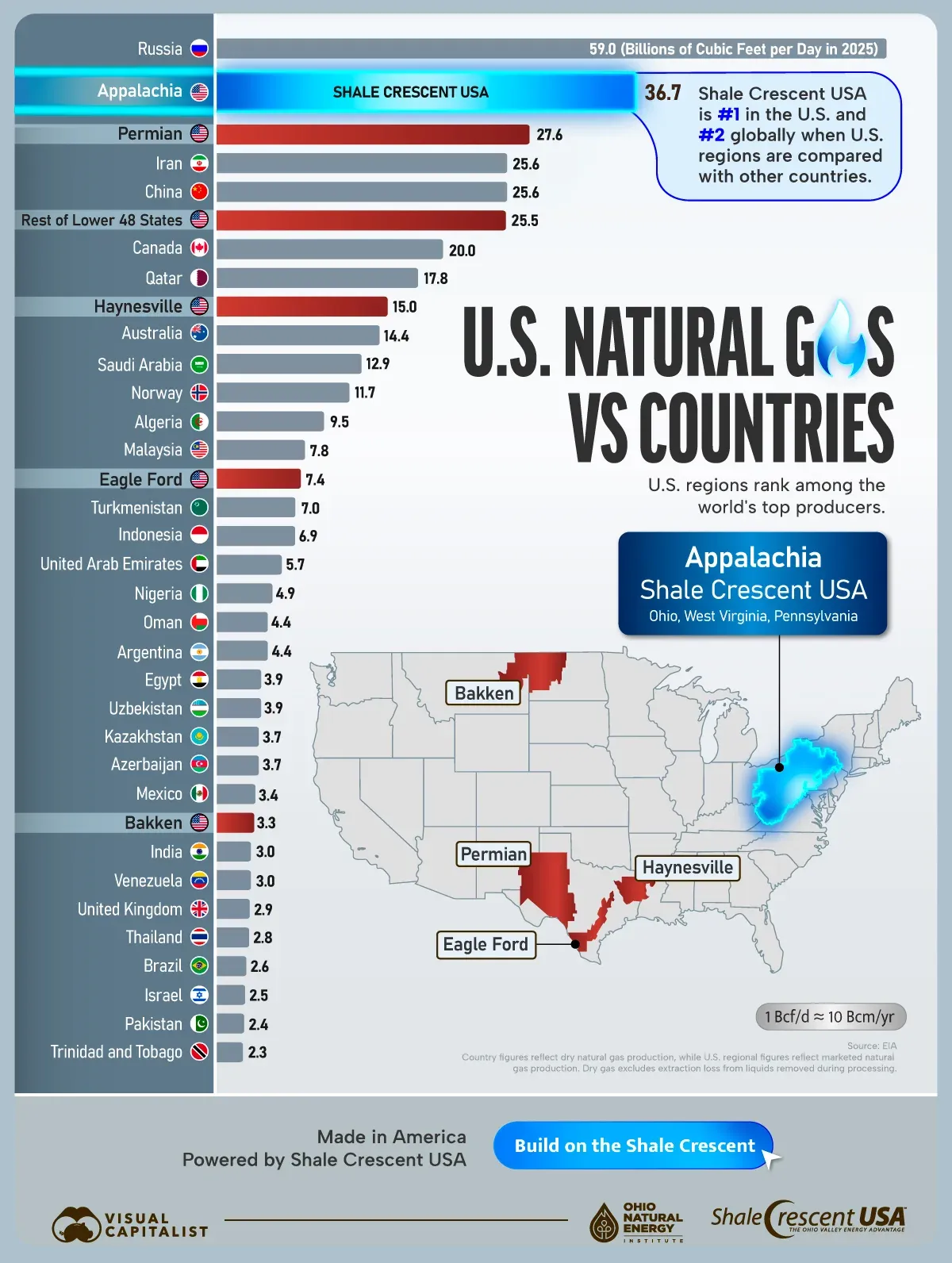
Graphic: Visual Capitalist, sponsored by Shale Crescent USA. Data: U.S. Energy Information Administration and Energy Institute. U.S. regions use marketed gas production; countries use dry gas production, so the measures differ.
17) Canada's importance looks different from each state: National trade totals can hide a local employer's exposure. This cross-border goods-trade map shows Canada accounting for more than half of international goods trade in North Dakota, Montana, Maine, and Vermont in the first half of 2026. Use it as a prompt for employer visits: which customers, inputs, and shipping routes depend on that relationship?
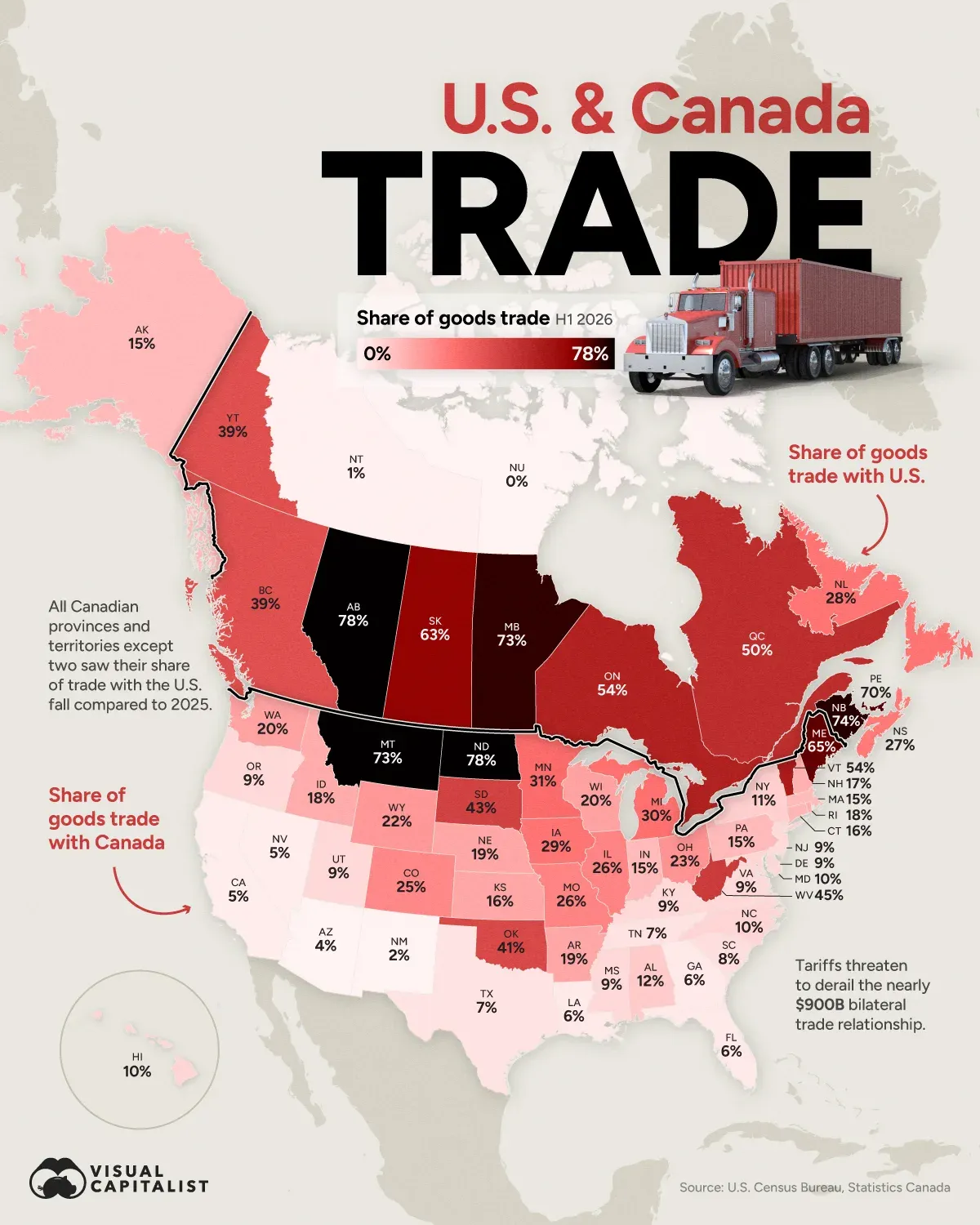
Graphic: Visual Capitalist. Data: U.S. Census Bureau and Statistics Canada. Shares combine goods imports and exports; they are not shares of state GDP.
18) Health care is not the whole local jobs story: Check your own industry's contribution before borrowing the national headline. Brian Kelsey's follow-up analysis finds that transportation and warehousing led net job gains in eight of 29 fast-growing heartland counties, while health care and manufacturing each led in six. These are larger counties in the top tenth for job growth, a useful reminder of how much local economies differ.
19) A much longer view of the workweek: Economic progress can show up as time people get back. This historical Our World in Data chart shows annual working hours falling substantially in seven wealthy economies between 1870 and 2017. The series changes coverage around 1950, and country comparisons have measurement limits, but the long-run shift offers perspective on what a more productive economy can make possible.
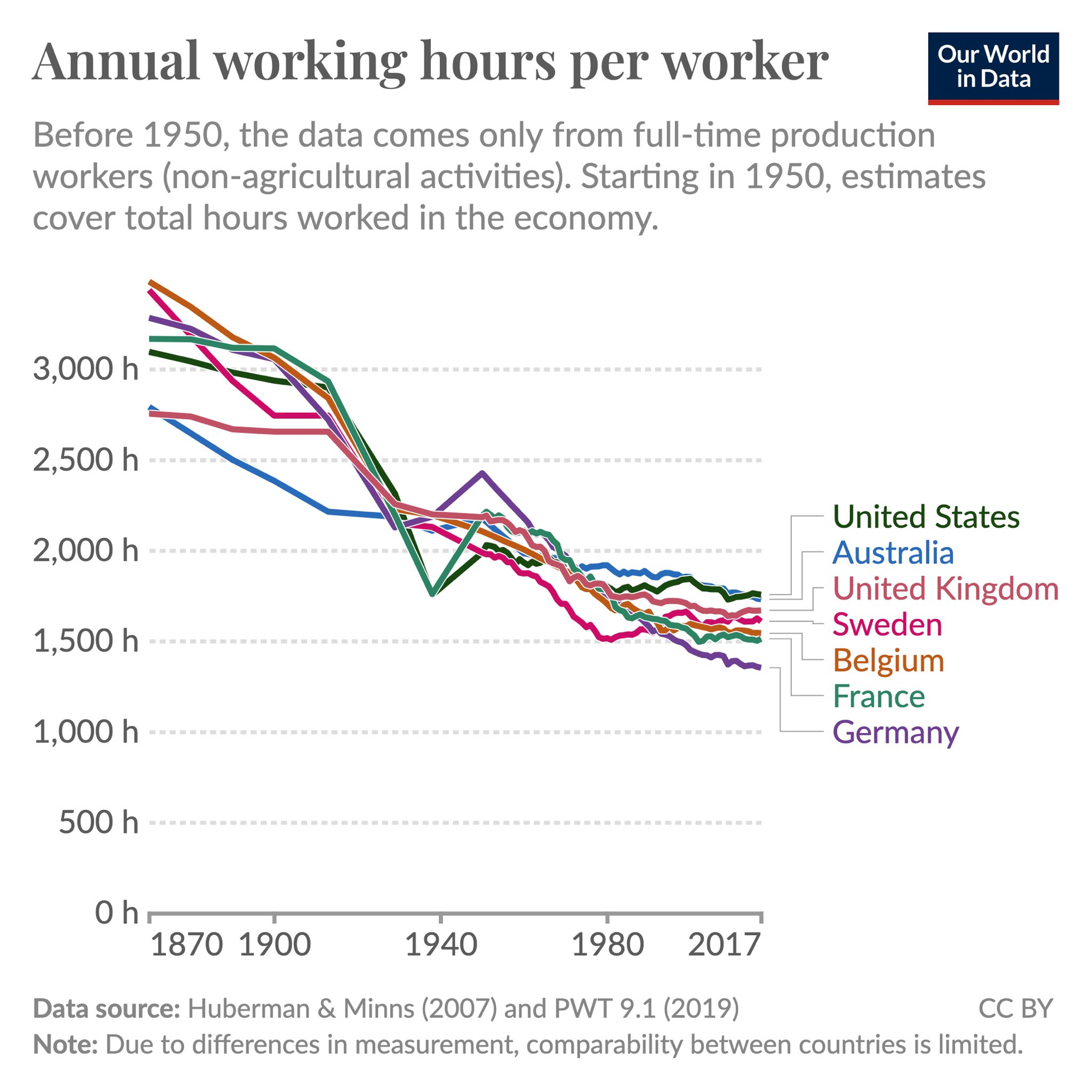
Chart: Our World in Data, CC BY. Sources: Huberman and Minns (2007), Penn World Table 9.1 (2019). Historical data through 2017.
20) The grocery bill belongs in the affordability pitch: Households experience the cost of living one purchase at a time. This state grocery-cost map puts Hawaii 36.3% above the national average and Mississippi 6.8% below it in Q1 2026. Most states sit much closer together. Pair housing comparisons with everyday expenses when explaining what a local wage can buy.
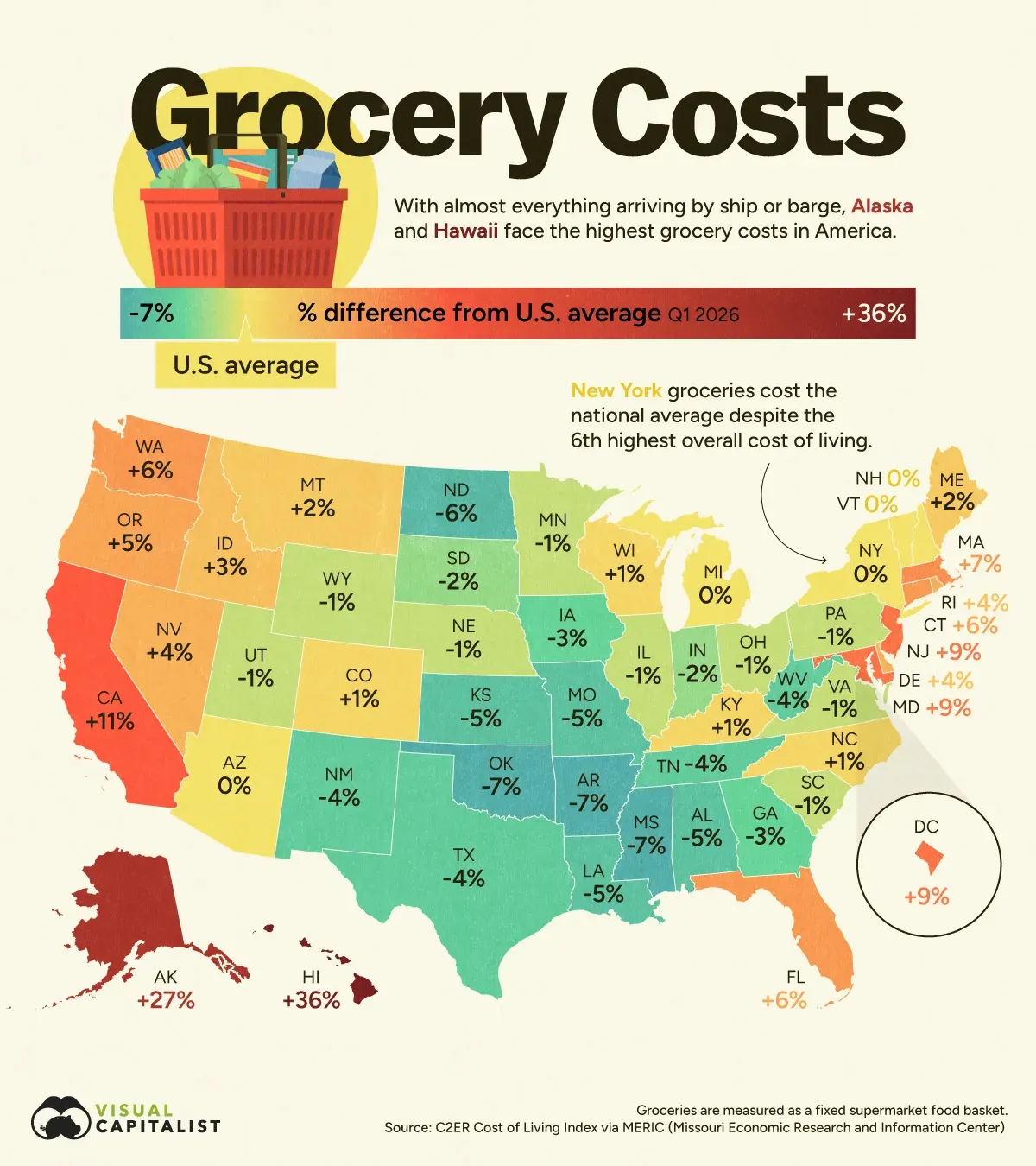
Graphic: Visual Capitalist. Data: MERIC / C2ER Cost of Living Index, Q1 2026. Compares the cost of a fixed basket of groceries.
21) Where a lower cost of living buys more: Affordability is more persuasive when paired with a good daily life. Tucson, Jacksonville, and San Antonio lead this comparison of quality of life relative to living costs in 41 U.S. cities. Treat the Numbeo-based ranking as a conversation starter about amenities and household budgets, with results shaped by the index's measures and method.
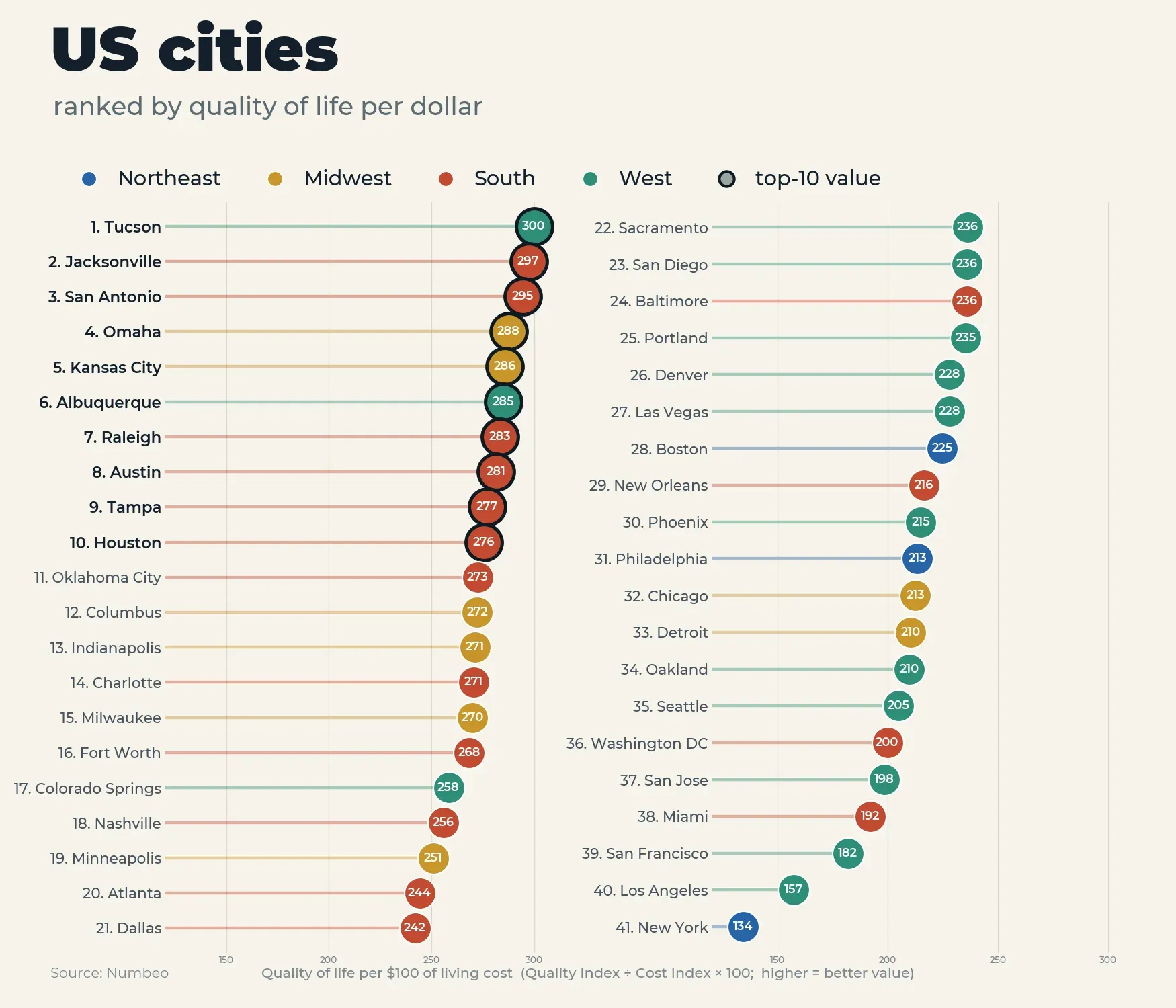
Graphic: Valerii Emelianov, via Visual Capitalist. Data: Numbeo.
22) Watch a county take shape: An animated map can make development history easier to understand. Parcelscope's Los Angeles County map brings today's buildings into view by the year they were built, with neighborhood views and address search. The important caveat is on the map itself: demolished buildings are absent. You are seeing the age of what survives, not a complete reconstruction of the past.
23) Same flowers, different reason to stop: A feature tells people what you have; a good message gives them a reason to care. In Grant Miller's two-panel marketing joke, one sign offers flowers for $10 and the other asks when you last bought flowers for Mom. Now look at the first sentence of your community's pitch.
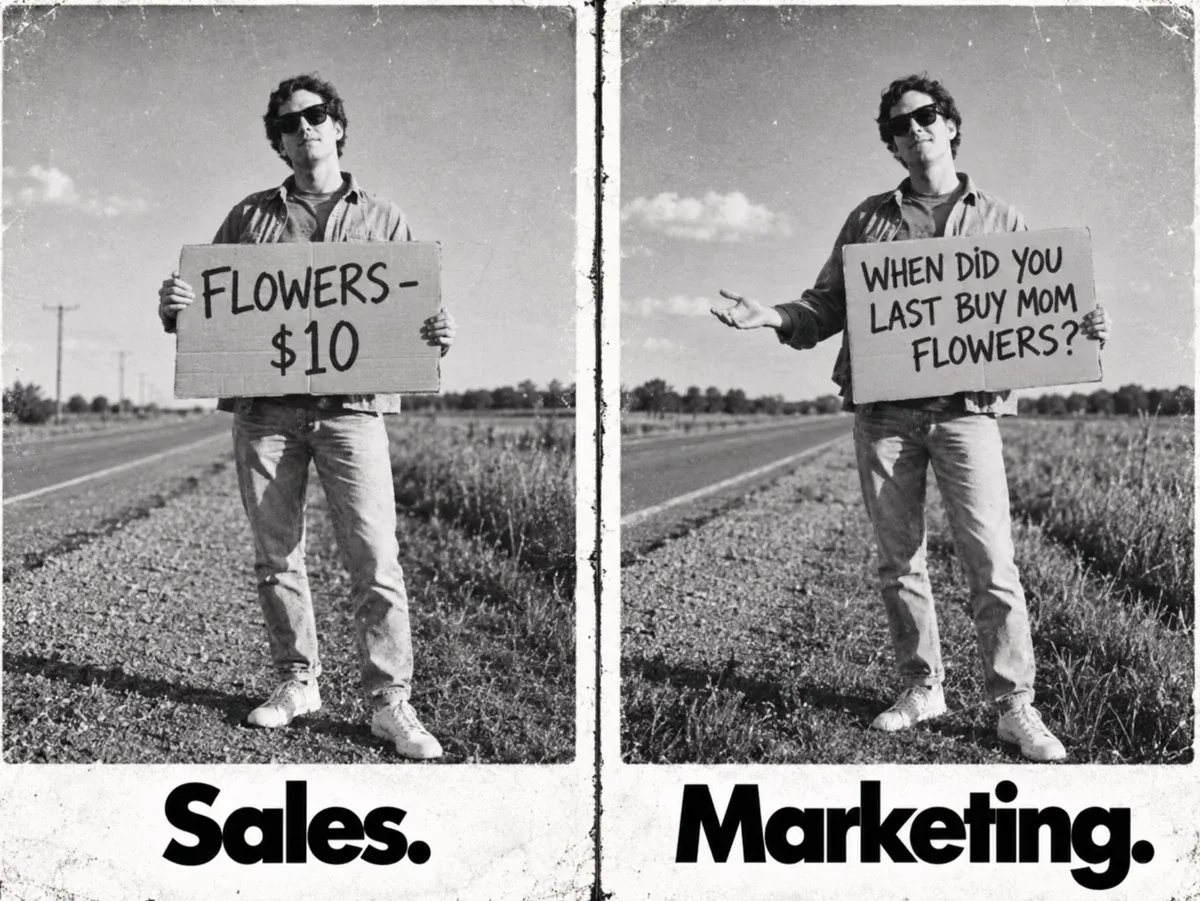
Image shared by Grant Miller on X.
24) The cities where children go to work for fun: Career exploration gets interesting when the whole town is the classroom. Defunctland's Kid Cities traces miniature towns where children try adult jobs, earn pretend money, and encounter real corporate brands. This 2024 documentary is a long weekend watch about entrepreneurship, learning through play, and the awkward boundary between education and advertising.
Reminder:
I’ll be speaking at the Texas Economic Development Council's 2026 Annual Conference, October 7 to 9 in Houston, at the Royal Sonesta Houston Galleria.
My session, “The Work Behind the Win: What 500+ Economic Developers Have Taught Me,” draws on the candid conversations I’ve had with practitioners serving communities of all sizes. I’ll share lessons on building stronger partnerships, telling your community’s story, using data and technology, and moving faster when opportunity arrives, while keeping the people behind the projects in focus.
If you’re attending, I’d love to see you there. Register for the conference.
Sitehunt will also have a booth. Come see us and what we can do for your organization.