26 Things Economic Developers Need to Know This Week
The stories Dane thinks you need to see. September 10, 2026 edition.


Welcome to this week's issue of What Economic Developers Need to Know This Week, where we explore the evolving dynamics of our economy.
This week we have 26 tools, stories, graphics, charts and videos that I think you'll find informative, useful, inspiring, and perhaps even humorous. Some are economic development related directly, and some only indirectly.
If you're wondering what to do with the info in this newsletter, send something to your board members. It will make you look good!
Today's email is brought to you by Resource Development Group
Resource Development Group and Convergent Nonprofit Solutions have recently announced a merger of these two well respected firms. RDG is now operating as Resource Development Group, a Convergent Company and will lead the combined operations in economic development and chamber engagements. Meanwhile, the Convergent banner will take the forefront on efforts on supporting traditional philanthropic and higher education organizations
This merger maintains RDG's innovative and custom approach while also creating the deepest bench of economic development and chamber fundraising expertise in the industry, the most complete data set in the country regarding economic development and chamber funding, and the greatest flexibility to be able to support engagement models tailored specifically to every market, regardless of size.
Whether you’re a single county EDO ready to kick off your first fundraising campaign or a large regional organization on your third funding cycle, they have the team and experience to get you the results you’re looking for.
Join us for EconDevCamp 2026 in New Orleans

Sitehunt is proud to support the third annual EconDevCamp on October 25, 2026, in New Orleans, just before the IEDC Annual Conference.
This collaborative “unconference” brings together economic developers, entrepreneurship support organizations, and small-business champions for lunch and candid, participant-led conversations about the field’s most relevant challenges and opportunities. No panels. No fluff. Just real discussions and practical ideas you can bring home.
Sitehunt members can receive 50% off registration with code SITEHUNT. Learn more and register at EconDevCamp.com.
1) Economic development and developers in the news #259: There is a lot of good work happening between the big announcements. The latest roundup brings together news from 82 economic development executives and organizations across 34 states. Find a peer tackling a familiar problem, then see what their approach might offer your community.

2) Site selection starts before the site: Learn what the company needs to accomplish before pitching a property. In Podcast 235, Thane Hutcheson explains how labor, supply chains, markets, and operating costs narrow the search. His advice for economic developers: submit properties that fit, understand their surroundings, and help prospects picture operating in your community for decades.

3) Rural communities need help delivering the project: A grant works better when someone has the time and expertise to use it. In Podcast 234, Amy Renner discusses how technical assistance, planning, and lasting partnerships help small communities move from good ideas to fundable projects. Staff capacity belongs in the budget from the beginning.

4) Good ideas keep their usefulness after the email leaves your inbox. The August 27 edition collected 25 stories, tools, and charts covering economic development practice, infrastructure, housing, work, and technology.


Sitehunt helps economic developers find, understand and enrich their sites, match them to projects, and respond with confidence in minutes instead of scrambling for days.
5) When a grocery store becomes community infrastructure: A place needs everyday services to remain a place people can live. John Shepard's rural retail case study looks at Circle C Market in Cody, Nebraska, where a nonprofit grocery provides food access and students learn store operations. Essential retail can retain local spending while supporting the workers and families your broader strategy depends on.
6) Ask the storefront owner first: Businesses experience the combined cost of government, even when each agency sees only its own rules. In Economic Development from the Storefront Up, florist Patrick Hall explains how permits, inspections, staffing, and insurance pressures accumulate. Involve owners early, ask what requirements cost in time and money, and check whether the resulting policy helped.
7) Give new board members a common foundation: Economic development education should survive the next election. Beth Land has launched LandWise, a platform for educating elected officials, boards, and community stakeholders. It offers short videos, ready-to-license materials, and customized content, with free introductory resources on common mistakes and responding to public opposition.
8) Build a measurement system you will actually use: Choose measures your team can maintain and act on. Jim Damicis's evaluation guide tackles familiar obstacles: limited staff time, uneven data, fear of accountability, and trying to measure everything. Match the effort to your resources, and be careful about claiming that your program caused every positive change in the local economy.
9) An older argument about what development is for: Investment matters when residents benefit. Kelvin Ayala's 2022 essay connects wealth creation with better services, public spaces, local businesses, and quality of life. It is useful background reading for a board conversation about how project activity becomes lasting community value.
10) Judge startup programs by stronger companies: A busy calendar is a weak substitute for founder progress. Paul O'Brien's Labor Day essay argues for better accelerator evaluation, mentors with startup experience, stronger university commercialization, and support for the people connecting founders with customers and capital. Survival, revenue, and follow-on investment deserve more attention than attendance.

I’ll be speaking at the Texas Economic Development Coucil's 2026 Annual Conference, October 7–9 in Houston, at the Royal Sonesta Houston Galleria.
My session, “The Work Behind the Win: What 500+ Economic Developers Have Taught Me,” draws on the candid conversations I’ve had with practitioners serving communities of all sizes. I’ll share lessons on building stronger partnerships, telling your community’s story, using data and technology, and moving faster when opportunity arrives, while keeping the people behind the projects in focus.
If you’re attending, I’d love to see you there. Register for the conference.
11) Understand the prospect's alternatives: Negotiating leverage is strongest before the location decision is locked in. Thane Hutcheson explains why signing a lease or announcing a location too early can weaken a company's position. His firm's free manufacturing comparison tool screens 362 metros across labor, real estate, utilities, taxes, and incentives, offering economic developers a view of the competitive comparison behind a prospect's shortlist.
12) The bill for yesterday's infrastructure decisions: Deferred maintenance leaves future leaders with both the repair bill and the difficult vote. Julie Roller Weeks makes the case for discussing asset condition, replacement costs, reserves, and utility rates before systems fail. Reliable water, sewer, and streets make the next development project possible, even when their maintenance never produces a photogenic ribbon cutting.
13) Housing provisions that could change supply: The practical test is whether a policy helps deliver or preserve homes. Brian Potter examines HOME program changes, rural rental assistance, disaster recovery, and institutional ownership provisions in the ROAD to Housing package. His analysis is a useful guide to separating measures that ease delivery from measures with limited effects on supply.
14) Data center debates need facts and workable agreements: Public trust depends on answering local questions about power, water, taxes, and costs. Axios reports X's allegations of foreign influence while documenting real local opposition. Gavin Baker's case for data centers emphasizes project design and ratepayer protections. The useful question for communities is what a specific project will deliver and who will pay.
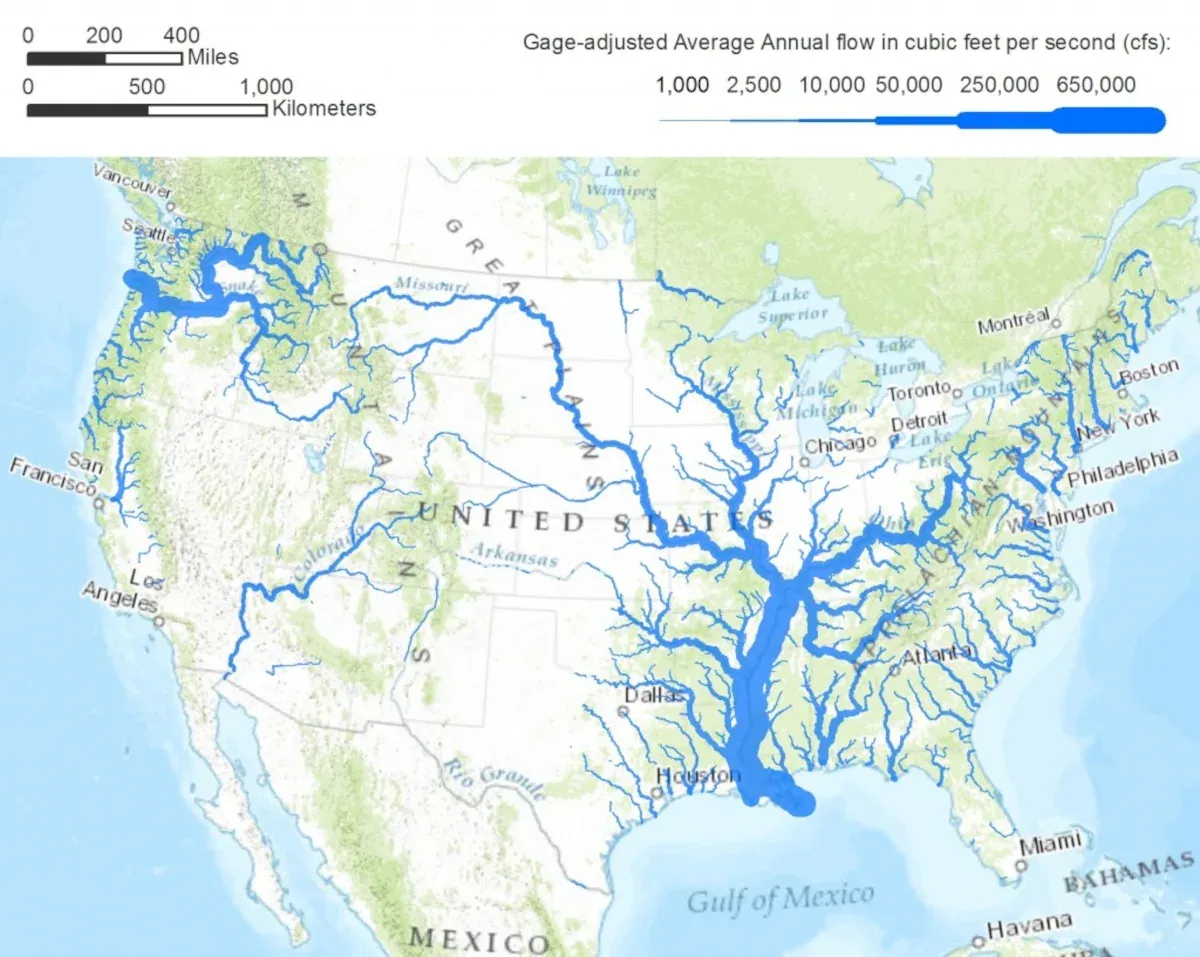
15) A different way to see America's rivers: Water geography looks very different when line width represents flow. This map of average river discharge makes the Mississippi system stand out and shows the relative thinness of many western rivers. It is helpful regional context; a project's water supply still needs its own availability and infrastructure analysis.
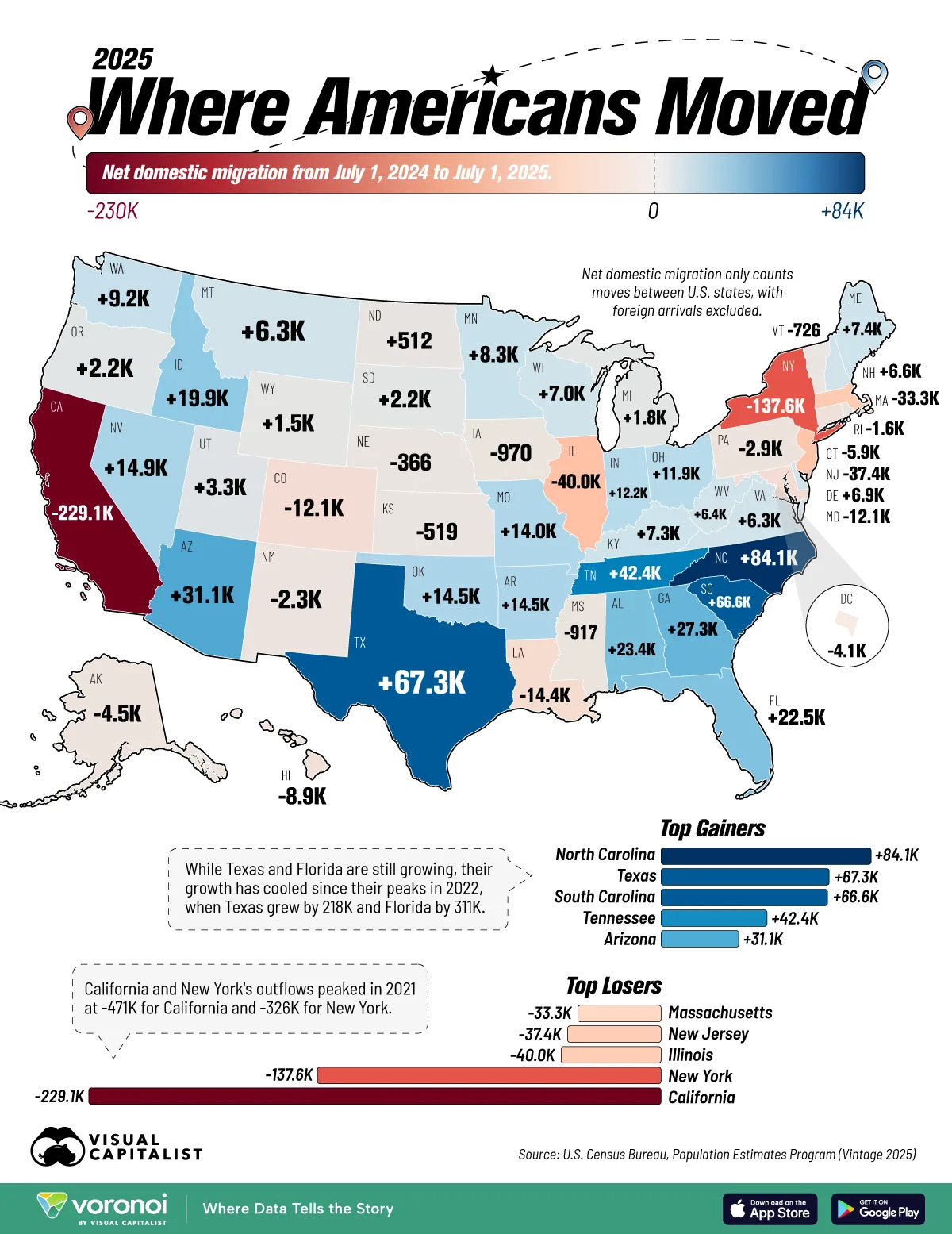
16) Where Americans moved: The Carolinas remain prominent in the competition for residents. North Carolina gained about 84,100 residents through net domestic migration between July 2024 and July 2025, ahead of Texas and South Carolina. This map measures moves between states; international arrivals, births, and deaths are outside its scope.
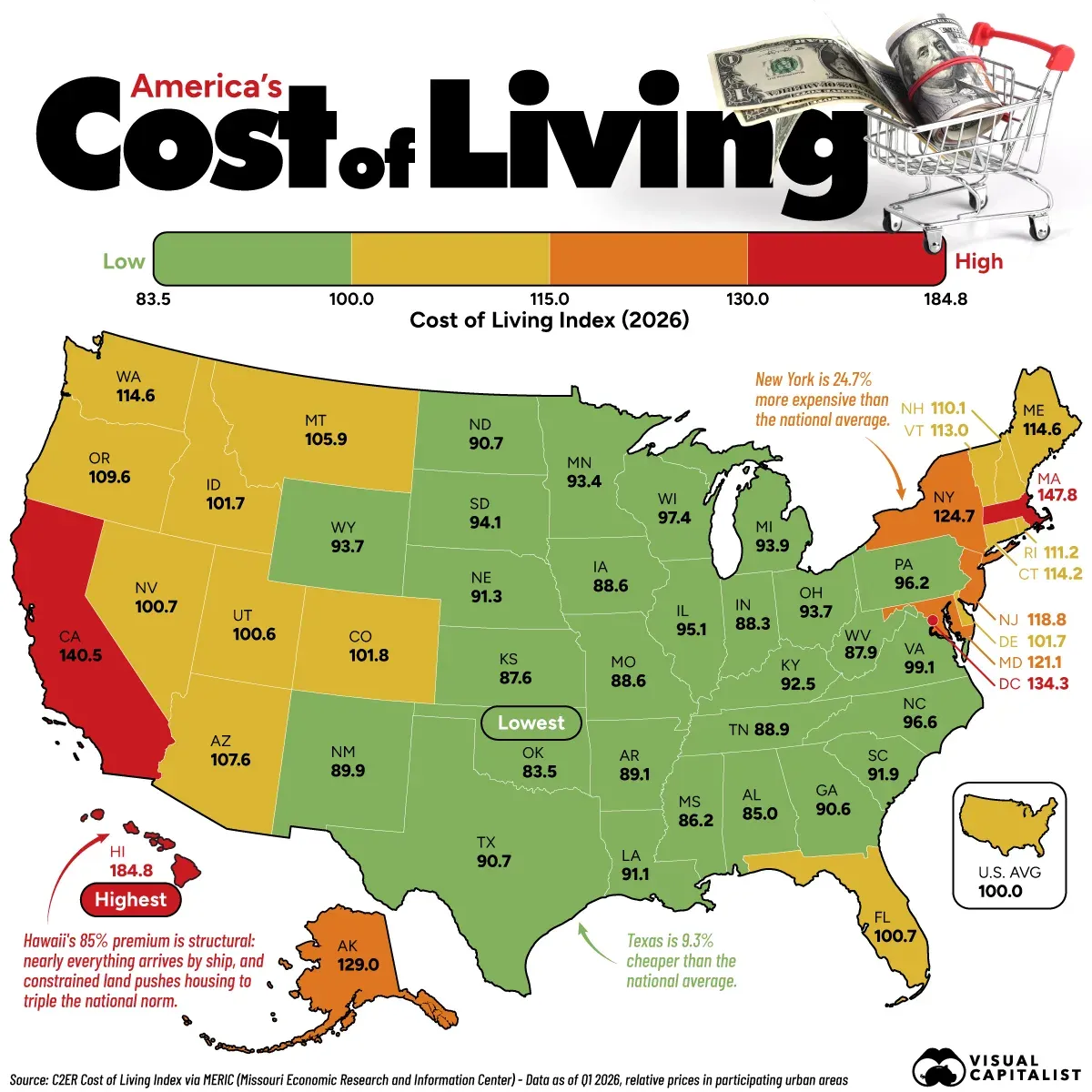
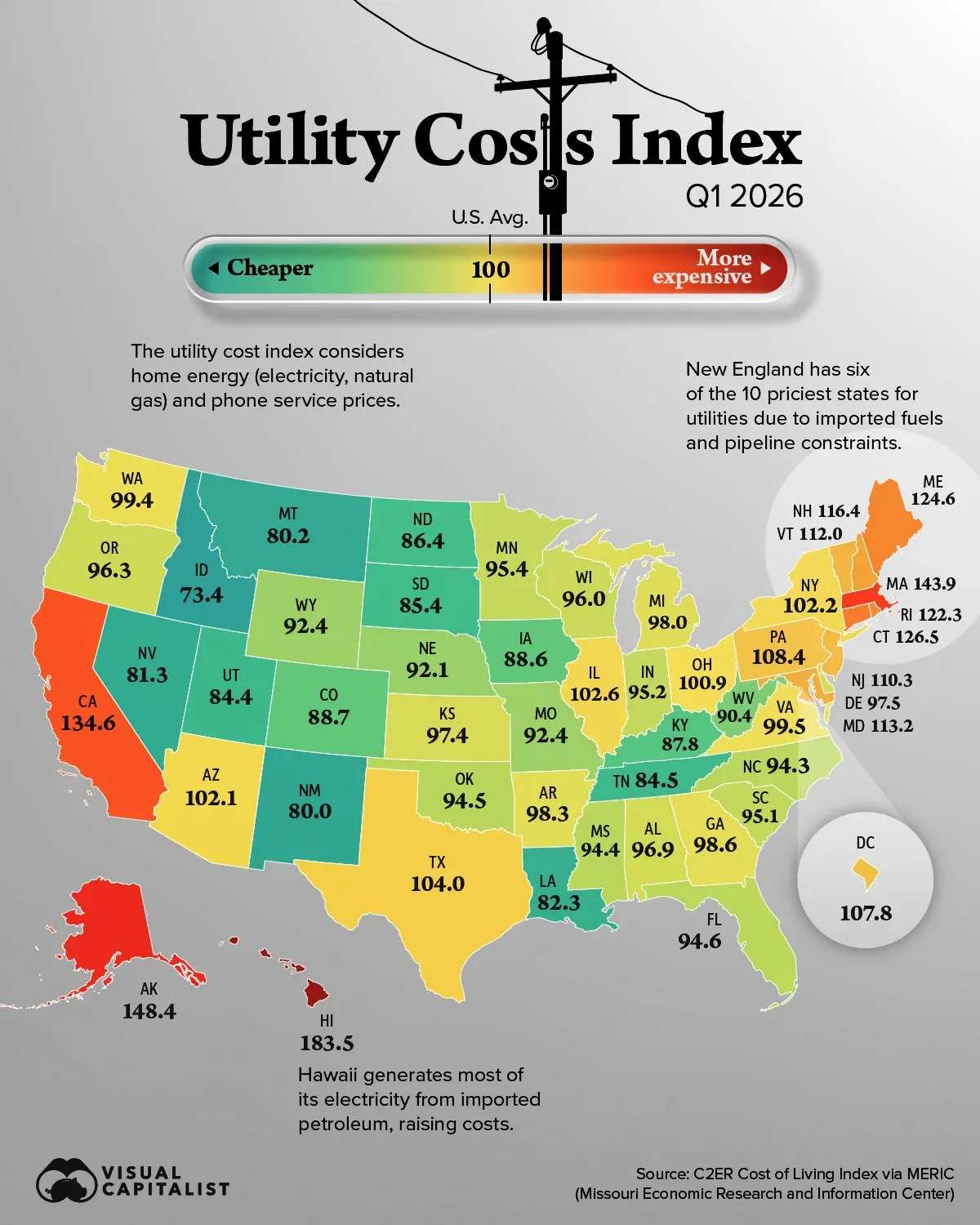
17) Affordability has more than one component: A low overall cost of living can coexist with high utility costs. These state cost-of-living and utility-cost maps illustrate the difference: Texas falls below the national average overall but above it for utilities. Talent-attraction comparisons should consider the full household budget.
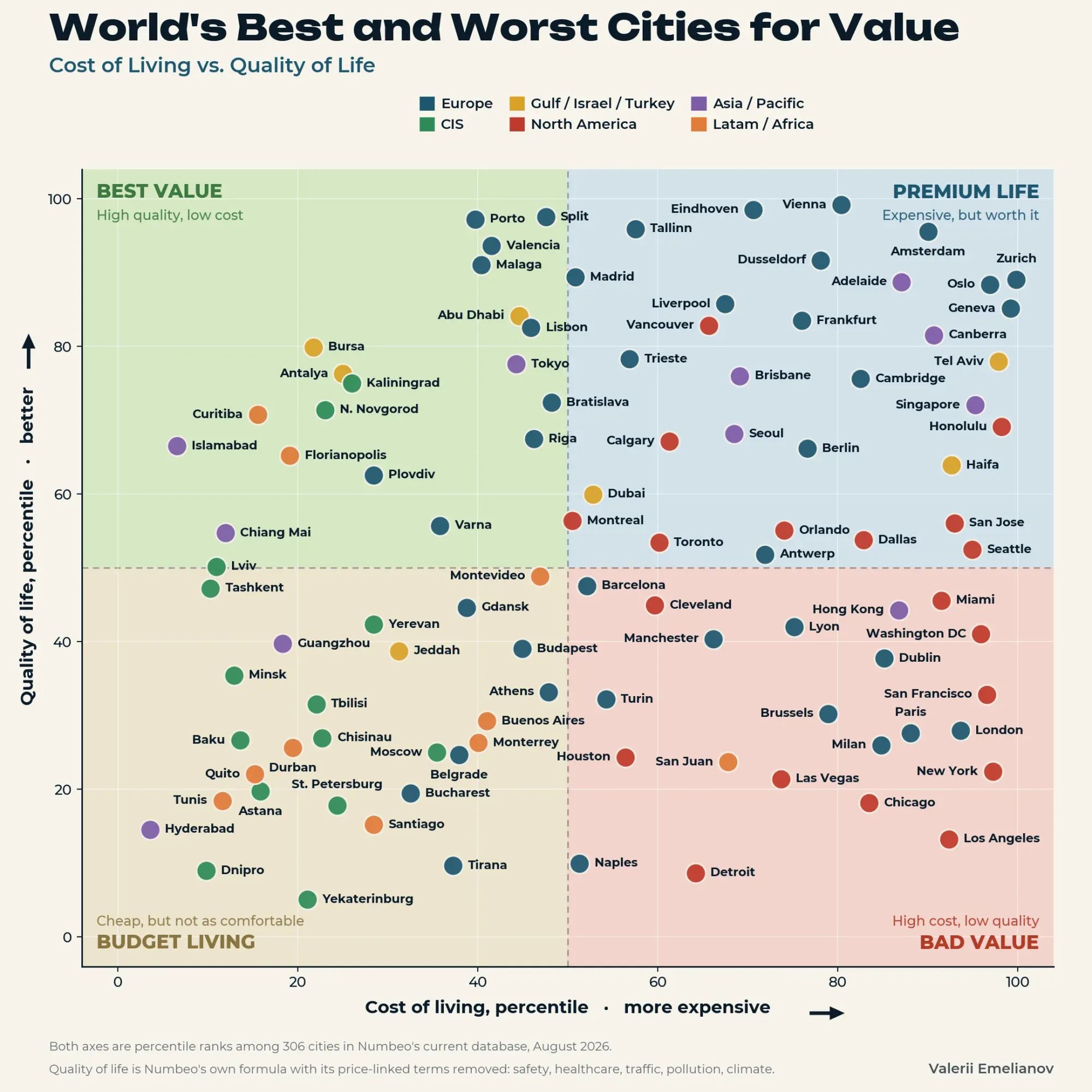
18) The cost of quality of life: Affordability and amenities need to be considered together. This comparison of 100 cities places cost-of-living and quality-of-life percentiles on the same chart. It is a useful discussion starter for talent attraction, with results shaped by Numbeo's data and the author's method rather than a universal definition of a good place to live.
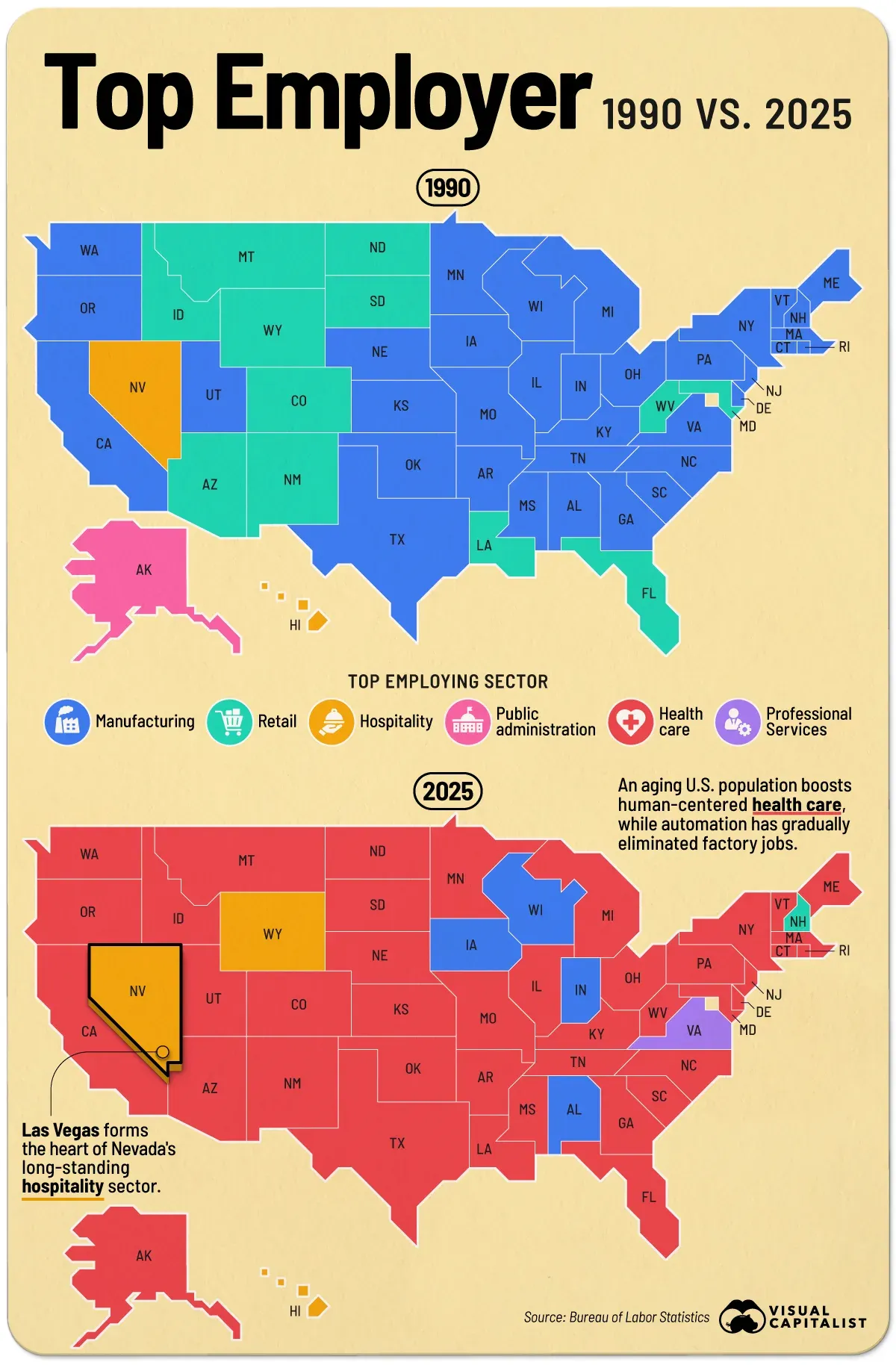
19) From manufacturing to health care: The employer mix has changed enough to reshape workforce strategy. Manufacturing was the largest employment sector in 35 states in 1990; health care led in 41 states in 2025, according to this state-by-state comparison. Training, transportation, and employer outreach should reflect who employs residents today.
20) Where metro employment is growing: The national labor market contains very different local stories. Brian Kelsey's July metro report finds employment above year-earlier levels in nearly 70% of heartland metros. Austin, Nashville, and Houston lead growth among metros with at least one million nonfarm jobs; Mankato leads the broader metro comparison.
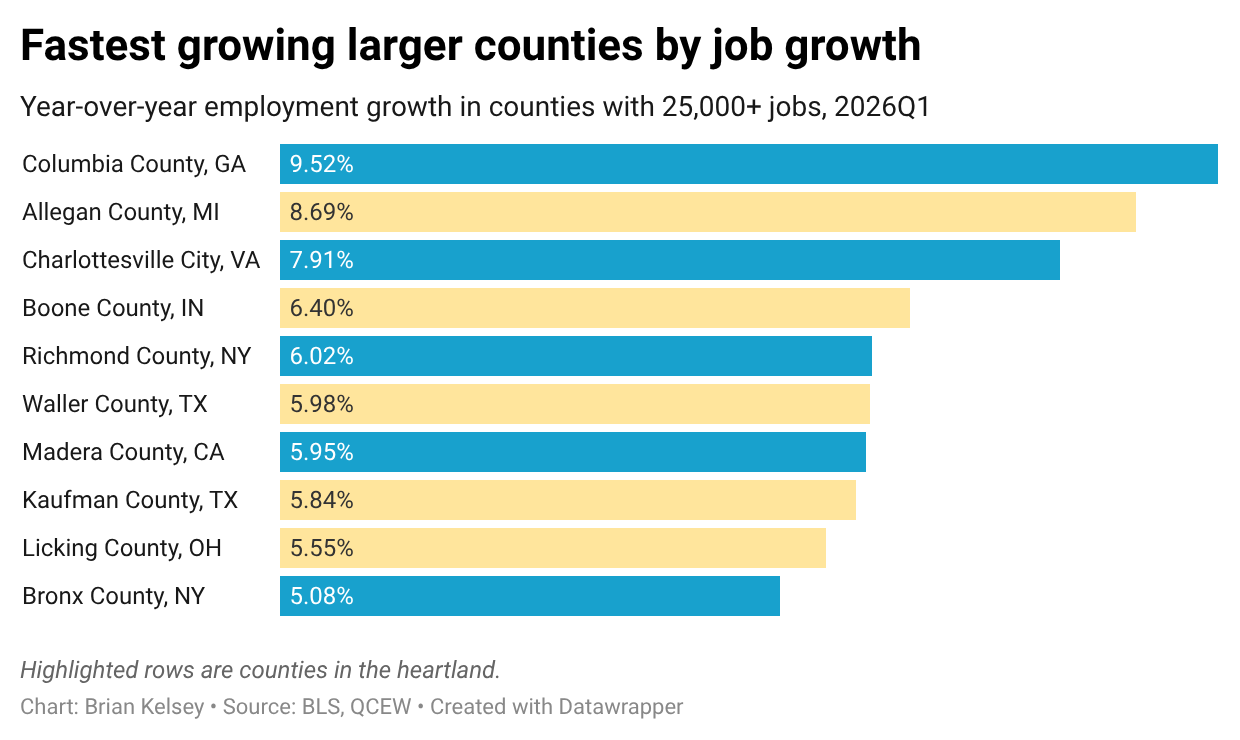
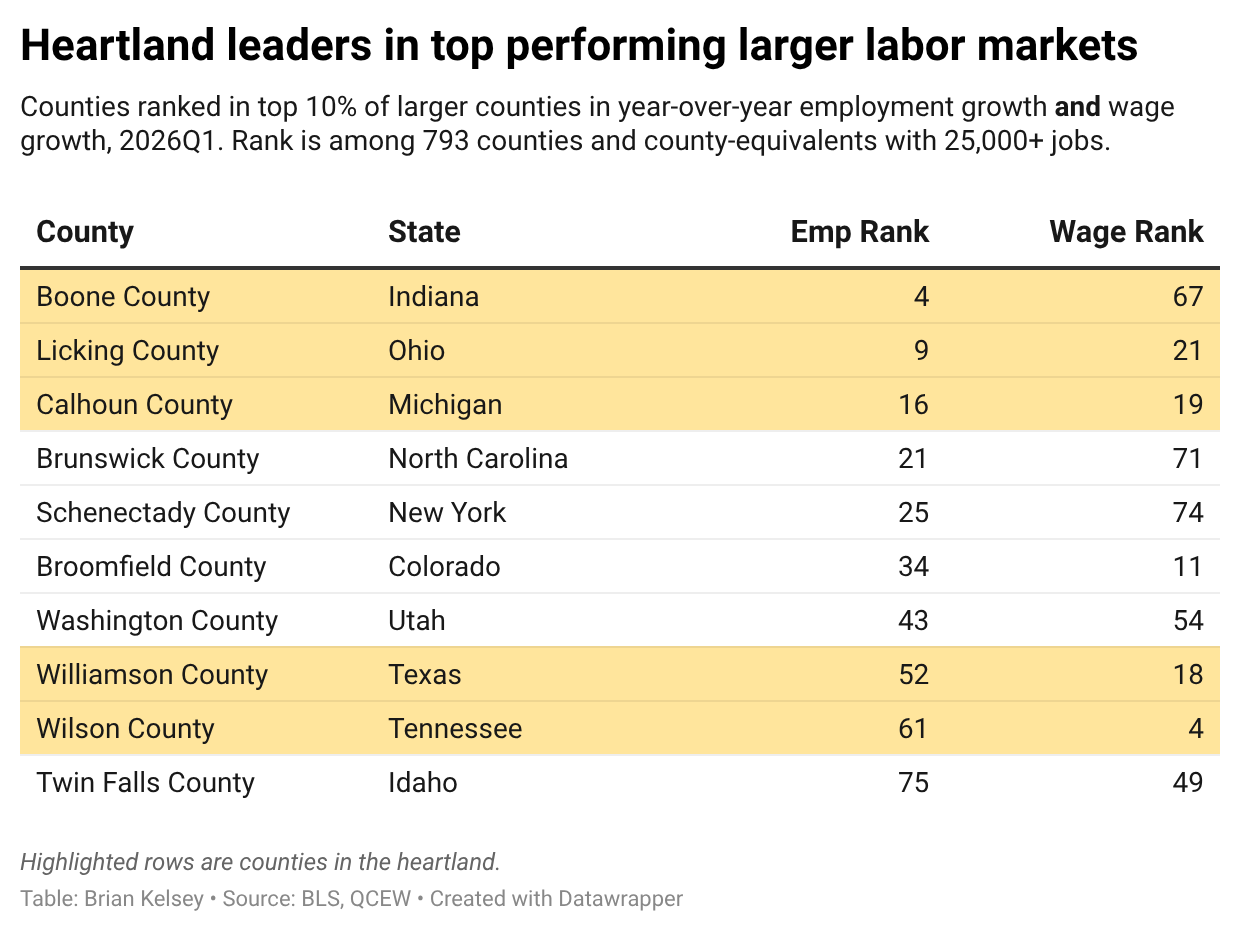
21) Look for wage growth alongside job growth: More jobs and better pay together make a stronger local story. Kelsey's Labor Day ranking uses Q1 2026 county data to compare both. Columbia County, Georgia leads job growth among counties with at least 25,000 jobs, while ten larger counties rank in the top tenth for both employment and wage growth.
22) Follow graduates beyond graduation: Talent-pipeline discussions get better when they include what happens after school. Andrew Foote shares a Census update covering more than 1,100 institutions. The Post-Secondary Employment Outcomes Explorer compares earnings and employment flows by institution, degree, and field of study, giving workforce partners another way to examine program outcomes.
23) A stronger market for workers without degrees: Workforce strategy needs to account for different paths into employment. The Wall Street Journal reports that unemployment among workers ages 22 to 34 without college degrees is unusually low relative to the past two decades. The story, shared by Byron York, is a timely prompt to revisit employer requirements and training pathways.
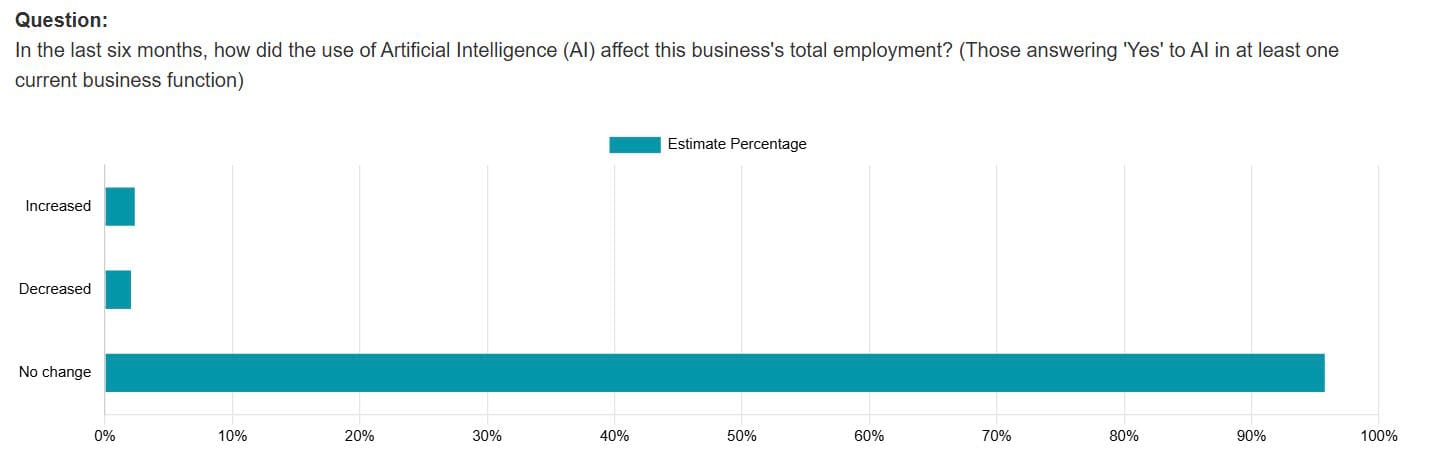
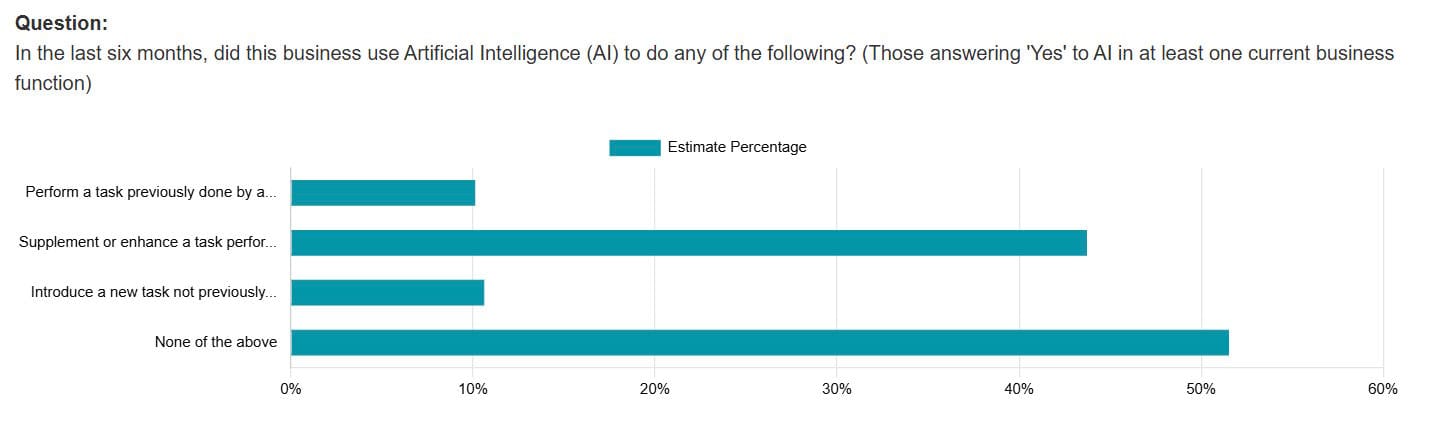
24) AI is changing tasks before the employment totals: Watch what employers are asking people to do as well as how many people they hire. Noah Smith reviews evidence of task changes and new demand, alongside the Economist's case for an emerging AI jobs boom. In the Census survey charts below, most AI-using firms report no employment change, while supplementing employee tasks is more common than replacing them.
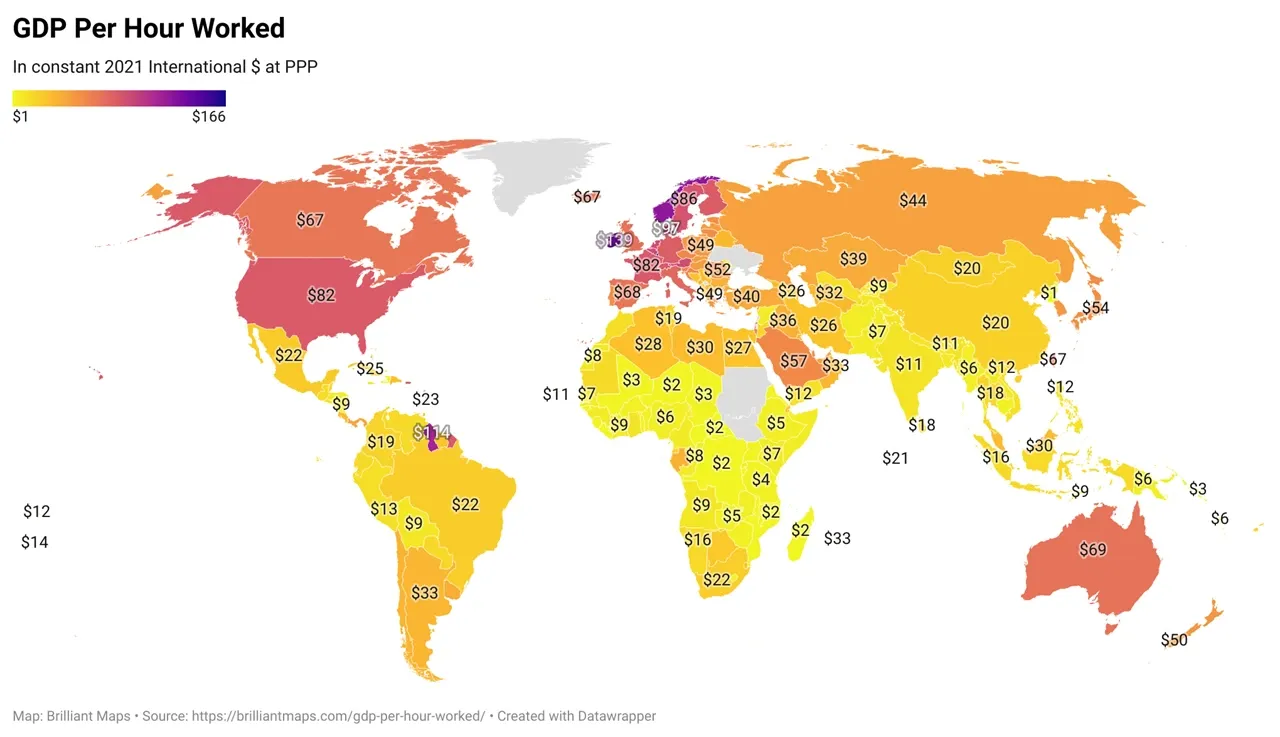
25) Economic output per hour worked: Productivity adds an essential dimension to comparisons of economies. This map using 2025 ILO estimates puts U.S. output at $81.80 per hour worked and Luxembourg's at $166.08, measured in constant 2021 international dollars adjusted for purchasing power. Capital, industry mix, and the organization of production all matter to the discussion.
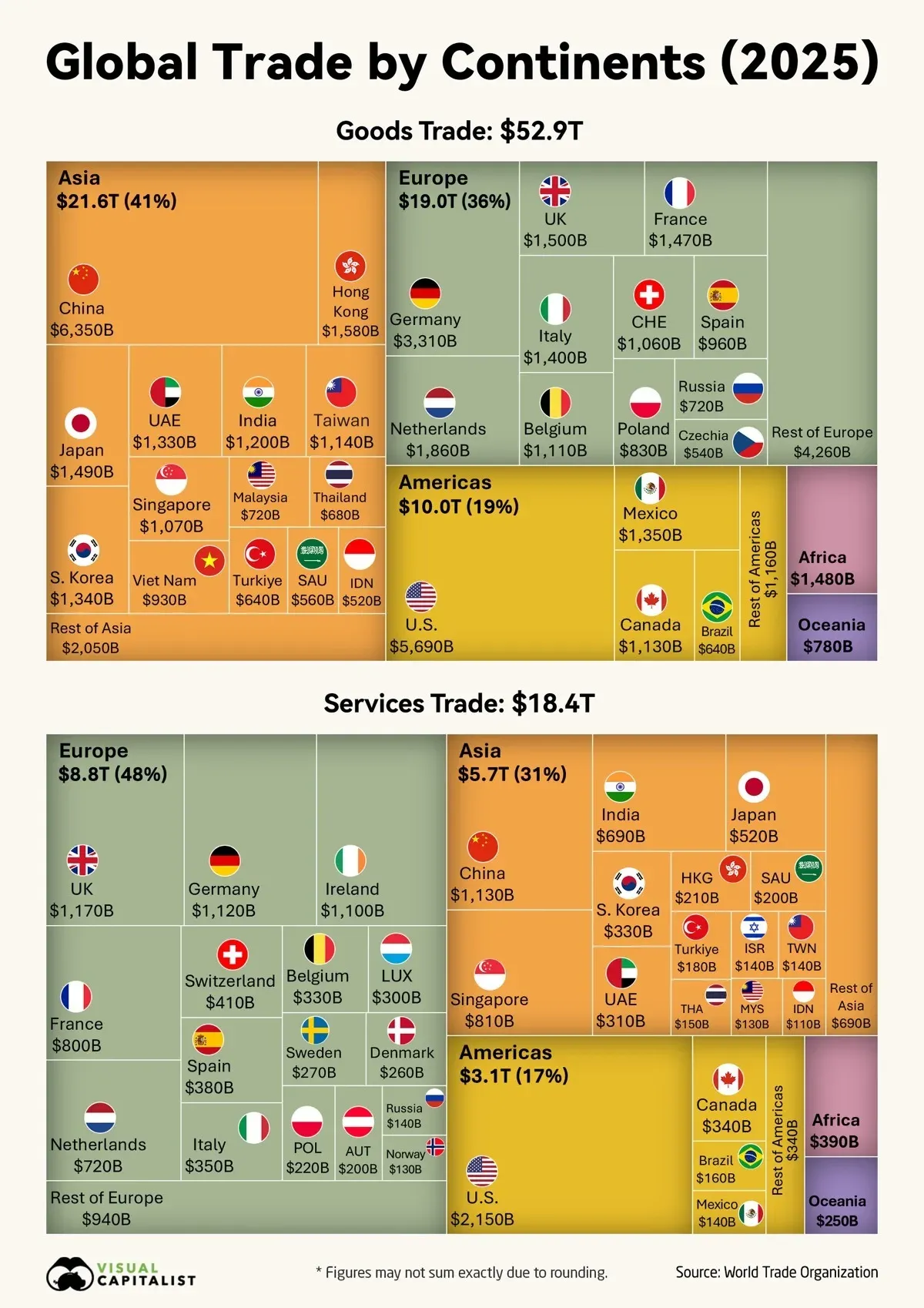
26) Goods and services have different trade centers: Export strategy should account for what a region sells. This 2025 global trade graphic shows Asia leading goods trade and Europe leading services trade, with the U.S. the largest individual services-trading economy shown. The figures combine imports and exports, so they describe total trade rather than export performance alone.