How a Staff-of-One EDO Can Go Proactive
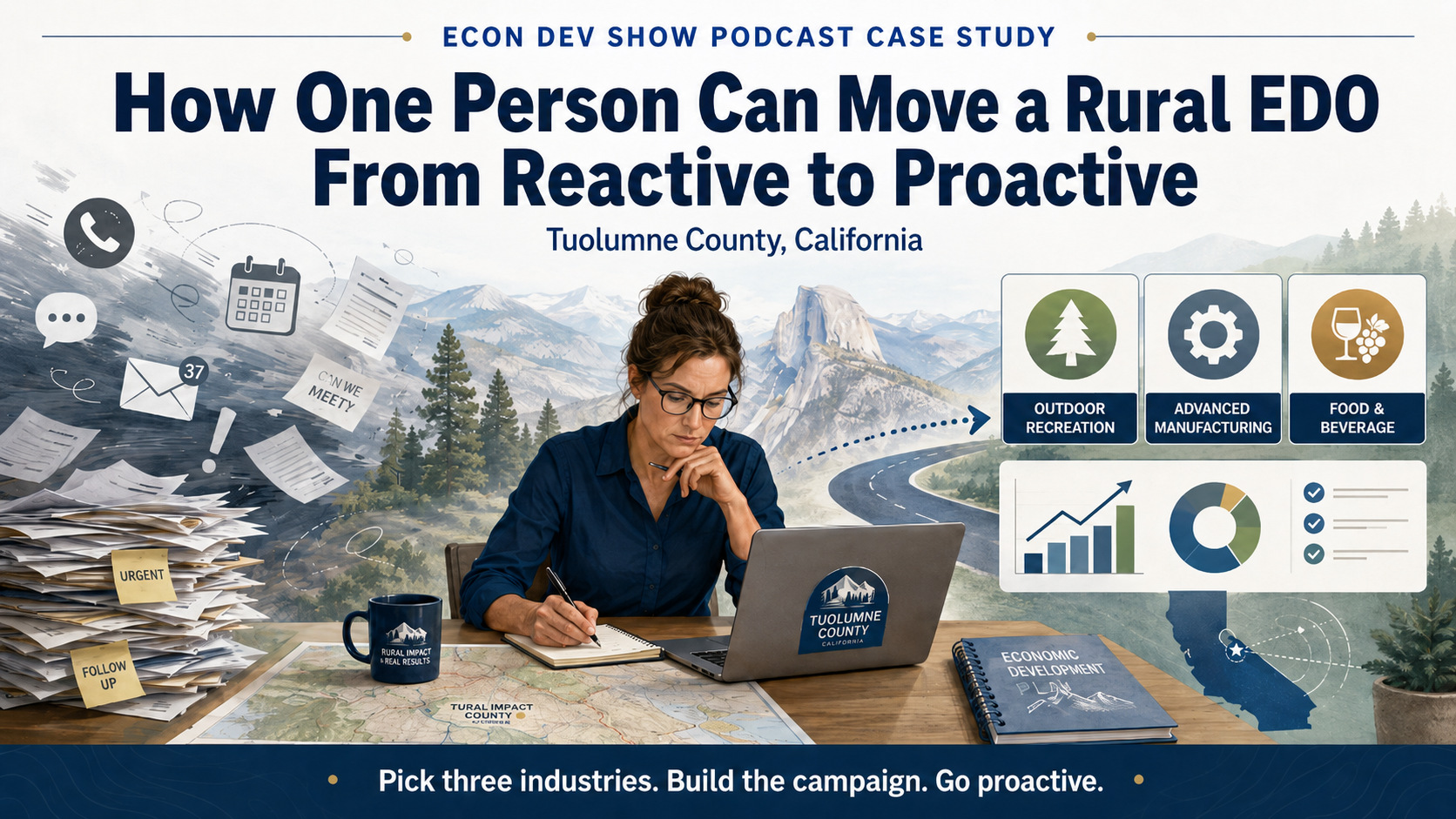
How One Person Can Move a Rural EDO From Reactive to Proactive
 Dane Carlson
The Challenge
Small and rural economic development offices often live in reaction mode.
The phone rings. A business needs help. A partner wants a meeting. A lead comes in. A board member asks for an update. None of it is fake work. In fact, most of it matters.
But when everything matters, the strategy can disappear.
That is the challenge Cole Przybyla described on the Econ Dev Show. In Tuolumne County, California, he helps lead innovation and business assistance for a rural county of about 54,000 people with what he called a “mighty staff of one.”
That means the office has to support existing businesses, respond to opportunities, coordinate with partners, and still find time to create forward movement.
For many small-market economic developers, that is the job.
The question is how to keep the daily work from becoming the entire strategy.
The Shift
Cole’s answer was simple and useful:
Move from reactive economic development to proactive economic development.
That does not mean ignoring existing businesses. It does not mean refusing to help people who call. It means creating a protected lane for intentional work.
For Tuolumne County, that meant choosing a small number of industries to pursue on purpose.
Cole’s advice: pick three industries.
Not ten. Not “everything that might fit.” Three.
That one decision changes the work. It gives the office a filter. It helps determine which prospects matter, what messages need to be built, which partners should be involved, and where limited staff time should go.
For a one-person office, the constraint is the strategy.
Why It Matters
Tuolumne County has a strong identity. Yosemite National Park is one of the most recognizable assets in the country, and tourism is central to the region’s economy.
That is a strength.
But a strong identity can also become a trap. A community can spend all its time managing the economy it already has and never build the discipline to pursue the economy it wants next.
Cole’s approach does not reject tourism or existing business support. It builds from reality.
The county can recognize the value of Yosemite, support local businesses, and still ask a sharper question:
Where do we have the best chance to attract new business if we act with focus?
That is the practical lesson.
The Playbook
Cole described a proactive attraction campaign built around a few core pieces.
First, choose the industries.
The choices should be based on evidence, not wishful thinking. A small EDO cannot afford to chase industries just because they sound good in a strategic plan. The target sectors need to connect to local assets, workforce, existing businesses, infrastructure, real estate, and market opportunity.
Second, build the campaign.
Once the industries are chosen, the message gets clearer. The audience gets clearer. The follow-up gets clearer. Instead of generic rural marketing, the office can speak directly to the kinds of businesses it actually wants to reach.
Third, use a mix of channels.
Cole talked about using physical, traditional, and digital marketing together. That matters because no single channel does all the work.
Physical presence builds trust. Traditional outreach reinforces credibility. Digital marketing extends reach and keeps the message in front of people over time.
But the channels are not the strategy.
The strategy is the focus.
The Result
The shift gave Tuolumne County a more disciplined way to work.
Instead of letting every incoming request set the agenda, the office could keep business retention and business assistance in place while also creating a repeatable attraction effort.
Cole pointed to measurable results, including roughly 7 to 10 new businesses connected to assistance tied to the attraction campaign.
For a one-person office, that matters.
The lesson is not that every rural county should copy Tuolumne County’s exact targets. The lesson is that small offices can create movement when the target is narrow enough to act on.
The Takeaway
Responsiveness feels productive.
The calendar fills up. Meetings happen. Businesses get helped. Partners feel heard. The office looks busy.
But busyness is not the same as progress.
For small and rural EDOs, the better standard is disciplined proactivity.
Pick three industries. Build a campaign around them. Use metrics. Combine physical, traditional, and digital outreach. Keep serving existing businesses, but do not let the inbox become the strategy.
Cole Przybyla’s staff-of-one playbook is a reminder that limited capacity does not have to create drift.
It can create focus.
Econ Dev Show Newsletter
Join the newsletter to receive the latest updates in your inbox.