How West Virginia Made Entrepreneurship Support Easier to Navigate
What West Virginia’s BusinessLink model teaches economic developers about making entrepreneurship support easier to use.

 Dane Carlson
Entrepreneurship support often breaks down at the very first question a founder asks: where do I start?
It is a simple question, but in most communities the answer is rarely simple. Over time, entrepreneurship ecosystems tend to grow by addition. A state launches a program. A university opens a center. A nonprofit offers training. A lender creates a small business product. A chamber builds a resource page. A regional organization hosts workshops. Each piece may be useful, and each may serve a real purpose, but the whole system can become difficult for an entrepreneur to understand.
That is the problem West Virginia’s BusinessLink model is built to solve.
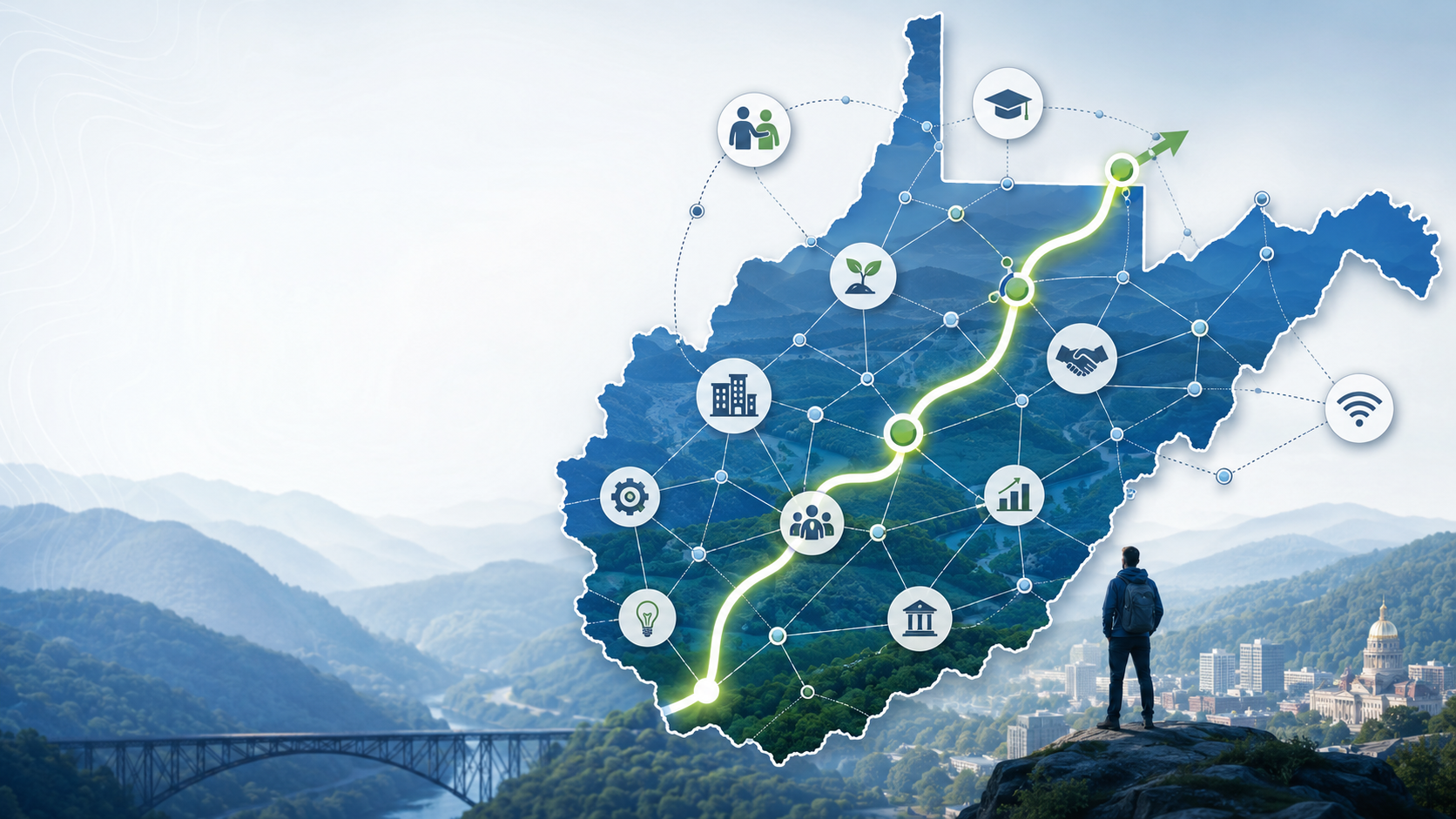
Bill Woodrum, Coordinator of the WV Entrepreneurship Network and project director for WV BusinessLink at the West Virginia Department of Economic Development, described a model that is not simply another entrepreneurship program. It is better understood as a navigator function inside a broader statewide ecosystem. WV BusinessLink does not try to replace the organizations already serving entrepreneurs. Its role is to help founders find the right door, understand the right next step, and connect with the right kind of help.
That distinction matters because many communities already have more entrepreneurship resources than founders realize. The issue is not always the absence of help. Just as often, the issue is that the help is scattered across different organizations, websites, programs, eligibility rules, intake forms, and acronyms. From the provider side, the ecosystem may make perfect sense. Each organization knows what it does and who it serves. From the founder’s side, however, the system can feel like a maze.
A first-time entrepreneur with only an idea does not need the same help as a main street business owner trying to improve marketing. A restaurant owner looking to expand does not need the same support as a technology founder preparing to raise capital. Yet too often they are all handed the same kind of resource list and expected to figure out the difference on their own.
A directory can be helpful, but a directory is not the same as a pathway. A list of resources gives information. A BusinessLink-style model gives direction.
That is the practical value of the navigator function. It helps translate a founder’s situation into a useful next step. It reduces wrong turns. It helps prevent entrepreneurs from being passed from one organization to another without clarity. It gives the ecosystem a more coherent front door, so that entrepreneurs do not have to understand every provider relationship before they can receive help.
For economic developers, this is an important shift in how entrepreneurship support is evaluated. It is not enough to ask whether the community has mentoring, training, capital access, technical assistance, and small business programs. Those questions matter, but they are incomplete. The better question is whether the system works from the entrepreneur’s point of view.
Can a founder find the first stop? Can that first stop understand the need? Can the system make a useful handoff? Does the entrepreneur know what to do next? Does the support path reduce confusion or add to it?
The BusinessLink model is valuable because it focuses on those questions. It treats entrepreneurship support not as a collection of separate offerings, but as a service path that founders should be able to move through without getting lost.
Woodrum’s connection to the WV Entrepreneurship Network is also important because a navigator function is only as strong as the network behind it. If support providers do not know one another, trust one another, or understand one another’s roles, referrals will be weak. A front door can point people somewhere, but the handoff still has to work.
That is where the network and the BusinessLink model reinforce each other. The network helps connect the ecosystem internally by building relationships among providers, clarifying roles, reducing duplication, and identifying gaps. BusinessLink makes that ecosystem more usable externally by helping entrepreneurs move through it. One without the other is weaker. A network without a founder pathway may be useful to professionals but still confusing to entrepreneurs. A navigator without strong partner relationships may promise connection but struggle to deliver it well.
The broader lesson for states and regions is that more support does not automatically mean better support. More providers can mean deeper expertise, broader reach, and more specialized help, but without coordination, more providers can also create more noise. Entrepreneurs may face more websites, more forms, more events, more program names, and more people offering assistance, while still being unsure where to begin.
That is especially true in a statewide ecosystem. A state may have strong organizations across many regions, but if those organizations are not connected through a clear referral logic, the founder still experiences the system as fragmented. The resources exist, but the pathway does not.
Before launching another entrepreneurship initiative, economic developers should ask whether entrepreneurs can already navigate what exists. If they cannot, the next investment may need to be a better front door rather than another room in the building.
A BusinessLink-style model should not be judged only by how many services it directly provides. That misses the point. Its real value is whether it improves access. Does it reduce founder confusion? Does it route entrepreneurs to the right provider faster? Does it improve handoffs between organizations? Does it reveal gaps in the ecosystem? Does it make the statewide support system feel connected instead of scattered?
When the model works, entrepreneurs spend less time decoding the system and more time getting useful help. Providers receive better-fit referrals. Economic developers gain a clearer view of where entrepreneurs are getting stuck and where the ecosystem needs attention.
That makes the BusinessLink model more than a convenience. It is infrastructure for the entrepreneurship ecosystem.
The lesson from West Virginia is straightforward: entrepreneurship support is not only about what resources exist. It is about whether founders can reach the right resource at the right time without getting lost.
For any community trying to strengthen entrepreneurship, the first move may not be to create another program. It may be to make the existing system easier to use.

Econ Dev Show Newsletter
Join the newsletter to receive the latest updates in your inbox.