Shop Local Is Not a Slogan. It Is a System.
What a consumer incentive model can teach economic developers about getting residents back into the local economy

 Dane Carlson
Most local business support starts with a very practical question: how do we help businesses survive?
That question matters. When a local economy is under stress, businesses may need grants, loans, technical assistance, emergency relief, or simply someone at city hall who can help them make sense of what is available. Those tools can keep doors open. They can help owners make payroll, pay rent, and get through a season when the normal rules of business suddenly stop applying.
But survival is not the whole problem.
A business can make it through the first shock and still not have enough customers on the other side.
That is the economic development lesson in Michael Mazur’s story. In his work with communities, including Akron, Ohio, Mazur helped cities think through how technology could do more than promote local businesses. It could actually help change local spending behavior. The goal was not simply to tell people to shop local. Every community already does that. The goal was to make shopping local easier to act on, easier to repeat, and easier to connect to a broader civic effort.
That may sound like a small distinction, but it is not.
Economic developers are used to building programs for businesses. They know how to think about capital, technical assistance, eligibility, reporting, and support. But when residents change their habits, when they stop visiting commercial districts, when they drift toward national platforms, or when they simply forget which businesses are open and worth visiting, the problem is no longer just business support.
It is customer activation.
That requires a different kind of tool.
During the pandemic, this became especially clear. Many cities were working hard to help local businesses stay alive. Grants and loans made sense. They were familiar and direct. A business applied, a city reviewed the application, funds were awarded, and the program could point to the number of businesses helped.
But local commerce does not recover through financial assistance alone. At some point, customers have to come back. They have to choose the local restaurant instead of the chain. They have to walk into the downtown shop instead of defaulting to an online cart. They have to remember that their spending decisions are part of the local economy, not just private convenience.
That is where a shop-local incentive model becomes more than a campaign.
Most communities already have the message. They post reminders. They run holiday promotions. They celebrate small businesses. They encourage residents to support the places that give the community its character.
All of that is good, but it often depends on goodwill alone.
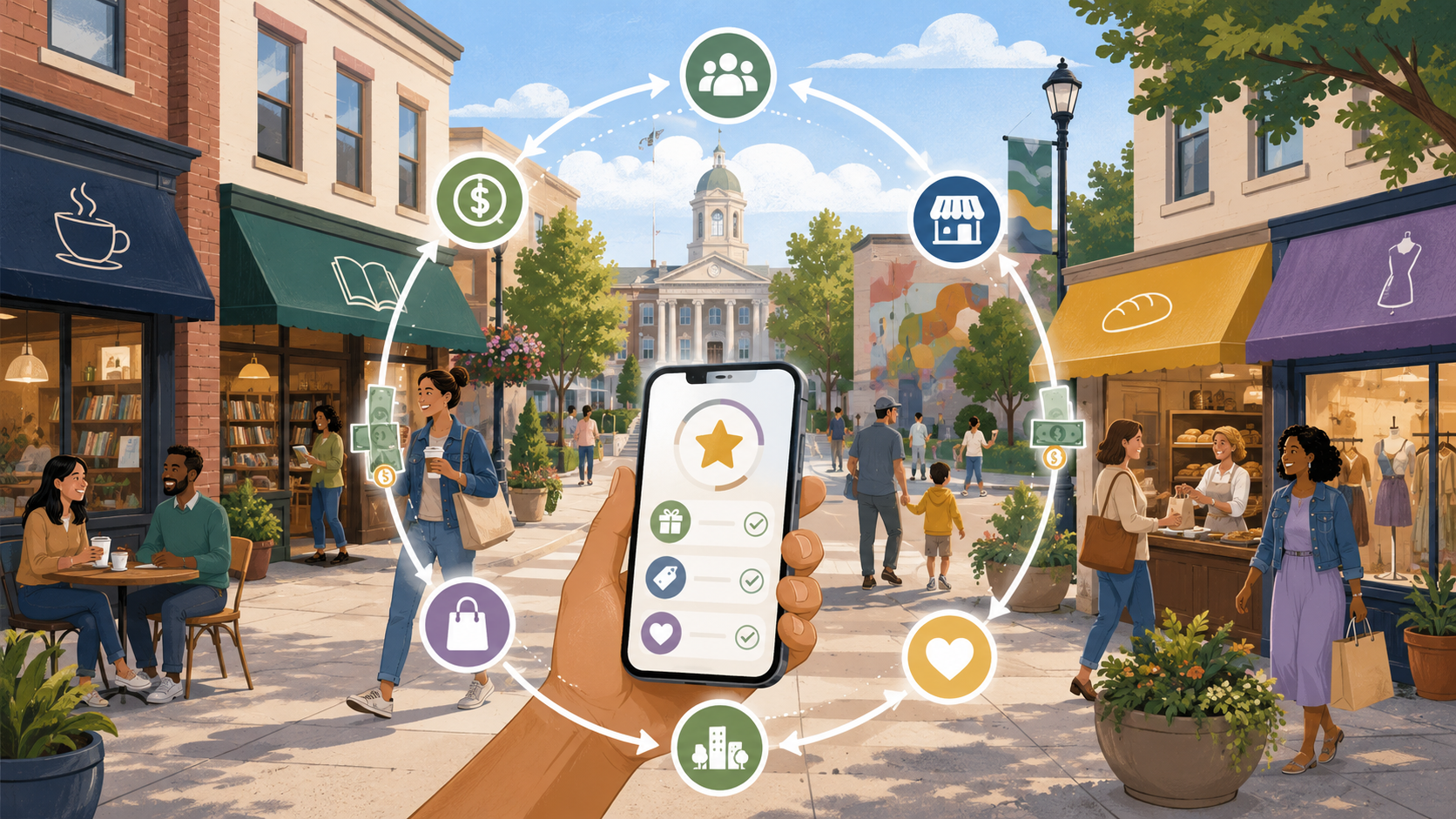
A local incentive platform adds structure. It gives residents a reason to participate and a clearer path for doing so. It creates a connection between the city’s message, the business community’s need, and the resident’s actual behavior. Instead of hoping that “support local” turns into action, the city creates a mechanism that helps action happen.
That is the important shift.
The city is no longer just communicating support for local businesses. It is organizing participation in the local economy.
Akron’s role in the story matters because of that mindset. According to Mazur, the city was willing to look outside the box. That phrase gets overused, but in this case it points to something specific. Akron understood that the familiar tools were useful, but not complete. Grants and loans could help businesses manage the immediate pressure. They could not, by themselves, rebuild customer habits.
That is the gap a consumer incentive model tries to fill.
It does not replace traditional business support. It works alongside it. Grants and loans help the operator. A shop-local incentive model works on the market around the operator. One helps with survival. The other helps with circulation.
For economic developers, that distinction is worth keeping. Too often, every small business challenge gets treated like a funding problem. Some are. But others are visibility problems, habit problems, participation problems, or demand problems. If customers have not returned, if residents no longer think first about local options, or if downtown activity has weakened, a city may need more than another round of direct assistance.
It may need a way to reconnect residents to the businesses around them.
That is why it is a mistake to treat shop-local technology as simply another marketing project. Yes, it has a public-facing side. There are messages to write, businesses to feature, and residents to reach. From the outside, it can look like promotion.
But the deeper value is not awareness. It is behavior.
A good shop-local incentive model helps people know where to go, what to do, and why they should do it again. It makes participation feel less abstract. It gives local businesses a shared platform instead of leaving each one to shout alone. It gives the city a practical way to move from “we support small businesses” to “here is how residents can participate right now.”
That is a more serious economic development function than a slogan.
It is design.
The best version of this model also helps communities diagnose the real problem more clearly. If a business is struggling because it lacks cash, then direct assistance may be the right answer. But if businesses are struggling because customers have changed their behavior, then the city has to think differently. The issue is not only whether businesses have enough support. It is whether the local market itself is active enough.
That is the question a consumer incentive model puts on the table.
Are residents engaged?
Are local options visible?
Is shopping local easy to do?
Is there a reason to participate now?
Is the city creating a repeated pattern of local spending, or only asking for it?
Those are economic development questions. They may not look like the traditional questions of site selection, incentives, workforce, or business retention, but they matter because local economies are built out of repeated behavior. Where people buy lunch matters. Where they shop on Saturday matters. Whether they think of local businesses first matters. Whether they feel connected to the businesses in their own city matters.
Small choices become local circulation.
That is what “shop local” is really trying to create.
The lesson from Michael Mazur is not that every community needs the same platform or the same program. The lesson is that local business support has to include the customer side of the system. Economic developers cannot assume that helping businesses survive automatically brings customers back. Sometimes it does. Often it does not.
If the goal is a stronger local economy, then communities need to think about both sides of the transaction.
They need tools that support businesses directly.
And they need tools that help residents act differently.
That is the real value of a shop-local incentive model. It turns support local from a message into a mechanism. It gives cities a way to move beyond encouragement and into participation. It helps residents see that their ordinary spending choices are part of the recovery and future of the community.
Grants and loans can help businesses stay alive.
But customer activation helps bring the local economy back to life.
Made possible by Sitehunt.

Econ Dev Show Newsletter
Join the newsletter to receive the latest updates in your inbox.