Small Communities Don’t Need Smaller Strategies. They Need a Different Rhythm.
How small communities can build momentum, set priorities, and create progress without borrowing a strategy built for somewhere else.

 Dane Carlson
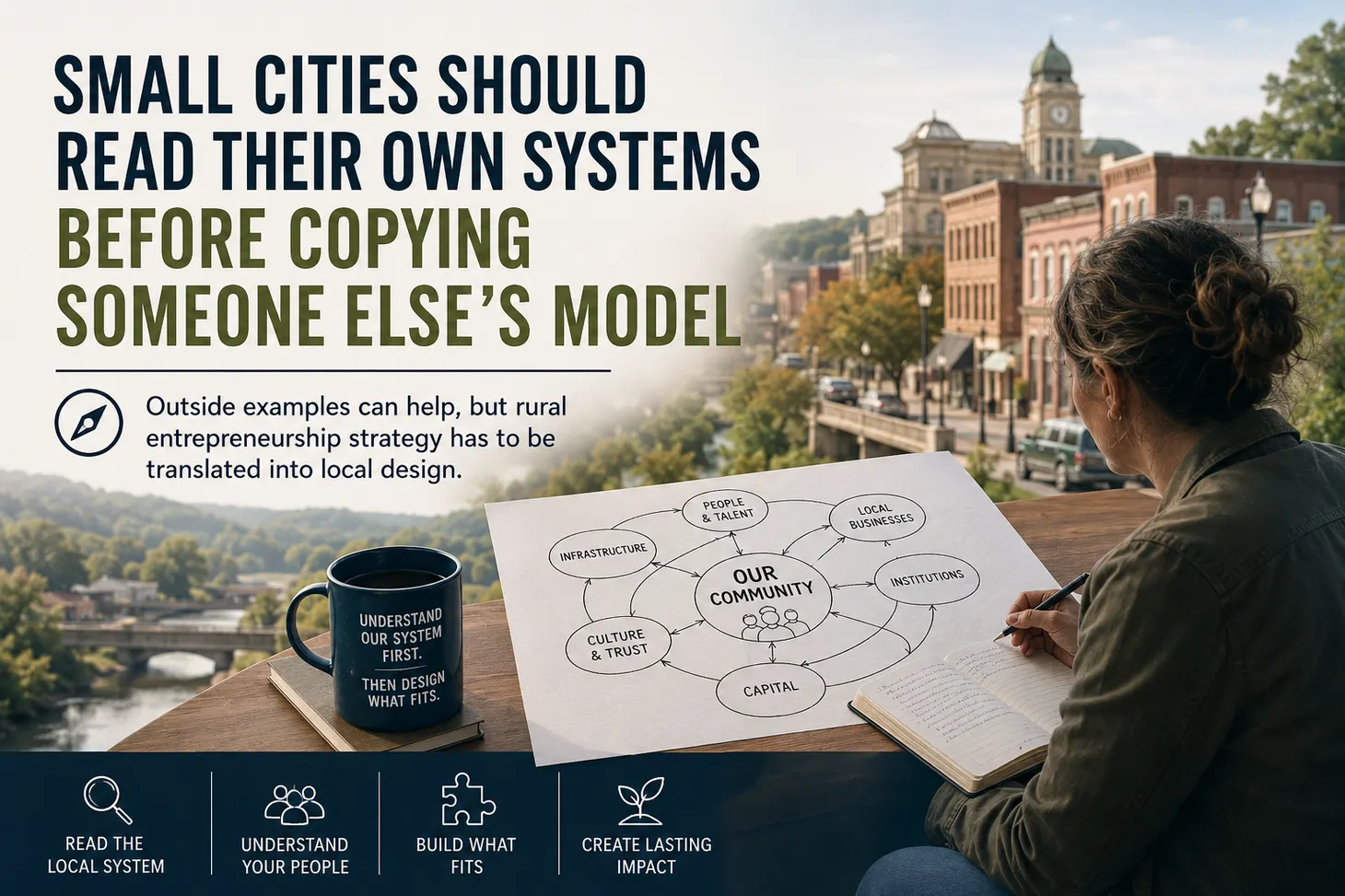
Small communities are often handed an economic development playbook built for somewhere else.
It is usually a playbook designed for places with more staff, more money, more institutional capacity, and more margin for error. The recommendations themselves are not necessarily wrong. Set goals. Market sites. Support employers. Recruit businesses. Improve downtown. Build partnerships. Chase growth. These are all familiar parts of the work, and in the right setting, they matter.
But for small communities, the problem is often not the list.
The problem is the rhythm.
That was one of the clearest ideas in Dane Carlson’s conversation with Jimi Copland, founder of The Rural Spark. Copland is not arguing that rural communities should be less ambitious, or that small-town economic development should settle for less. Her point is more useful than that. She is saying that small communities need an approach that fits the real conditions of the place.
A strategy that works in a larger region may not work in a smaller community simply because it has been scaled down. Small places are not just smaller versions of big places. They operate differently. Relationships are closer. Capacity is thinner. Leadership changes are felt more quickly. Apathy can become one of the hardest barriers to overcome. And when one person is carrying most of the work, a strategy that looks reasonable on paper can become impossible in practice.
That is why the order of the work matters so much.
Before a small community can carry a complicated strategy, it may need to build momentum. Before an economic developer can make meaningful progress, the board and council may need to agree on real priorities. Before the community can support a long-term plan, it may need to see visible evidence that something is actually happening.
This is not about lowering expectations. It is about understanding what makes progress possible.
In many small communities, people have seen plans come and go. They have attended meetings, served on committees, watched consultants present recommendations, and heard big ideas announced with enthusiasm. Then months pass. Leadership changes. Funding gets complicated. The urgent replaces the important. Eventually, the plan becomes one more document people vaguely remember.
That history matters because it shapes how people respond to the next effort. A new plan may be well written and strategically sound, but if the community does not believe it will lead to action, it starts with a credibility problem.
Copland’s emphasis on momentum is helpful because it begins there.
Momentum is not hype. It is not a slogan. It is the practical work of creating visible movement so people can begin to believe that more movement is possible. Sometimes that means starting with a smaller action than leaders might prefer. Sometimes it means choosing a project because it can be completed, not because it is the most impressive item on the list. Sometimes it means resisting the temptation to launch everything at once.
A modest win can do more than improve one corner of the community. It can change the emotional conditions around the work. It gives leaders something to point to. It gives residents a reason to pay attention. It gives the board confidence that the economic developer is not just planning but executing. And it gives the next project a better chance of succeeding.
That kind of momentum is especially important in places where the economic development system is thin.
In a large organization, some ambiguity can be absorbed. There may be departments, specialists, consultants, and enough staff capacity to keep several priorities moving at the same time. A small community usually does not have that luxury. One person may be responsible for business retention, site marketing, downtown issues, entrepreneurship, workforce conversations, grants, housing, investor relations, and whatever new concern comes up at the next meeting.
Without clear priorities, the work becomes reactive. Every complaint can become a strategy. Every board member can carry a different definition of success. Every council meeting can reset the agenda. The economic developer may be busy all the time and still struggle to show progress, because the target keeps moving.
This is why Copland’s point about setting priorities with boards and councils matters so much. Priorities are not just internal management tools. In small communities, they are protection for the work itself.
When priorities are clear, the economic developer has a way to explain what matters now and what comes later. The board has a framework for evaluating progress. Elected officials have a shared understanding of what they have asked staff to pursue. And the community has a better chance of seeing sustained effort instead of scattered activity.
That focus also makes it easier to practice another discipline Copland emphasizes: progress over perfection.
At first, progress over perfection can sound like a motivational phrase. In small-town economic development, it is more practical than that. It is a way to keep the work from being trapped by ideal conditions that may never arrive.
Many communities are waiting on something. More funding. Better data. More volunteers. A cleaner property inventory. A stronger website. A more complete plan. A less divided board. A perfect moment to begin.
Some of those things matter. But if every action has to wait until everything is ready, the community may never build the confidence it needs to take the next step.
Progress over perfection does not mean accepting sloppy work. It means recognizing that visible forward motion often creates the conditions for better work later. A community can learn by doing. Leaders can improve the process as they go. Early efforts can reveal who is serious, where the real barriers are, and what kind of support is needed next.
In small communities, progress is not just the result of strategy. Sometimes it is the thing that makes strategy possible.
That same mindset applies to entrepreneurship and startup ecosystems.
Small communities are often comfortable talking about business retention, recruitment, and downtown development, but the language of startup ecosystems can feel like it belongs somewhere else. It can sound too urban, too tech-focused, or too formal for a place where entrepreneurship may look more like a side business, a local service company, a maker, a food producer, a contractor, or someone quietly testing an idea after work.
But the concept matters deeply.
A startup ecosystem is simply the environment around people who are trying to build something. Do they know where to go for help? Can they find encouragement? Are there connections to customers, mentors, capital, space, and peers? Does the community notice emerging businesses early, or only pay attention once they are already established?
Small communities often have more entrepreneurial energy than they realize. It may be informal, hidden, or disconnected. The work of ecosystem building is not to import someone else’s model. It is to make local initiative easier to find, support, and grow.
That matters because outside investment cannot be the whole strategy. Recruitment will always have a place, but a community that only waits for the next external project is leaving too much potential unused. Local entrepreneurs are already tied to the place. They already understand the market. They already have a reason to stay. Helping them grow is not a lesser form of economic development. It is one of the most practical ways a small community can build resilience.
The key is to make the approach scalable.
That word is often misunderstood. In small communities, scalable does not mean taking a big-city program and making it cheaper. It means designing the work so it can actually function with the people, politics, relationships, and capacity available.
A strategy that assumes specialized staff, deep budgets, or professional distance may collapse in a town where one person manages the program and everyone knows each other. A tactic that looks efficient in a metro area may create too much administrative burden in a rural county. A committee structure that works in a large organization may become dead weight in a small one.
Right-sized strategy is not less serious. It is more honest.
It asks what the community can sustain, what the staff can execute, what leaders will actually support, and what kind of progress will build confidence rather than exhaustion.
That may be the larger lesson from Copland’s work. Small communities should stop judging themselves by whether they can imitate larger economic development models. The better question is whether they are building a rhythm that fits their own conditions.
Are they creating enough momentum for people to believe in the work?
Are they setting priorities clearly enough to protect the economic developer from constant redirection?
Are they willing to make progress before everything is perfect?
Are they paying attention to the entrepreneurs and startups already present in the community?
Are they designing strategies that can scale to the place, rather than borrowing strategies designed for somewhere else?
Those questions are not less ambitious. They are more grounded.
Small communities do not need economic development with smaller dreams. They need economic development with better sequencing. They need leadership that understands when to simplify, when to focus, when to move, and when to turn early progress into deeper capacity.
That is what makes The Rural Spark useful. It gives small communities language for something many practitioners already know by experience: the work changes when the place changes.
And when a community understands that, it can stop apologizing for not operating like a larger region.
It can build its own rhythm.
It can create momentum in a way that fits.
And over time, that rhythm can become the strategy.
Econ Dev Show Newsletter
Join the newsletter to receive the latest updates in your inbox.