What a Pre-Positioned Industrial Park Actually Does for Economic Development
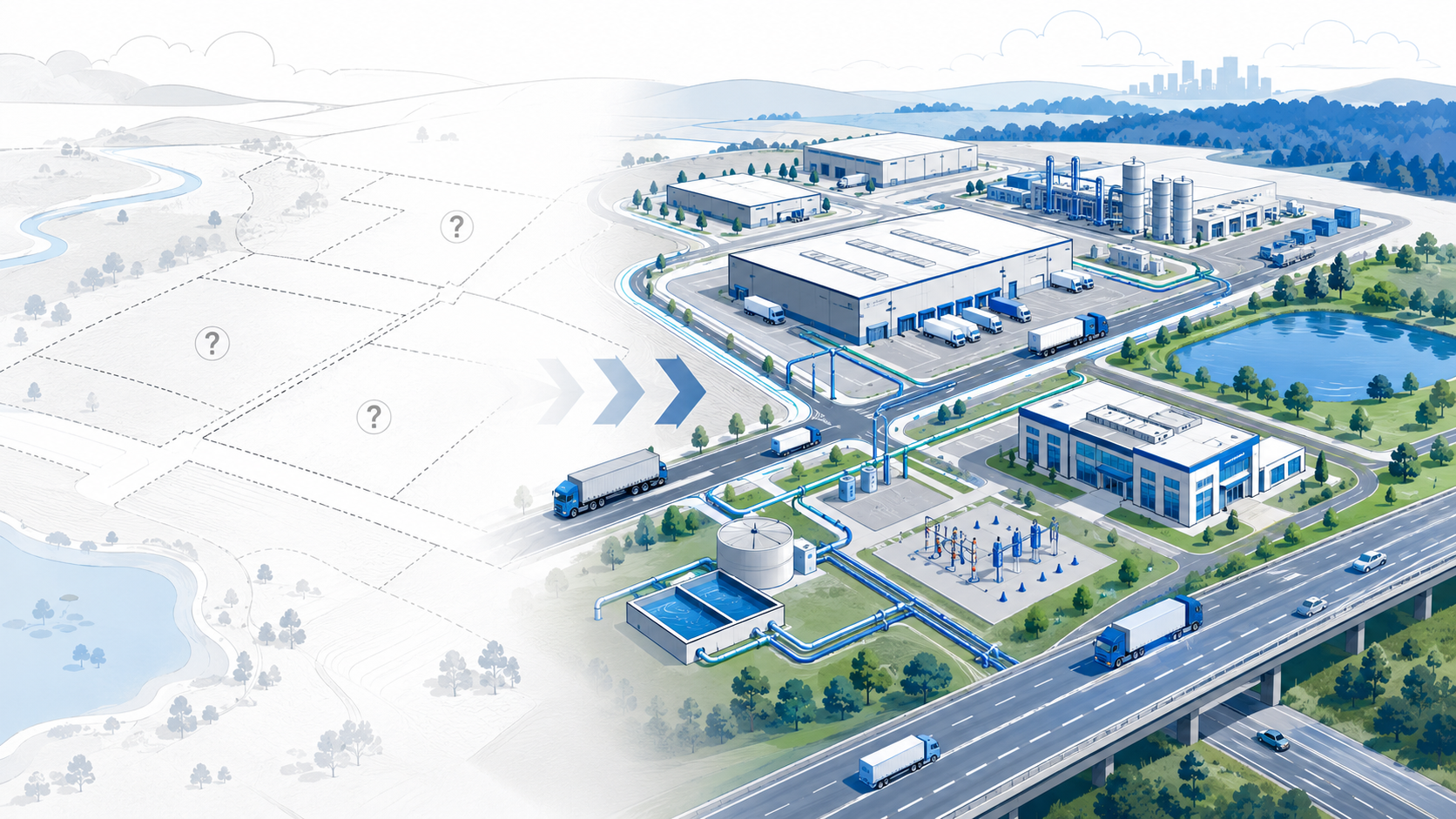
A community can have industrial land and still not have an industrial product.

That distinction matters more than it sounds.
Industrial land is a parcel with potential. It may be in the right general area. It may sit near a highway. It may look promising on a map. It may even be included in a recruitment brochure. But potential is not the same as readiness.
A pre-positioned industrial park is different. It is land that has been moved closer to actual use. The zoning, access, infrastructure, workforce support, and local coordination are far enough along that a company or site selector can begin evaluating fit instead of first trying to determine whether the site can become viable at all.
That is the useful lesson inside Kristen Gamboa’s discussion of Los Lunas, New Mexico.
Gamboa describes three industrial parks on the western side of Los Lunas in Valencia County. They sit near New Mexico Highway 6, which connects to I-40 and gives certain traffic a way to avoid the heavier Albuquerque metro. The parks were already zoned for industrial use. A new University of New Mexico workforce training center was opening. Water and sewer infrastructure was finally reaching the western tip of the parks.
In her telling, the advantage was not one giant breakthrough. It was the accumulation of many small details finally coming together.
That is what makes the example useful beyond Los Lunas. This is not just a story about having industrial parks. It is a site readiness concept: an industrial park readiness model built around reducing uncertainty before a prospect arrives.
The Gap Between Land and Readiness
Economic development often gets stuck in the gap between “we have land” and “we have a site that can support a serious project conversation.”
A community may own acreage. It may have private landowners interested in development. It may have a map, a target industry list, and enough highway proximity to feel competitive. But when a prospect begins asking practical questions, the difference becomes clear quickly.
Is the land already zoned for industrial use? Can water and sewer reach the site? How does freight move in and out? Is the workforce story credible? Who coordinates the response? What public investments are already complete, and what still has to happen?
If those answers are vague, the site is not yet a strong product. It is a possibility with too many unknowns attached.
A pre-positioned industrial park helps solve that problem by moving the community from possibility toward decision-readiness. It does not guarantee a project. It does not remove every risk. It does not mean the site is perfect for every company. What it does is improve the quality of the conversation.
Instead of spending the first stage proving that the land can become usable, the community can focus on whether the opportunity fits the project. That shift saves time, builds credibility, and gives economic developers something more concrete to market.
What Makes the Park Pre-Positioned
A pre-positioned industrial park is not defined by one asset. It is defined by a stack of conditions that work together.
The first condition is land use certainty. In Los Lunas, the parks were already zoned for industrial use. That matters because zoning uncertainty can slow a project before it has even started. When industrial use is already aligned with local policy, the conversation begins from a stronger place.
The second condition is logistics value. The parks’ location near Highway 6 matters because Highway 6 links to I-40 and creates an alternative route around the Albuquerque metro. Gamboa’s point is practical: traffic coming from California or Arizona, or moving south and then west, can avoid some of the congestion and complexity of the metro area. That is not a slogan. It is an operating advantage.
The third condition is enabling infrastructure. Water and sewer reaching the western tip of the parks is exactly the kind of detail that changes the meaning of the land. Without utilities, industrial acreage remains speculative. With utilities moving into place, the site becomes easier to evaluate, phase, and explain.
The fourth condition is workforce support. The University of New Mexico workforce training center adds another layer to the readiness story. Industrial development is not only about land and infrastructure. A company also wants to understand whether workers can be trained, whether partners are nearby, and whether the community can support the people side of growth.
The fifth condition is the connector role. Gamboa makes clear that many of the assets were already there, but no one had been fully connecting the pieces and getting the word out. That is a critical part of the model. A strong industrial park can remain underused if nobody translates its zoning, infrastructure, access, and workforce story into a coherent proposition for site selectors, companies, local leaders, and residents.
Pre-positioning is not just physical preparation. It is also organizational preparation.
The Job the Concept Performs
A pre-positioned industrial park performs several jobs at once.
It lowers friction in the early stages of a project because a prospect does not have to begin with a long list of unanswered basics. The community can speak more confidently about what is ready, what is underway, and what still needs to be completed.
It also strengthens credibility. Site selectors hear a lot of communities claim they are ready for growth. The claim becomes more believable when the community can point to zoned land, utility progress, logistics advantages, workforce infrastructure, and clear coordination.
The concept can also make public investment easier to understand. Infrastructure spending can sound abstract when it is disconnected from a specific growth strategy. But when water, sewer, roads, or workforce assets are tied to an industrial park readiness model, the investment has a visible purpose.
It helps local leaders sequence decisions, too. If the park is already zoned but utilities lag, the next priority is clearer. If infrastructure is moving but the workforce story is weak, that becomes the next piece to strengthen. If the assets exist but site selectors do not understand the story, the problem may be communication and coordination rather than land.
That is the practical value of the concept. It gives economic developers a way to diagnose readiness instead of simply hoping exposure will create opportunity.
Why the Workforce Story Matters
One of the strongest parts of the Los Lunas example is that Gamboa does not frame industrial readiness only as a business attraction issue. She also connects it to brain drain in New Mexico and to local awareness.
That matters because economic development is not only about bringing in companies. It is also about helping local people see a future where they already live.
Residents in Valencia County may not realize that high-paying jobs from international companies are already nearby. Students may not see a clear path from training to employment. Parents may assume their children have to leave to find better opportunities. Local businesses may not understand how industrial growth could create new demand for their services.
A pre-positioned industrial park can support that work because it gives the workforce conversation a physical anchor. When students, parents, teachers, and job seekers can see where industrial growth is happening, the opportunity becomes more concrete.
The University of New Mexico workforce training center strengthens that connection because it links the physical site to the skills pipeline. The park creates demand. The training center helps build capacity. The economic developer connects the two.
That is an important lesson for practitioners. Site readiness and workforce readiness should not be treated as separate stories. For many industrial projects, they are part of the same proposition.
The Weaker Alternative Is Marketing Bare Land
The weaker alternative is to market bare land as if it were already a competitive industrial product.
That happens often. A community has acreage. The land is near a major route. The brochure looks clean. The pitch sounds confident. But when a serious prospect starts asking detailed questions, the weaknesses show up.
Utilities are not there yet. Zoning is not settled. The workforce pipeline is unclear. The infrastructure plan depends on future decisions. The local response is split across multiple people who are not fully aligned.
The issue is not that the land has no potential. The issue is that potential is being marketed as readiness.
That can damage credibility. Site selectors do not just evaluate the land. They evaluate how prepared the community is to answer practical questions. A community that overstates readiness may get attention once, but it may not get trust twice.
The pre-positioned industrial park model is stronger because it starts with reducing uncertainty before increasing promotion.
The Failure Mode Is Declaring Victory Too Early
There is also a common misuse of the concept.
Some communities assume that once land is labeled an industrial park, the readiness work is mostly done. It is not. A park can exist on paper and still lack the conditions that make it decision-relevant. It may need utilities, road improvements, better internal coordination, workforce partnerships, clearer ownership structures, or a sharper story for site selectors.
That is why Gamboa’s emphasis on the little pieces matters. Readiness is built through details. It is not achieved by naming the park, drawing boundaries, or putting it on a map.
The model only works when leadership keeps asking what is still missing.
How to Tell Whether It Is Working
An industrial park readiness model is working when the park starts functioning like a real product instead of a speculative hope.
The community can answer basic questions faster. The logistics story is easy to explain. Utility progress is clear. Zoning does not create unnecessary uncertainty. Workforce partners understand how their work connects to the park. Local leaders can see which investments matter next. Site selectors can quickly understand why the location deserves attention.
Most importantly, the park gives the EDO a stronger operating narrative. The message is no longer just, “We have land.” It becomes, “We have zoned industrial land with improving utilities, useful access, workforce support, and a coordinated plan to make this area ready for growth.”
That is a much stronger position.
The Practical Takeaway
The lesson from Kristen Gamboa’s Los Lunas example is not simply that Valencia County has three industrial parks.
The larger lesson is that industrial land becomes more powerful when it is pre-positioned. Zoning, logistics, enabling infrastructure, workforce training, and the connector role all work together to turn land into something a company can realistically evaluate.
For economic developers, that changes the question.
Do not ask only whether the community has industrial acreage. Ask whether the park has been prepared well enough to reduce uncertainty, support a serious conversation, and show both outside prospects and local residents where opportunity can happen.
When the answer is no, the next move is not louder marketing. It is finishing the stack.
That is what a pre-positioned industrial park actually does for economic development. It makes the opportunity more usable before the prospect ever arrives.
Brought to you by Sitehunt.

Econ Dev Show Newsletter
Join the newsletter to receive the latest updates in your inbox.