Workforce Access Is Not the Same Thing as Workforce Availability
A case study on transit, labor sheds, and the hidden friction inside workforce claims.

 Dane Carlson
Economic developers are fluent in labor shed math.
They know how to draw the radius. Count the people. Pull occupation data, commuting patterns, wage comparisons, educational attainment, and drive-time maps into a clean workforce narrative.
The result often looks persuasive.
There are 250,000 people within 30 minutes. There are 1.2 million people within 60 minutes. There are thousands of workers in relevant occupations. There are nearby neighborhoods, training providers, community colleges, and workforce partners.
On paper, the workforce is there.
But Joya Stetson’s conversation on the Econ Dev Show points to a harder question:
Can that workforce actually reach the job?
That question changes everything.
Workforce availability is not the same as workforce access.
A region can have workers and still fail the workforce test. It can have the population, the skills, and the density, yet still offer an employer a labor market that is smaller, weaker, and riskier than the proposal suggests.
The problem is not always the workers.
The problem is the connection.
The Labor Shed Is Not the Labor Market
A labor shed map is a useful starting point. It tells an employer who lives within a certain geography. It helps a community explain regional scale. It gives the prospect a sense of population, reach, and potential.
But a labor shed is not the same thing as an accessible labor market.
The difference is operational.
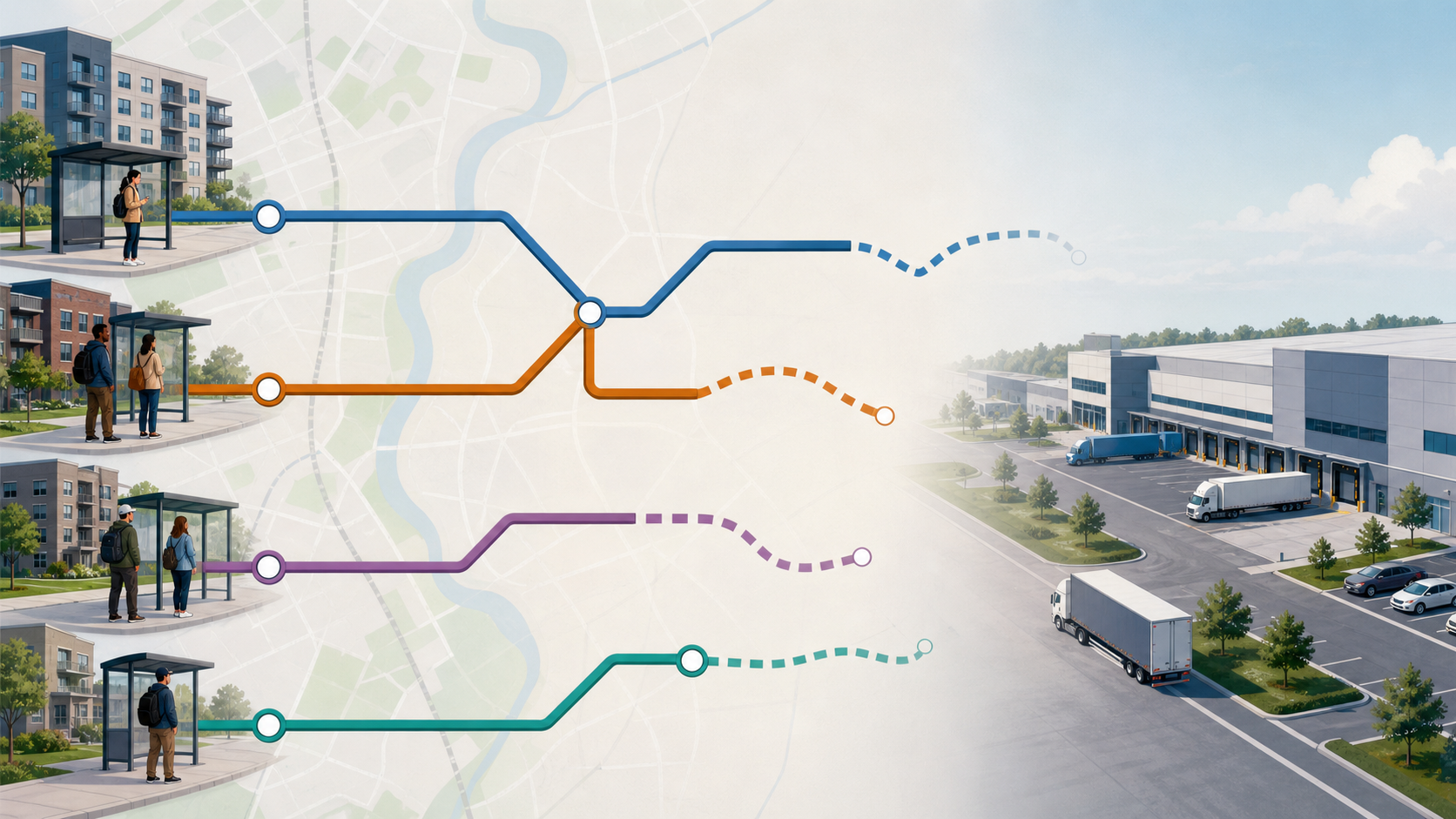
A worker may live inside the mapped region and still be functionally disconnected from the job. The transit route may exist, but not serve the shift. The stop may be nearby, but not close enough. The commute may work in theory, but require multiple transfers, long waits, unsafe walking conditions, or a final mile that turns a possible job into an impossible one.
That worker counts on the map.
That worker may not count in real life.
This is the quiet weakness inside many workforce narratives. They describe where people are. They do not always prove whether the trip works.
For employers, that distinction is not academic. It affects recruiting, attendance, retention, shift coverage, overtime costs, turnover, supervisor time, and production reliability.
A transportation problem becomes a workforce problem.
A workforce problem becomes an operations problem.
An operations problem becomes a site-selection risk.
The map can be technically accurate and still be strategically misleading.
Workforce Is a System, Not a Statistic
Economic development has become very good at describing workforce as a number.
Population. Occupation counts. Wage rates. Commuter inflow. Certifications. Graduation pipelines.
Those numbers matter.
But employers experience workforce as a system.
They experience it when applicants do or do not show up. When new hires miss work because the bus connection failed. When a second-shift worker can get to the facility but cannot get home. When the only available route adds ninety minutes to a trip that takes twenty minutes by car. When a worker’s access to employment depends on a family member’s vehicle, an unreliable ride, or an expensive rideshare.
In that world, the question is not simply, “How many workers are nearby?”
The better question is:
How many workers can reliably participate in this labor market?
That is a much more demanding question.
It forces the community to test the assumptions behind its own pitch. It asks whether the people counted in the labor shed are actually reachable. It asks whether an industrial park, office campus, logistics site, hospital district, or commercial corridor is connected to the neighborhoods where the likely workers live.
It also asks whether the system works at 6 a.m., 3 p.m., 11 p.m., and on weekends.
Many workforce claims are built around daytime office assumptions.
Many employers do not operate on daytime office schedules.
That gap matters.
Transit Is Economic Infrastructure
Transit is often treated as a public service issue, separate from business attraction and economic development.
That separation is convenient.
It is also wrong.
If transportation determines whether workers can reach employment, then transportation is part of the business environment.
It belongs in the same broad category as roads, utilities, broadband, childcare, housing, training, and permitting. It may not matter equally for every project, but when it matters, it matters directly.
Especially in suburban and exurban markets.
Many suburban employment centers were built for cars. Industrial parks, logistics facilities, business campuses, and medical corridors often sit outside the strongest transit networks. They may be close to workers by distance but far from them by actual trip design.
A five-mile commute can become a two-transfer problem.
A nearby neighborhood can become unreachable.
A job center can be visible from the road and still inaccessible to a worker without a car.
This is why first-mile and last-mile issues are not side issues.
They are the place where the labor shed becomes real or breaks down.
A route that gets workers within two miles of a site is not the same as a route that gets workers safely to the front door. A bus that runs during business hours does not solve a production shift. A transit map that includes the corridor does not prove access for the specific employer, at the specific site, on the specific schedule.
Economic developers do not need to run the transit agency.
But they do need to understand the access story well enough to know when the workforce claim is strong, when it is fragile, and when it is mostly wishful thinking.
Public-Private Partnerships Should Solve Specific Friction
Economic development loves the phrase “public-private partnership.”
Sometimes it means something real.
Sometimes it means everyone sat in a room and agreed the issue was important.
Workforce access is a place where the phrase needs to become practical.
Employers can identify the real friction points: shift times, attendance patterns, recruitment zones, turnover data, parking constraints, worker surveys, and the job classifications most affected by transportation barriers.
Transit providers can identify service constraints: route design, vehicle availability, funding limits, ridership patterns, service hours, and the tradeoffs involved in changing coverage.
Local governments can address infrastructure: sidewalks, lighting, bus stops, crossings, road design, zoning, and land use.
Workforce boards and training providers can connect transportation barriers to actual job placement and retention outcomes.
Economic developers can convene the group around the project risk.
That is their role.
Not to own every solution.
To make sure the people who own pieces of the solution are solving the same problem.
Without that coordination, everyone sees a different piece of the elephant. The employer sees attendance problems. The transit agency sees a low-ridership route. The workforce board sees placement challenges. The city sees infrastructure requests. The economic developer sees a project at risk.
The opportunity is to connect those signals earlier.
Development Friction Starts Before the Building Permit
Communities usually define development friction around the site itself.
Is the land controlled? Is zoning in place? Are utilities available? Are wetlands mapped? Is the road adequate? How long will permitting take? Can the community support incentives? Is the building expandable? Are there environmental risks?
Those questions are necessary.
They are not sufficient.
Workforce access can create development friction long before an employer reaches full operation.
In fact, it may create the kind of friction that is hardest to see during recruitment and hardest to fix after the project is announced.
A weak access story may not kill a project in the first round. It may simply add doubt.
Will we really be able to hire enough people here?
Will entry-level workers stay?
Will absenteeism become a problem?
Will our second and third shifts be harder to staff?
Will we need to spend more on shuttles, wages, overtime, or retention programs?
Will a competing site give us fewer operational headaches?
That doubt matters.
Site selection is not just a hunt for upside. It is a process of eliminating risk.
Communities lose projects when they create uncertainty the employer does not have to accept. A site with a clearer workforce access story can feel safer, even if its raw labor shed numbers are smaller.
This is why access should be studied before the site visit, not after the employer starts asking uncomfortable questions.
The strongest communities will not wait to be challenged.
They will already know the answer.
Here is where workers live. Here is how they reach this site. Here is where the system works. Here is where it breaks. Here is what we are doing with employers, transit providers, local governments, and workforce partners to close the gaps.
That kind of answer builds confidence.
RFP Workforce Narratives Need to Grow Up
Many RFP responses still treat workforce as a broad marketing category.
They offer big numbers. They list nearby institutions. They mention training partners. They describe the regional labor force. They include a few charts and maps.
They sound confident.
But they often stop before the employer’s real question:
Can we operate here?
A stronger workforce narrative needs to move from description to proof.
That means explaining not only who is in the region, but who is realistically connected to the site. It means showing how the commute works for the workers the employer is most likely to hire. It means asking whether transit routes match shift schedules. It means identifying missed connections, long transfer times, last-mile gaps, sidewalk problems, safety concerns, and service-hour mismatches.
It also means being honest about what is not solved yet.
That can feel risky. Communities are trained to sell. They worry that acknowledging gaps will weaken the pitch.
But vague confidence is weaker than specific credibility.
An employer would rather hear, “Here is the gap, and here is the partnership already working on it,” than discover later that the community never understood the problem.
Precision builds trust.
Hand-waving creates risk.
A mature RFP workforce narrative should answer questions like these:
Which neighborhoods and communities are realistically connected to this employment center?
What share of the relevant workforce depends on personal vehicles, shared vehicles, transit, rideshare, vanpooling, or employer-supported transportation?
Do current routes serve the site, or merely pass near it?
Do schedules align with the employer’s operating model?
What happens at shift changes?
What happens on weekends?
Where are the missed connections?
What first-mile and last-mile barriers reduce the effective labor shed?
Are there existing public-private partnerships that can improve access?
Could microtransit, vanpools, shuttles, route adjustments, shared parking, sidewalk investments, or employer coordination solve the most important gaps?
Those details separate a generic workforce pitch from an operationally useful one.
Sustainability Has to Survive the Commute
There is also a broader competitiveness issue here.
Communities increasingly talk about sustainability, resilience, transportation choice, emissions, housing, and land-use efficiency. Employers do too. For some companies, these topics connect to corporate goals. For others, they connect to workforce stability, cost, and long-term operating conditions.
Transit can strengthen that story.
But only if it works in daily life.
A community cannot credibly call itself sustainable if reaching work requires heroic effort from the workers least able to absorb it.
It cannot describe mobility as an asset if the relevant routes do not match actual job schedules. It cannot claim access as a strength if last-mile conditions leave workers stranded just short of opportunity.
This is not an argument that every site must be transit-served in the same way.
It is an argument for honesty and specificity.
Some sites are car-dependent. Some are transit-viable. Some could become accessible with targeted intervention. Some should not be marketed as workforce-accessible without major changes.
The point is to know the difference.
Sustainability language that does not match real commuting conditions becomes another form of overstatement. It may sound good in a proposal, but it will not help a worker get to a shift or an employer fill a production line.
The Case Study Lesson
The case study lesson from Joya Stetson’s conversation is straightforward:
The workforce map is not enough.
Economic developers need to test the connection between workers and jobs with the same seriousness they bring to utilities, zoning, incentives, and site readiness.
That means asking better questions earlier.
Are we counting workers, or measuring reachable workers?
Does our labor shed reflect actual commute behavior?
Do shift schedules match the transportation system?
Where do missed connections shrink the real workforce?
Are first-mile and last-mile gaps weakening our strongest sites?
Can workers reach the site safely, affordably, and reliably?
Have employers and transit providers compared real operating needs against real service patterns?
Are our RFP responses giving employers useful access intelligence, or just attractive workforce language?
The communities that answer those questions well will have a better workforce story.
Not necessarily a bigger story.
A better one.
More precise.
More credible.
More useful.
And more likely to survive the employer’s due diligence.
The Bottom Line
Workforce availability tells an employer who might be in the market.
Workforce access tells the employer who can actually participate in it.
That is the distinction economic developers need to take seriously.
A community can have the people and still lose the project. It can have the skills and still create operational risk. It can have population density and still fail the workforce test.
The labor advantage becomes real only when the connection works.
If workers cannot reliably reach the jobs, the labor shed is overstating the market.
And if the labor shed is overstating the market, the community is overstating its advantage.
Before you tell a prospect a site is ready, make sure the site data is ready.
Sitehunt helps economic developers turn scattered property information into clear, RFI-ready site intelligence, including infrastructure, utilities, transportation access, environmental constraints, zoning, ownership, and labor shed context.
It is not enough to know that a property exists. You need to know how strong it is, where the gaps are, and whether it can survive the next round of questions.
Sitehunt helps you see the site the way a prospect will see it.
Use Sitehunt to review your properties, strengthen your site narratives, and respond to RFIs with better answers in less time.

Econ Dev Show Newsletter
Join the newsletter to receive the latest updates in your inbox.