18 Things Economic Developers Need to Know This Week
The stories Dane thinks you need to see. June 25, 2026 edition.


Welcome to this week's issue of What Economic Developers Need to Know This Week, where we collect links, articles, charts, and ideas about the economy and place.
This week we have 18 tools, stories, graphics, charts, and videos that I think you'll find informative, useful, inspiring, and perhaps even humorous. Some are economic development related directly, and some only indirectly. 🤔
If you're wondering what to do with the info in this newsletter, send something to your board members. It will make you look good!
Today's email is brought to you by Resource Development Group
Resource Development Group and Convergent Nonprofit Solutions have recently announced a merger of these two well respected firms. RDG is now operating as Resource Development Group, a Convergent Company and will lead the combined operations in economic development and chamber engagements. Meanwhile, the Convergent banner will take the forefront on efforts on supporting traditional philanthropic and higher education organizations
This merger maintains RDG's innovative and custom approach while also creating the deepest bench of economic development and chamber fundraising expertise in the industry, the most complete data set in the country regarding economic development and chamber funding, and the greatest flexibility to be able to support engagement models tailored specifically to every market, regardless of size.
Whether you’re a single county EDO ready to kick off your first fundraising campaign or a large regional organization on your third funding cycle, they have the team and experience to get you the results you’re looking for.
1) Economic development and developers in the news #249: 52 economic development executives and organizations in 28 states.

2) Podcast 224: building trust before building buildings: The non-glamorous work is often the work that makes the ribbon cutting possible. Janae Stark talks about Washington's Community Economic Revitalization Board, the "right project, right time" approach, rural infrastructure, tribal communities, broadband, construction timelines, and why trust matters before a project gets into trouble. Listen: Building Trust Before Building Buildings with Janae Stark.

3) 16 new economic development jobs this week: This week's list spans 16 states, with salaries from $51,971 to $190,000 and openings in economic development, planning, housing, MEP work, utilities, AWS, chambers, and local government. Browse: 16 New Economic Development Jobs This Week.

4) 17 things economic developers needed to know last week: 17 Things Economic Developers Need to Know This Week.
Sitehunt) Economic development is human work.
It’s the phone call after the meeting. The trust built over coffee. The story you tell about your community. The quiet confidence that comes from knowing your sites, your people, and your opportunities.
That’s the work only you can do.
It gathers the property data, checks sites against RFIs, builds clear responses, and helps you move faster without losing the human part of the job.
Do the human things.
Let Sitehunt do the rest.
5) The gross reason suburban yards are this size: Infrastructure rules can quietly become urban form.
6) The word "entrepreneur" is a liability for economic developers: Paul O'Brien argues that Louisiana's Nexus Louisiana is doing something unusually clear by separating high-growth startups and founders from the much broader world of small business and "entrepreneurship." Read: Louisiana Just Did Something No Other State Has Had the Guts to Do.
7) Economic development done right makes room for joy: Outcomes are not only jobs, dollars, and ribbon cuttings. Janae Stark makes the case for judging projects by whether they make daily life better for families: more stability, more local options, more places to gather, and more reasons to feel connected.
8) What rural communities do not know they have: Agricultural assets can be industrial assets if someone inventories them that way. Jim Gibson argues that grain elevators, cold storage, processing buildings, rail spurs, water rights, practical equipment skills, logistics relationships, rural lenders, and unused energy capacity may already give agricultural communities a stronger industrial base than they realize. The first job is not marketing. It is knowing what is actually there.
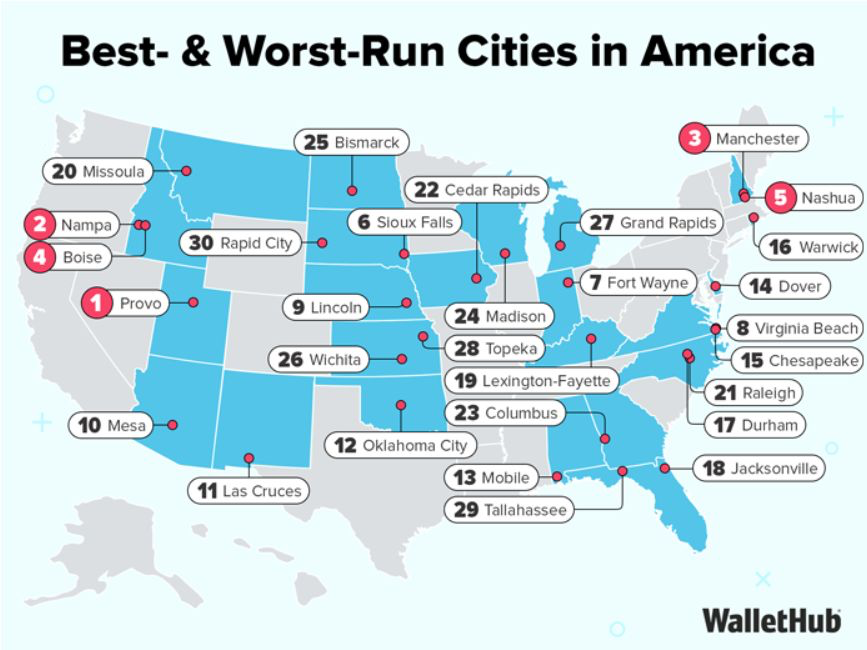
9) Best and worst-run cities in America: Governance capacity is part of the business climate. The WalletHub map puts Provo, Nampa, Manchester, Boise, and Nashua at the top of the ranking.
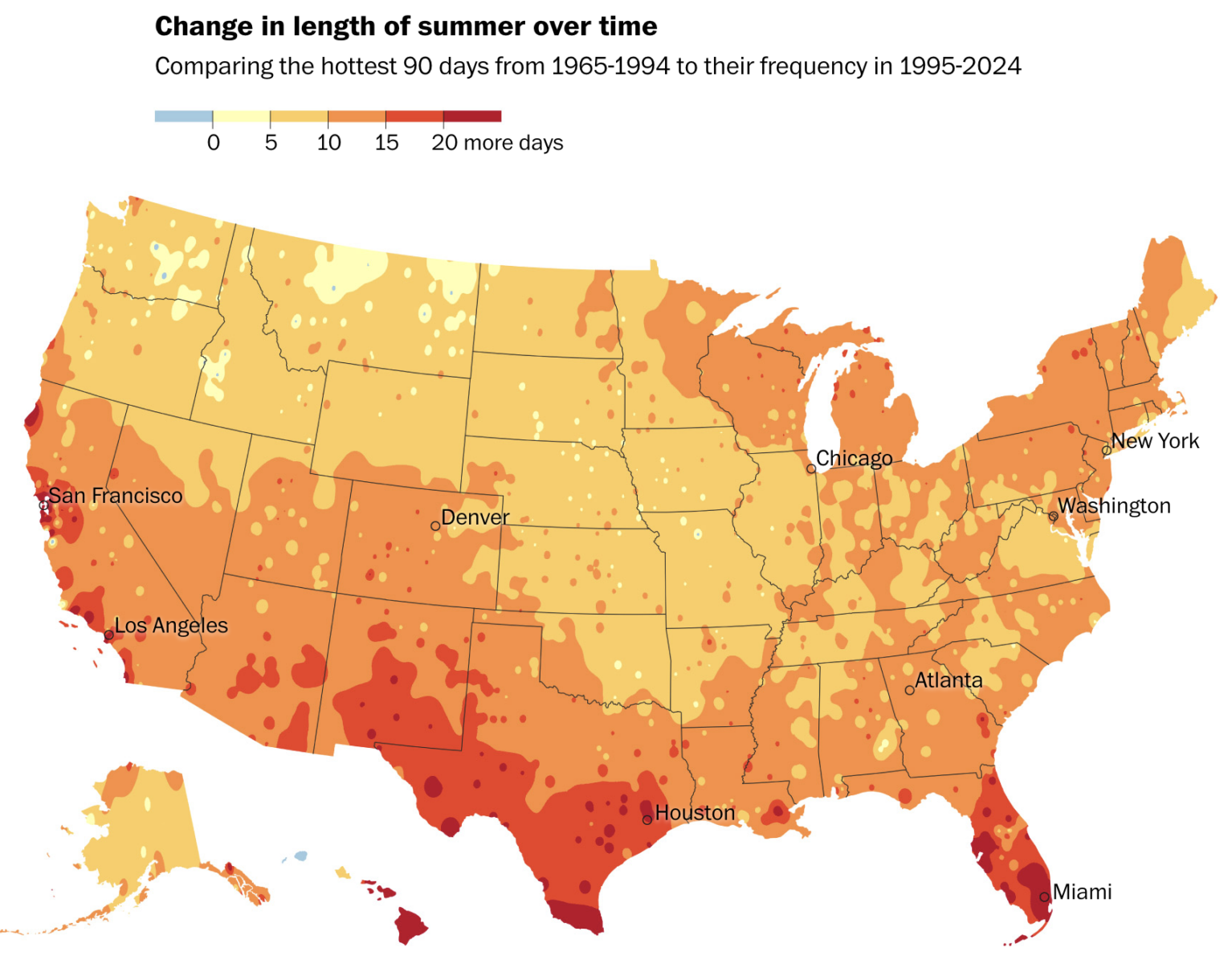
10) Welcome to summer! This Climate Central map compares the hottest 90 days from 1965 to 1994 with their frequency from 1995 to 2024.
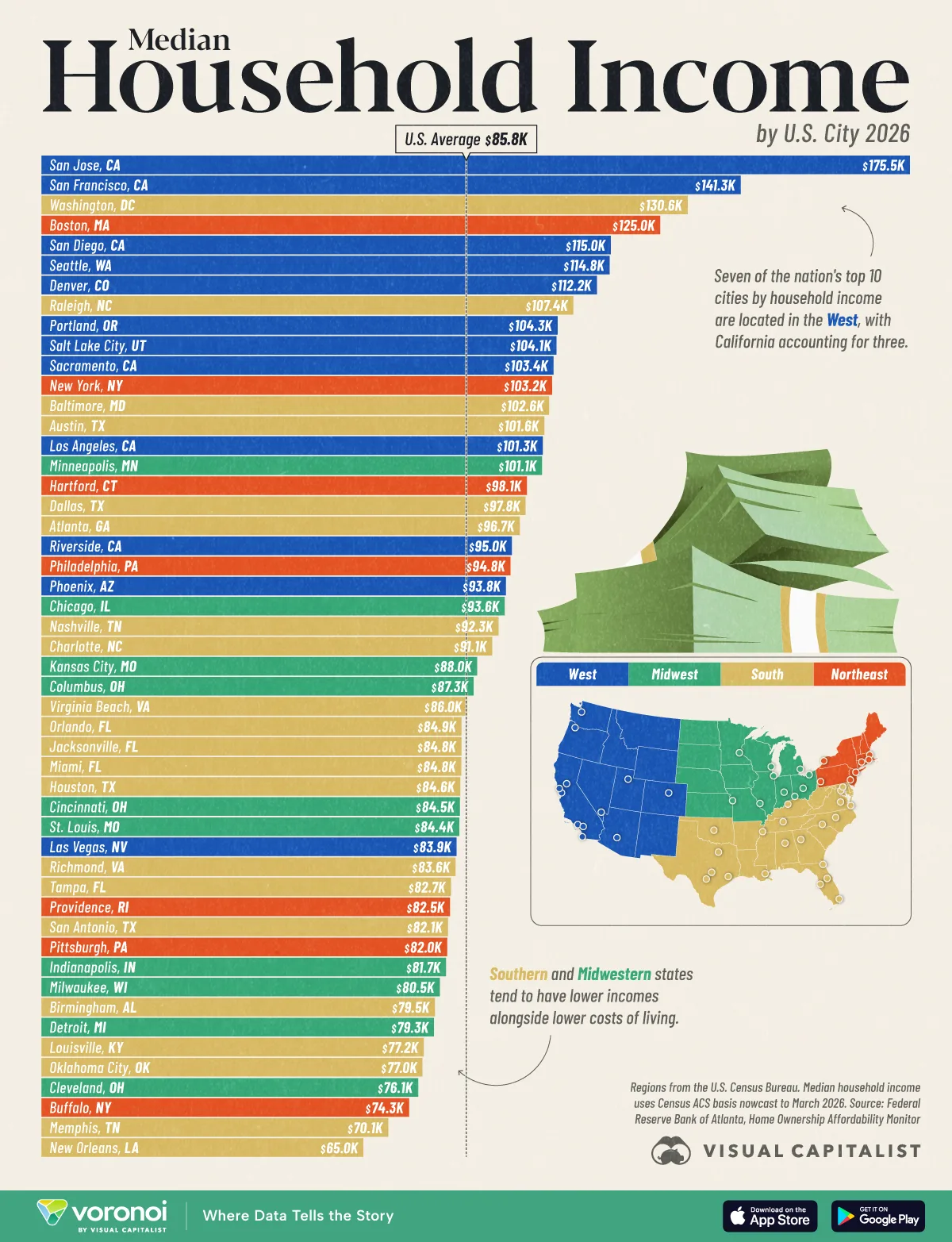
11) Median household income by U.S. city: The income map is also a cost, talent, and housing map. For economic developers, this is a reminder to read wage strength and household pressure together: high incomes can signal talent depth, but also housing scarcity, cost pressure, and harder relocation math.
12) Anything but a data center: A lot of data center fights are really zoning literacy fights. Sarah Grzywacz's "Twilight Zoning" frame is useful because it explains why residents often treat private land as community-choice land once an unpopular use appears. The practical point for EDOs is that project communication has to explain ownership, existing zoning, lawful use, infrastructure constraints, and what public bodies can actually decide.
13) How we measure success in economic development: Leading indicators deserve more attention. Carrie Kelly lays out four connected pillars: business health, government as a competitive advantage, innovation and entrepreneurship, and community competitiveness. Jobs, investment, wages, tax base, and GDP still matter, but they are lagging indicators. The useful question is whether a community can track the conditions that make those outcomes more likely.
14) Why half of America's cities are depopulating: Shrinkage needs its own planning discipline. Popular Mechanics summarizes research projecting that close to 15,000 U.S. cities could face noticeable population decline by 2100, with the biggest pressure in the Northeast and Midwest.
15) Real estate and U.S. reindustrialisation: Industrial policy eventually has to touch dirt, power, and permits. This interview with Ken Biberaj is a good site-readiness companion to the reshoring conversation: reindustrialization is not only about tariffs, subsidies, and strategy. It depends on land availability, energy capacity, permitting speed, and the real estate constraints that decide whether a project can actually happen.
16) Site identification: choosing the site: A parcel is not a site until the non-negotiables survive due diligence. Devin Hillsdon-Smith frames site identification as narrowing the "funnel of certainty": acreage, buildability, 100+ MVA power needs, wastewater, rail, heavy-haul routes, certified sites, Phase I, geotech, wetlands, archaeology, GIS review, encroachment, and the greenfield-versus-brownfield tradeoff.
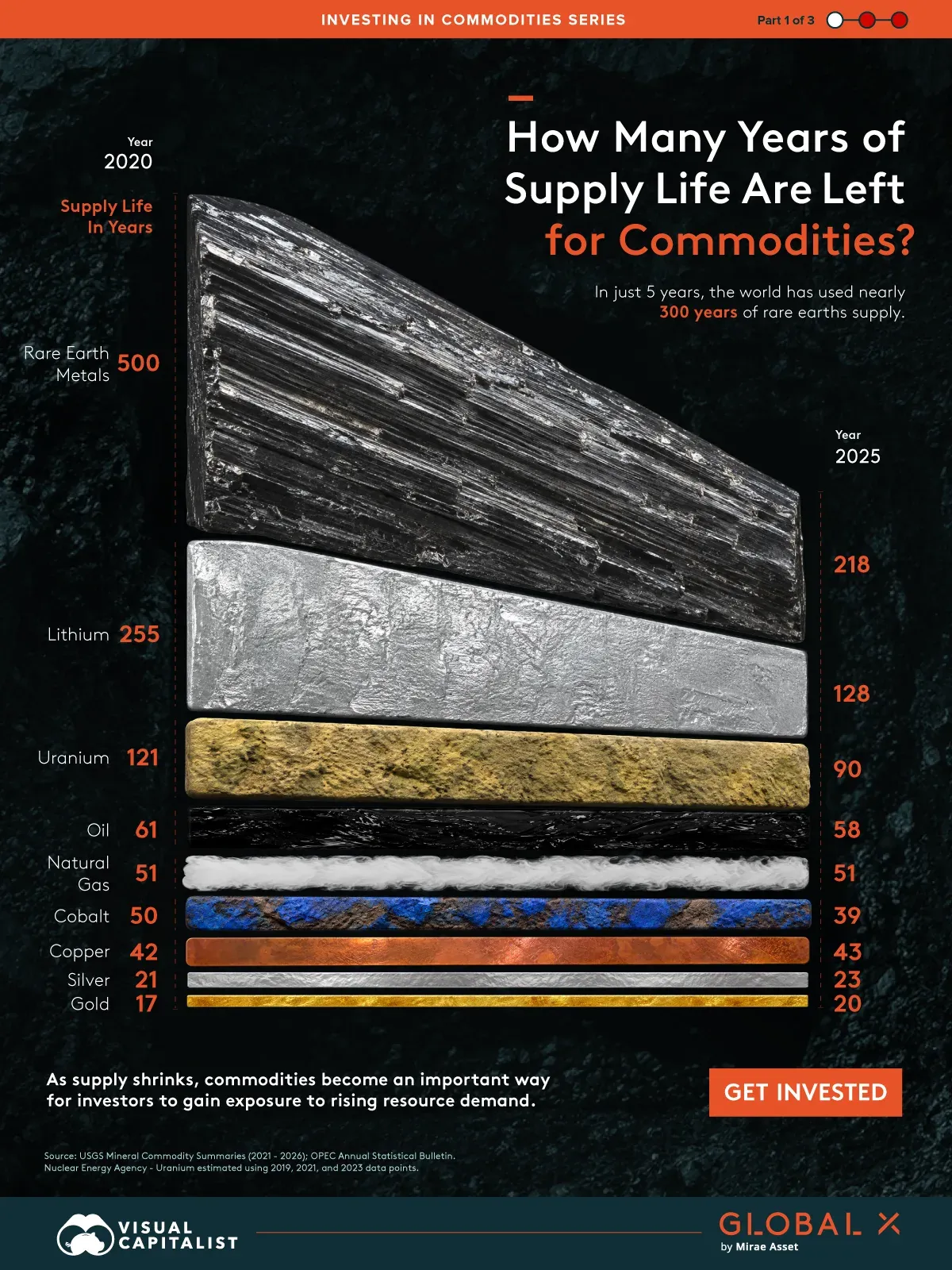
17) How many years of supply life are left for commodities? Critical minerals are moving from background assumption to project risk.
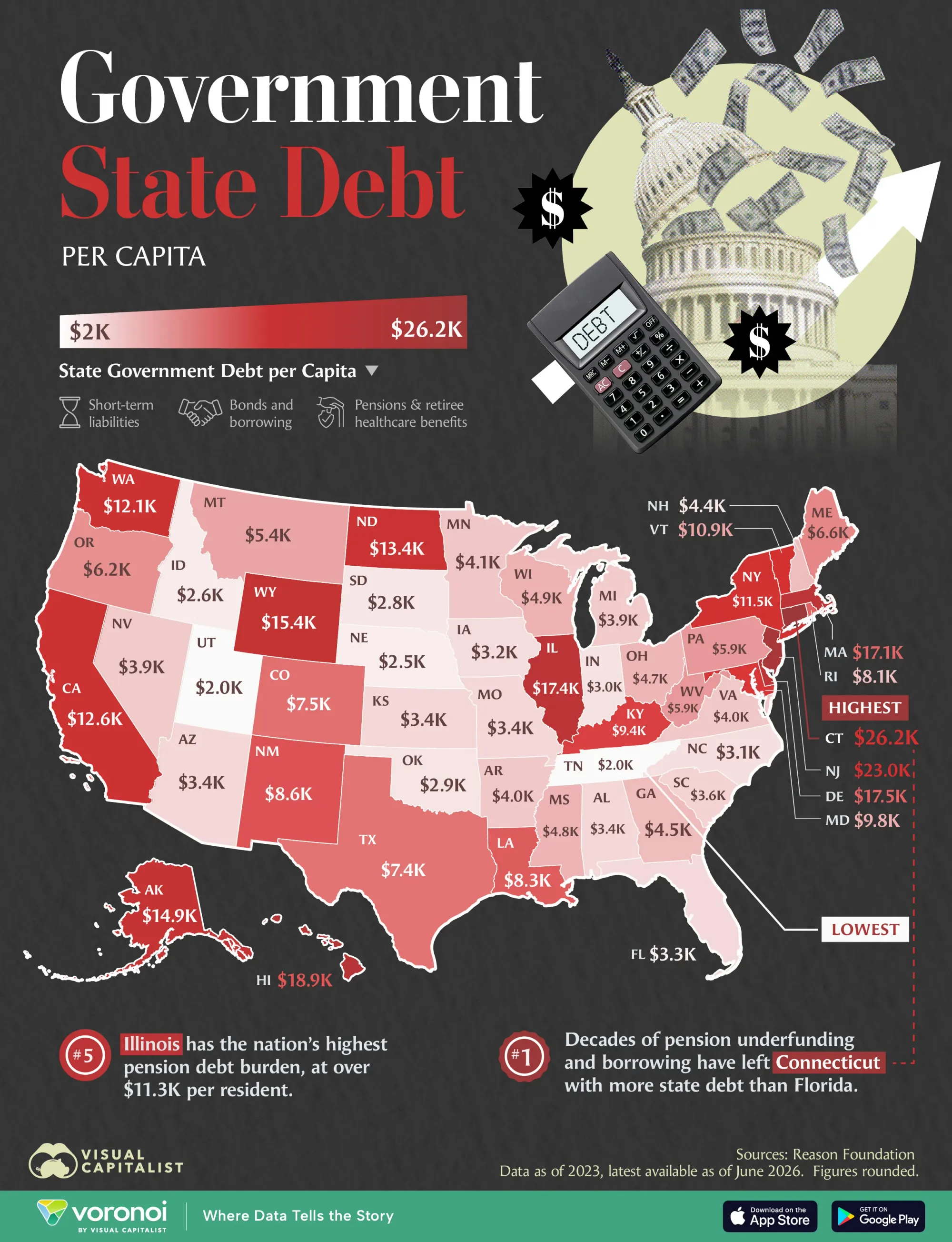
18) The states carrying the most debt per resident: Fiscal capacity is a competitiveness issue too. Visual Capitalist maps state debt per resident, with Connecticut at $26,187, New Jersey at $22,968, Hawaii at $18,909, and Tennessee lowest at $1,952. California carries the largest total debt load at $496.8 billion, but ranks 10th per resident.