When the Chamber Becomes the Town’s Communication Layer
How small-town chambers and EDOs turn scattered local activity into shared civic momentum


 Dane Carlson
In a small community, information does not move on its own.
Residents may not hear about an event unless someone keeps reminding them. Business owners may not know where to find updates unless there is a trusted place to look. Volunteers may care deeply about the community and still miss the moment when their help is needed. Local partners may be working hard, but without a shared channel, their efforts can remain scattered and disconnected.
In larger cities, this kind of communication is usually spread across many institutions. Newspapers, city departments, school districts, tourism offices, neighborhood groups, nonprofits, media outlets, and professional communications teams all carry part of the local signal. No single organization has to hold the whole system together.
Small communities often do not have that luxury. Sometimes, the whole civic signal runs through one office.
That was one of the clearest insights from Jamie Beasley’s conversation on the Econ Dev Show. In many small communities, the chamber of commerce, the economic development organization, or a merged chamber/EDO role becomes the place where local information gathers, gets organized, and moves back out into the community.
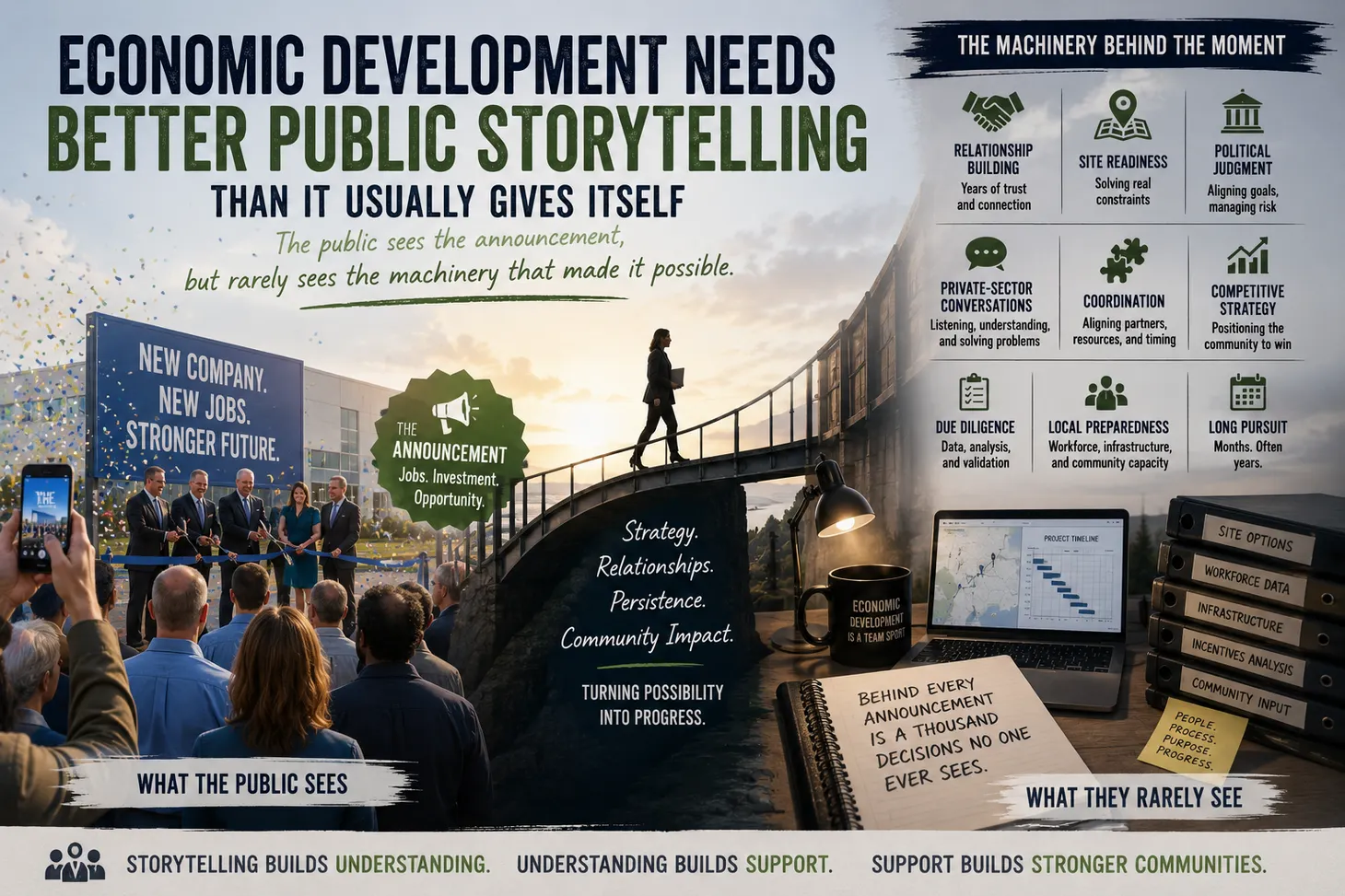
From the outside, that work can look simple. Post the flyer. Send the email. Remind people about the meeting. Share the event. Tell the community what is happening.
But in a thin-capacity community, that is not just promotion. It is infrastructure.
The Challenge
Small communities often expect one person, or sometimes part of one person, to carry several jobs at once. The same office may be responsible for business support, community events, member relations, tourism questions, volunteer coordination, downtown activity, economic development conversations, social media, newsletters, ribbon cuttings, public updates, and general civic visibility.
That is not a clean organizational chart. It is the reality of local capacity.
Because the work is so varied, communication often gets treated as something secondary. The “real work” is assumed to be business attraction, workforce, incentives, sites, housing, or downtown redevelopment. Communication becomes the thing someone handles after the larger tasks are finished.
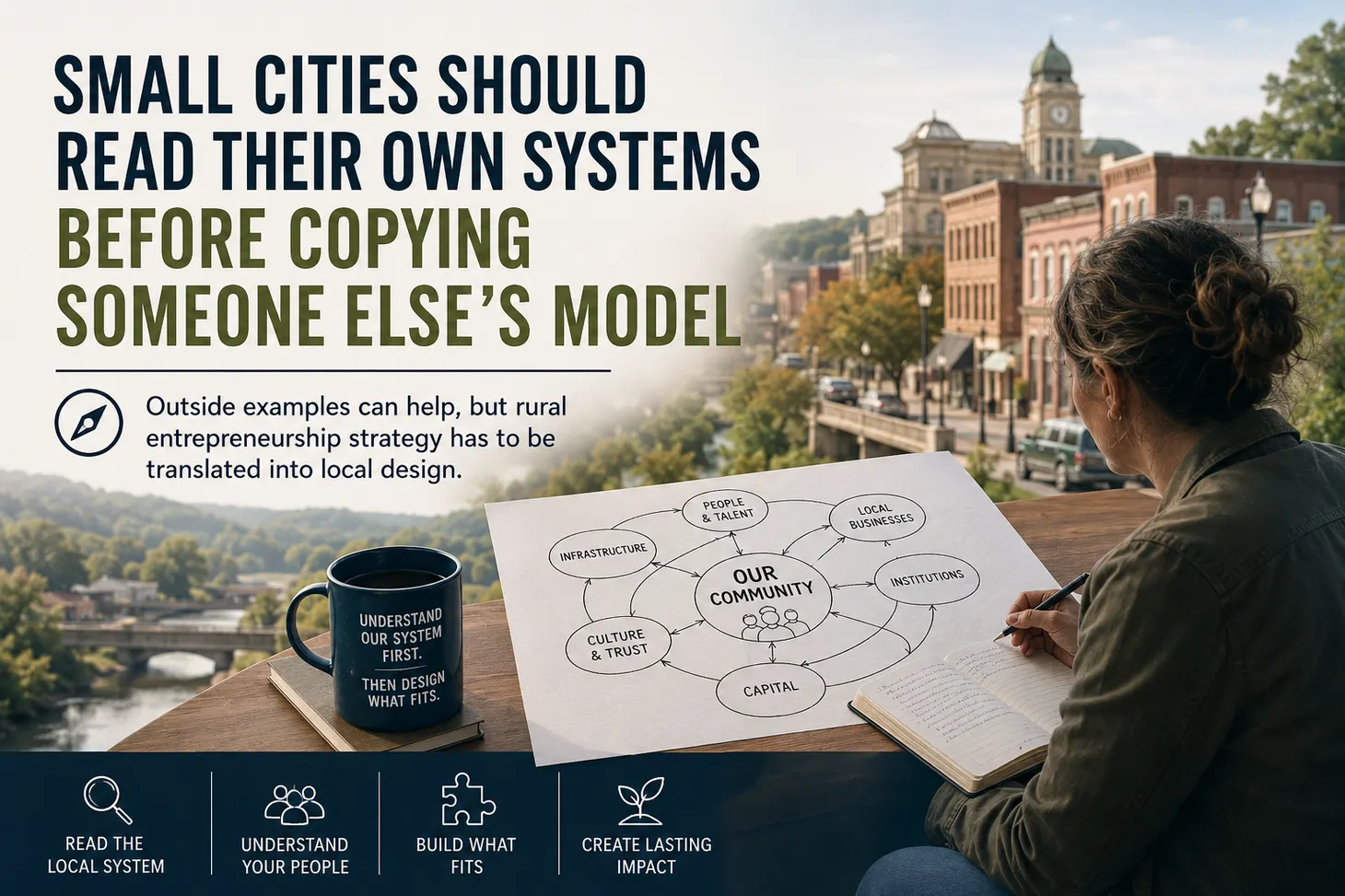
But for a small community, communication is often how those strategies actually reach people. A business support program only matters if business owners hear about it in time to act. A downtown event only works if residents know it is happening. A volunteer effort depends on repeated reminders. A tourism push depends on visible activity. A local initiative depends on people understanding why it matters and where they fit.
When the communication layer is weak, good work can disappear into the noise. The community may be more active than it appears, but residents, businesses, and partners may not be able to see the activity clearly enough to join it.
The Insight
The better way to understand this role is not simply “getting the word out.” That phrase makes the work sound like a final step, as if the real work has already happened and communication is just the announcement at the end.
In practice, a chamber or EDO in a small community may be serving as the town’s communication layer. It becomes the trusted mechanism that moves useful local information from scattered activity into public awareness.
That layer does several things at once. It gives people a repeated place to look. It helps businesses know where updates come from. It turns disconnected announcements into a rhythm. It makes events, programs, opportunities, and local momentum easier to see.
Most importantly, it makes community activity visible enough to be joined.
That matters because visibility is a condition for participation. People cannot attend what they do not hear about. Businesses cannot use resources they never see. Volunteers cannot support needs they do not know exist. Residents cannot feel momentum if local activity is happening in fragments and never becomes legible.
In that sense, communication is not cosmetic. It is a delivery function.
The Response
The practical response is for local leaders to treat communication as part of the economic development system, not as a side task. That means asking better questions than whether the chamber or EDO “promoted” something.
Does the community have a trusted place to receive useful local information? Do businesses hear about opportunities early enough to use them? Do residents know where to look for what is happening? Do events become visible beyond the small circle of insiders? Do partner organizations understand what others are doing? Does the chamber or EDO help turn scattered activity into shared awareness?
Those questions change the way the work is valued. They also make the workload more visible. If one office is carrying the community communication layer, that office needs time, tools, expectations, and support. It cannot be treated as informal labor that happens after the “important” work is done.
Because in a small place, this may be the important work.
The Result
A strong communication layer reduces civic friction. Without it, people waste time searching, guessing, repeating, and missing things. Business owners miss programs. Residents hear about events too late. Volunteers do not know where to plug in. Partner organizations duplicate work or schedule around incomplete information.
The result is not just inconvenience. It can make a community feel less active, less organized, and less confident than it really is. Local momentum may already exist, but if no one is carrying it into public view, that momentum is easy to miss.
A chamber or EDO that functions as the communication layer helps correct that. It does not create every piece of activity. It makes activity easier to see, understand, trust, and join.
That is a real economic development function. Downtown vitality, small business support, tourism, entrepreneurship, events, and civic confidence all depend on whether people can see enough happening to believe the community is moving.
Execution matters, but execution without visibility underperforms.
The Lesson
The lesson from Jamie Beasley’s episode is that in many small communities, the chamber or EDO is doing more than running events or supporting businesses. It may be holding the town’s information system together.
That role deserves to be named, supported, and built intentionally. When local leaders understand the chamber or EDO as a communication layer, they can stop treating newsletters, event promotion, reminders, updates, and public visibility as minor tasks. They can see them for what they are: part of the infrastructure that helps a community stay coordinated.
When a chamber or EDO becomes the communication layer, it is not just promoting what happens.
It is helping the community stay connected enough for what happens to matter.

Econ Dev Show Newsletter
Join the newsletter to receive the latest updates in your inbox.